The story
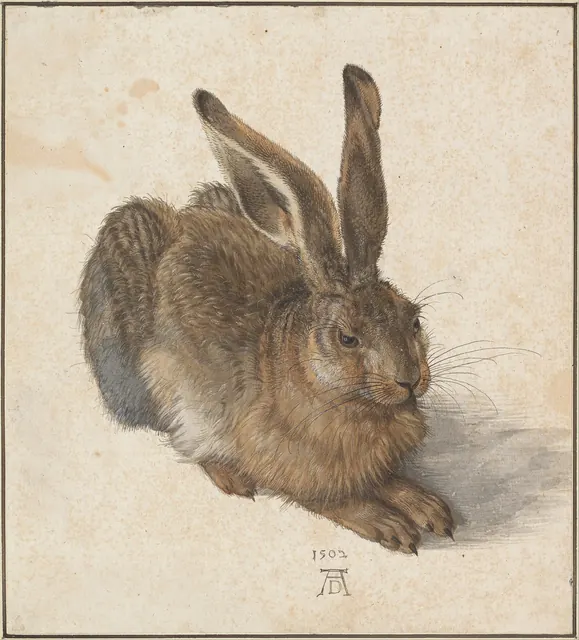
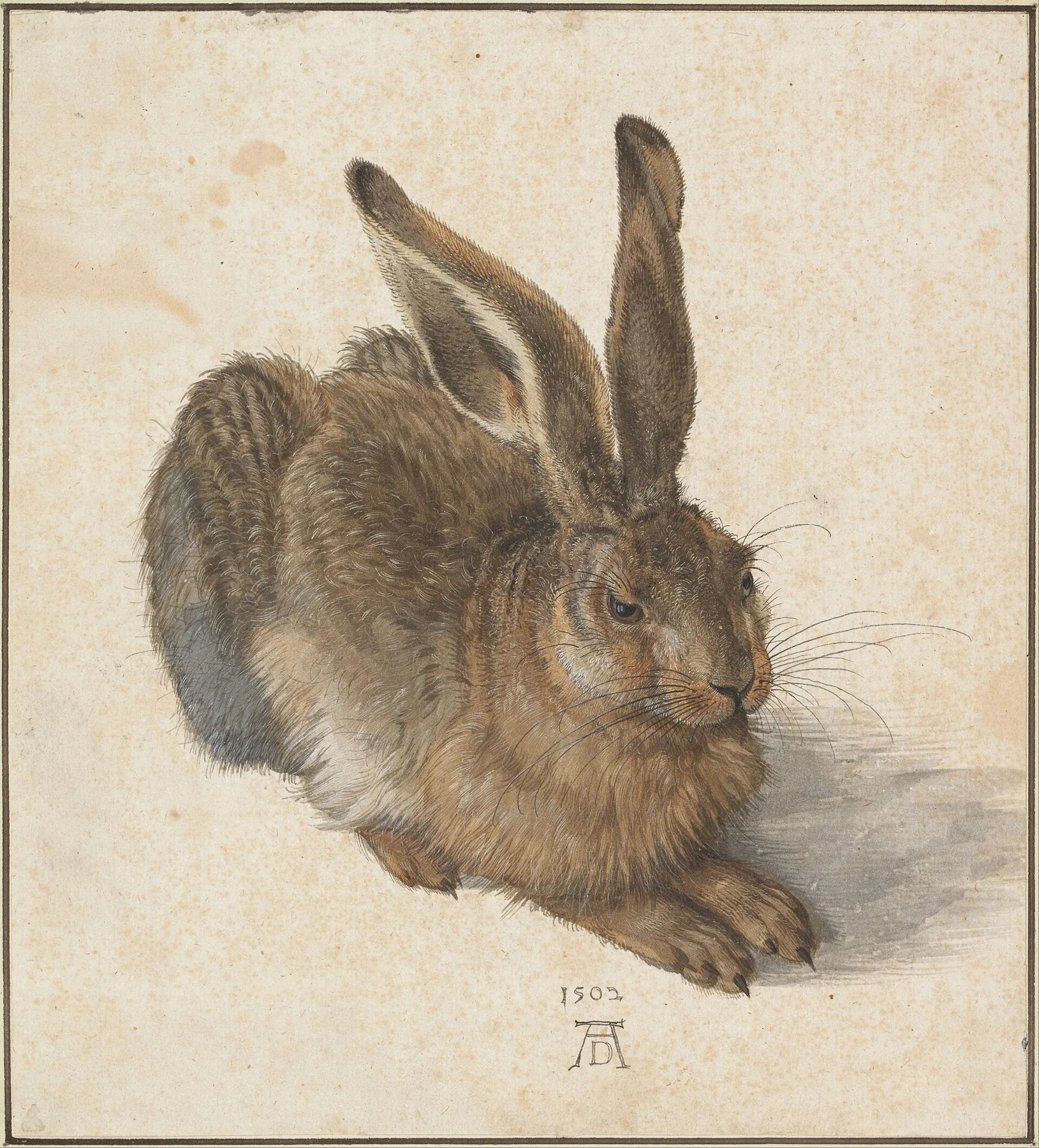
Before us sits a modest sheet of paper, yet its subject is announced with unmistakable clarity: “A Young Hare.” The title, recorded in early catalogues, strips away any allegorical veil and invites the viewer to meet the creature on its own terms. In the quiet of the frame, the hare appears poised, its soft fur rendered in delicate washes that catch the eye without the distraction of narrative. The background is a plain, unadorned expanse of paper, allowing the animal’s form to dominate the composition. Light falls gently across the animal, highlighting the subtle curve of its ears and the tender texture of its coat, creating a moment of still, focused observation.
The hand behind this delicate observation belongs to Albrecht Dürer. In the fine rendering of the hare’s fur, one can sense the artist’s exacting eye for detail, each strand of hair suggested by a whisper of pigment rather than a heavy stroke. The ears are caught in a slight tilt, the nose rendered with a soft, almost velvety touch, and the eyes—though merely hinted—convey a quiet alertness. Such confidence in handling both line and wash reflects a mastery of the medium that Dürer consistently displayed in his works on paper. The study’s precision invites the viewer to linger, tracing the subtle transitions that give the animal a palpable presence.
The study was completed in 1502. This precise dating provides scholars with a firm anchor, allowing the work to be placed alongside other pieces Dürer produced in the same period. By comparing the handling of light, the treatment of surface, and the compositional choices, researchers may discern subtle shifts in his technique as he explored the possibilities of watercolor and gouache. The year also marks a moment when Dürer was actively experimenting with natural observation, and the hare stands as a clear example of that investigative spirit. Knowing the exact year helps us appreciate how this study fits within the broader trajectory of his early artistic development.
The surface before us is a sheet of paper painted with both watercolor and gouache, a combination that gives Dürer a versatile palette of translucency and opacity. Watercolor, with its thin, transparent washes, allows the light of the paper to shine through, creating a luminous quality that suggests the softness of the hare’s coat. Gouache, denser and more matte, provides the depth needed for shadows and the crisp definition of the animal’s outline. By layering these two water‑based media, Dürer achieves a delicate balance: the subtle tonal shifts of watercolor convey the gradations of the fur, while gouache reinforces form where stronger contrast is required. This mixed technique demonstrates the artist’s command over material, enabling him to render a lifelike presence within the modest confines of paper.
Measuring roughly twenty‑five centimeters by twenty‑three centimeters, the work is modest in scale, inviting an intimate encounter. The compact size means the viewer must draw close, almost as if peering over a naturalist’s sketchbook, and this proximity accentuates the fine brushwork and nuanced tonal transitions that Dürer achieved with his water‑based media. The edges of the paper frame the study, emphasizing its character as a personal observation rather than a grand public display. Such a size encourages a quiet, focused viewing, where every subtle shift of hue and every delicate line can be examined in detail, reinforcing the sense that the hare has been captured in a moment of direct, unmediated observation.
The work is held in the Graphische Sammlung Albertina, Vienna, a distinguished collection devoted to works on paper. Within the Albertina’s walls, the hare is preserved under conditions that safeguard its delicate pigments and paper support, ensuring that Dürer’s original handling remains visible to scholars and visitors alike. The museum’s stewardship underscores the lasting value attributed to this modest yet masterful observation, positioning it among a broader corpus of graphic art that the Albertina curates. By being housed in such a specialized institution, the study continues to fulfill its original purpose: to be examined closely, appreciated for its technical finesse, and studied as a testament to Dürer’s keen eye.
In the quiet detail of this tiny paper, Dürer invites us to pause, to look closely, and to rediscover the wonder of a single young hare captured over five centuries ago. The study stands as a reminder that profound observation can arise from the simplest of subjects, and that the marriage of skillful technique with attentive observation can create a work that continues to speak to viewers across the ages.
Thank you for joining us in this close look at Albrecht Dürer’s Young Hare.