The story
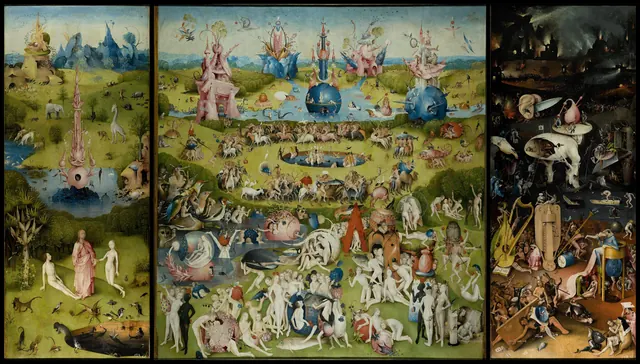
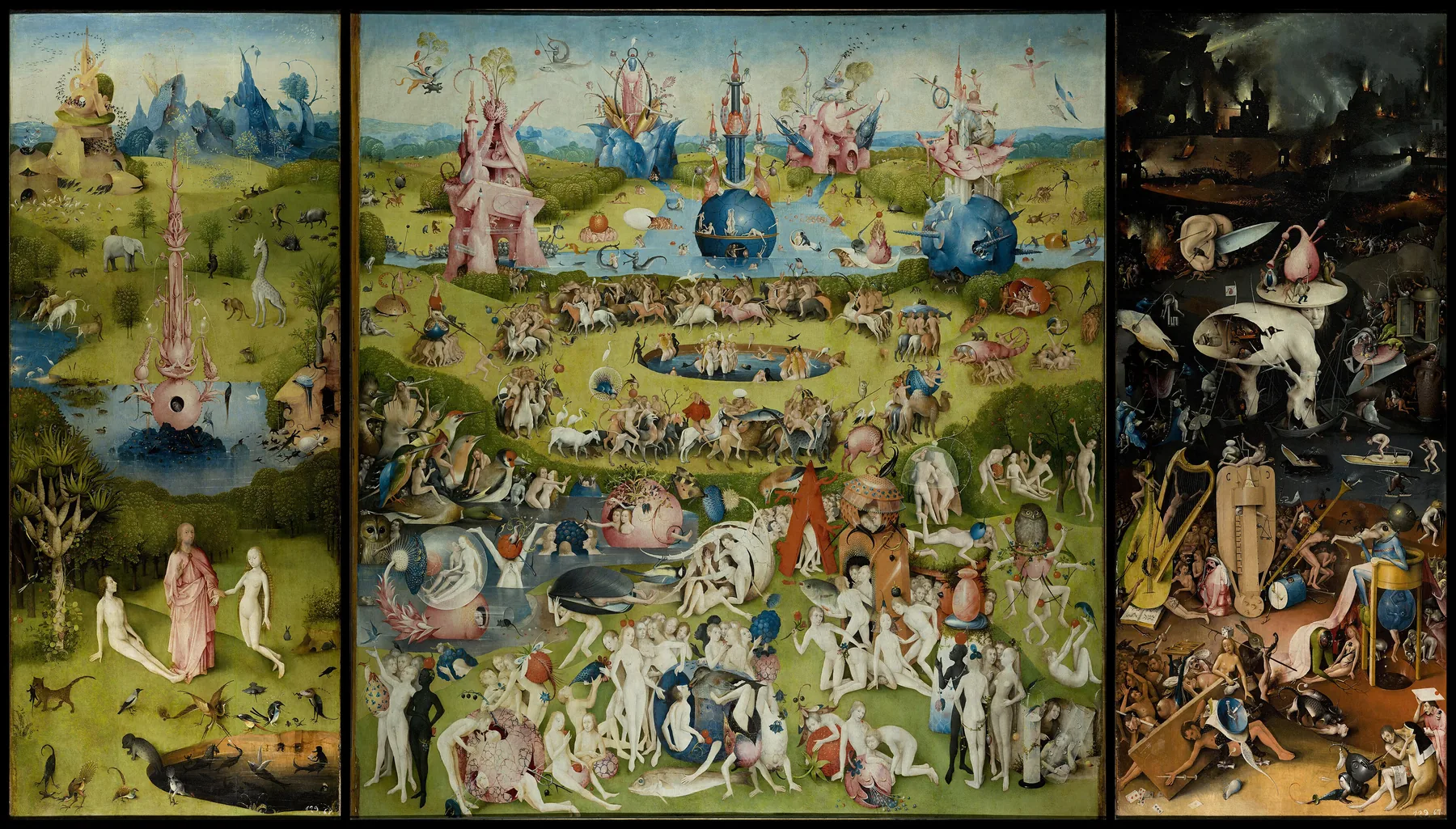
The Garden of Earthly Delights, painted by the Netherlandish master Hieronymus Bosch, stands as a monumental oil‑on‑wood triptych created around 1490–1500. When the wings are spread the three panels together reach a height of seven feet three inches and a width of twelve feet nine inches, a span that approaches thirteen feet, roughly four metres. This immense surface, composed of richly coloured scenes, was designed for private contemplation. Though the work was never signed, its attribution to Bosch rests on stylistic analysis. The painting now belongs to the collection of the Prado Museum in Madrid, Spain.
When the triptych is closed, its outer wings present a serene, almost scientific tableau. Each side shows a transparent globe filled with water, land, and clouds, within which a figure of God holds an open book. Above the sphere the inscription reads, “For he spoke and it was; he commanded, and it stood”. The muted, grey‑toned palette creates a contemplative prelude, inviting the viewer to pause before the vivid worlds hidden behind the doors.
Opening the left wing reveals Bosch’s vision of the Garden of Eden. Here God introduces Adam and Eve amid a lush landscape populated by hybrid animals that blend bird, beast and fish. The scene is rendered in bright, natural colours, and the figures stand in a gentle, almost reverent pose, emphasizing innocence. Art historian Hans Belting reads this panel as a paradisiacal realm where the first humans have never been expelled, suggesting that Bosch imagined an unfallen world and thereby opened a new dimension of artistic freedom.
The central panel, after which the whole work is named, unfolds a world that resembles Eden yet teems with countless nude figures, oversized fruits and a menagerie of real and imagined creatures. Bosch populates the landscape with people engaged in music, dance and strange games, while fantastical beasts roam among giant strawberries and bizarre birds. Amid the revelry, darker motifs appear: souls are tormented by musical instruments turned into weapons and gluttons are forced to consume grotesque creatures. Belting interprets this bustling scene as a depiction of a paradisiacal world in which Adam and Eve have not been expelled, a vision that challenges conventional moral readings.
The rightmost wing plunges the viewer into a nightmarish vision of Hell. Here tormented souls are subjected to bizarre punishments: musical instruments become deadly weapons, and grotesque creatures are forced upon the damned as food. The palette darkens to deep reds and blacks, and the composition is chaotic, amplifying the sense of endless suffering. This stark counterpoint to the preceding panels underscores a moral warning, presenting a false paradise that collapses into torment. The panel’s imagery has been interpreted as a warning against lust and other sins, reinforcing the triptych’s overarching moral narrative.
Bosch’s fantastical imagery left a lasting imprint on subsequent generations. His richly detailed style was widely imitated, influencing Pieter Bruegel the Elder, who echoed Bosch’s intricate symbolic layering in his own works. Centuries later, the surreal juxtapositions of the central panel resonated with 20th‑century Surrealists, who saw in Bosch a precursor to their explorations of the unconscious. This lineage demonstrates how Bosch’s visionary approach continued to shape artistic language across time, linking Netherlandish Renaissance imagination with modernist experiments in dream‑like reality.
Soon after the triptych was first displayed, reproductions entered the market, allowing Bosch’s visionary scenes to travel far beyond the walls of the Prado. These early copies helped disseminate his complex iconography, ensuring that the striking figures and fantastical creatures reached a broader audience. The spread of these images contributed to the work’s growing reputation and cemented its place in the visual culture of Europe, long before the age of photography.
Hieronymus Bosch lived circa 1450–1516, born in ’s‑Hertogenbosch in Brabant, now the Netherlands, and was buried there on August 9, 1516. He was a member of the religious confraternity known as the Brotherhood of Our Lady, an affiliation that may have shaped the moral concerns evident in his work. The exact chronology of his surviving paintings remains uncertain, as none are dated and only a few bear his signature; the Garden of Earthly Delights is attributed to him despite the absence of a signature. These biographical details provide context for understanding the devotional intent and symbolic depth that permeate the triptych.
Viewed as a whole, the three panels guide the eye from an idealized creation, through a world of earthly pleasures, to a nightmarish vision of punishment. This progression invites contemplation of humanity’s choices, suggesting that indulgence without moral restraint leads to ruin. While scholars continue to debate specific meanings, the triptych endures as a visual meditation on sin, desire, and redemption, compelling each generation to confront the thin line between paradise and perdition.
The Garden of Earthly Delights now resides in the Prado Museum in Madrid, Spain, where it is displayed among other masterpieces of European art. Its presence in the museum’s collection ensures that visitors can encounter Bosch’s intricate worlds within a historic setting, allowing the painting’s vivid colors and complex symbolism to continue inspiring awe and scholarly inquiry.
In the hush of the Prado, Bosch’s three worlds still whisper, urging us to look, wonder, and question the fragile balance between delight and doom.