The story
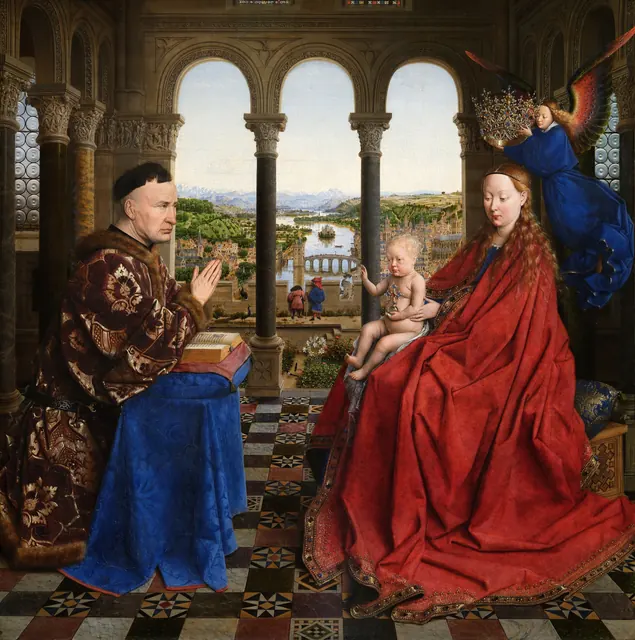
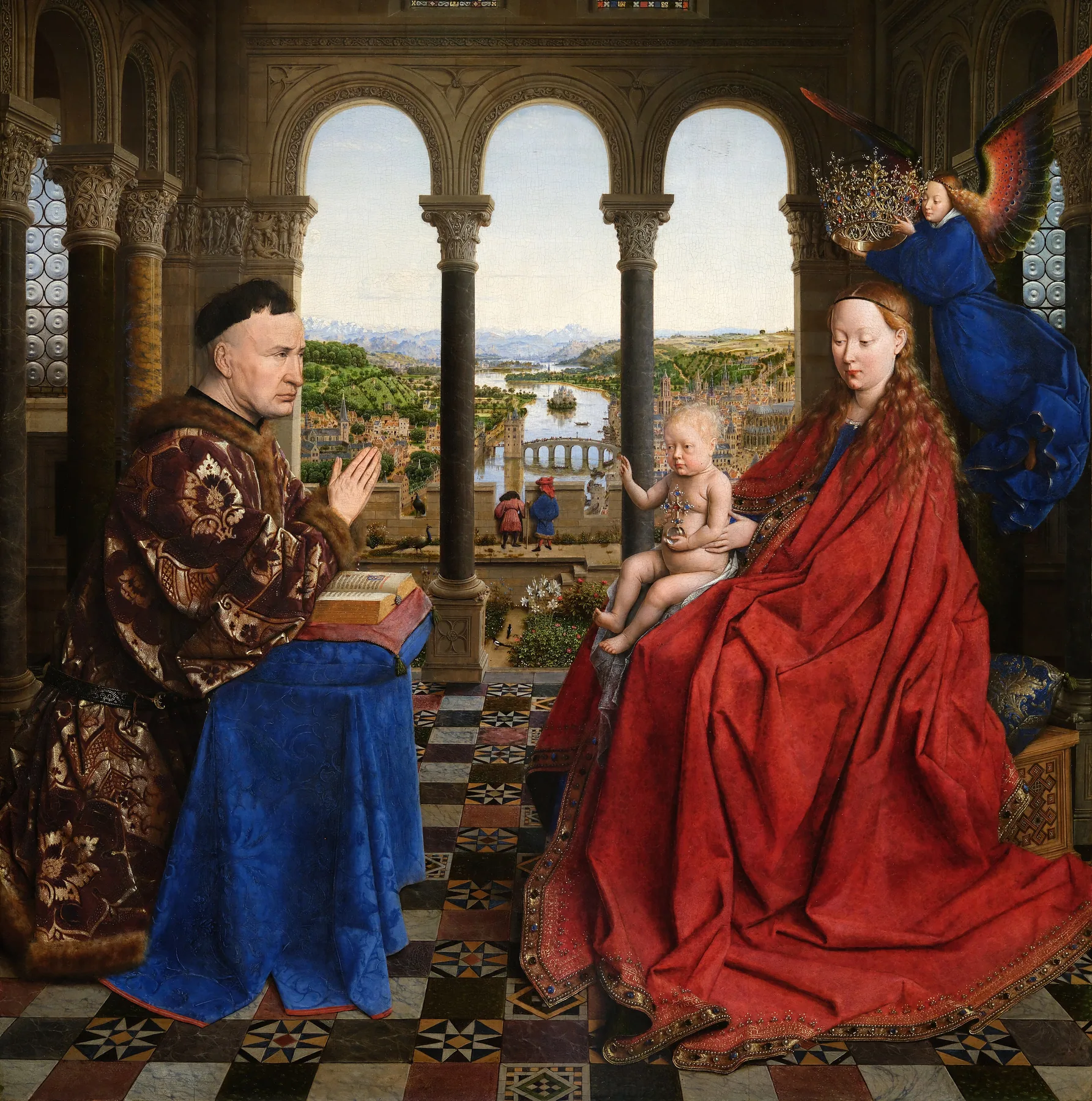
The panel before us bears the formal title “The Madonna of Chancellor Rolin,” a name that also echoes as “the Virgin of Autun.” This dual designation immediately signals both the patron’s status and a later devotional association. Equally important, scholars attribute the work to Jan van Eyck, the pioneering Flemish master whose hand reshaped early Netherlandish painting. Recognizing van Eyck as the artist frames every brushstroke as part of his relentless pursuit of realism and subtle symbolism, inviting us to consider how a single panel can embody both personal devotion and broader artistic ambition.
The panel was painted in the second quarter of the fifteenth century, roughly between 1430 and 1435. Placing the work in this narrow window situates it at the height of van Eyck’s mature period, when his technical innovations were already well established. This dating also aligns the painting with a moment of intense artistic ferment in the Low Countries, a time when medieval conventions were beginning to give way to a more naturalistic visual language. Understanding the precise chronology helps us see the Madonna not as an isolated devotional image but as a product of a dynamic, transitional era.
Executed in oil on oak wood, the panel showcases van Eyck’s mastery of a medium that was still relatively new in the early fifteenth century. Oil allowed him to build luminous layers, achieving subtle gradations of light and colour that give the surface a depth that seems to glow from within. The choice of oak as a support provided a stable, fine-grained foundation for the delicate brushwork. Together, oil and oak enabled the artist to render textures—from flesh to stone—with a realism that would set a new standard for generations of painters.
Inside the painted space, a tiled floor stretches forward, its geometric pattern guiding the eye toward a series of marble columns. The capitals of these columns vary: some are purely ornamental, while others depict scenes from the Old Testament, weaving biblical narrative into the architectural framework. Beyond the columns, three arches open onto a miniature landscape that unfolds in stages—a cultivated garden, a distant city, and finally a countryside that rises into mountains. This carefully staged depth not only demonstrates van Eyck’s skill in perspective but also creates a visual journey that mirrors the spiritual ascent of the figures within.
Through the arches, the garden blooms with a rich botanical tableau: lilies, wild roses, peonies, cornflowers, and irises share the space with birds such as magpies and the proud peacock. Each flower carries a traditional symbolic weight—lilies for purity, for instance—while the birds add layers of meaning drawn from medieval bestiaries. The inclusion of this diverse flora and fauna enriches the composition, offering viewers a lush, natural world that coexists with the sacred interior, and inviting contemplation of the interconnectedness of creation and devotion.
Turning the panel over reveals a surprising trompe‑l’oeil effect: the reverse is painted as a green faux marble, an illusion that tricks the eye into seeing stone where there is only wood. Recent conservation work has attributed this clever surface treatment to Jan van Eyck himself with certainty. This hidden façade demonstrates the artist’s playful engagement with perception, extending his experimental spirit beyond the front narrative to the very materiality of the panel, and reminding us that even the back of a masterpiece can be a canvas for invention.
The exhibition text frames the Rolin Madonna as a visual embodiment of the tensions that animated Flemish art in the first third of the fifteenth century. On one side, the composition adheres to medieval tradition—hieratic placement of the sacred figures and symbolic flora—while on the other, van Eyck pushes boundaries through his sophisticated oil technique, meticulous observation of light, and the inclusion of a realistic, almost secular landscape beyond the arches. This juxtaposition captures a moment of artistic transition, where reverence and innovation coexist, offering a vivid snapshot of an era in flux.
Critics describe the painting as a major work of Western art with an important meditative dimension, yet it remains surprisingly overlooked. The serene expressions of the Virgin and Child, the soft illumination that bathes the interior, and the harmonious balance between the enclosed space and the expansive garden invite quiet contemplation. While the work may not enjoy the same fame as van Eyck’s more celebrated pieces, its depth of feeling and technical brilliance continue to captivate scholars, underscoring how a modestly sized panel can hold profound artistic and spiritual weight.
Join us next time as we uncover more hidden stories behind the world’s greatest works of art.