The story
Imagine a pair of brothers, each a master of the emerging oil medium, working side by side on a monumental altar. The Ghent Altarpiece is attributed to Jan van Eyck and his elder brother Hubert; Hubert laid the initial design and began the panels, but his untimely death in 1426 left Jan to complete the commission. This partnership, though brief, fused Hubert’s architectural vision with Jan’s pioneering oil technique, resulting in a work that would redefine Northern European painting for centuries to come. Such a joint effort is rare in the period, and the seamless handover suggests a shared artistic language that survived the elder brother’s early death, a testament to the workshop’s cohesion.
The altarpiece did not merely appear in a studio; it was consecrated on a specific day that still echoes through the cathedral’s stone walls. On May 6, 1432, the completed work was dedicated and installed in the Church of Saint John, the building we now know as Saint Bavo’s Cathedral in Ghent. That precise moment anchored the polyptych within a sacred space, turning it from a private commission into a public object of devotion for the city’s faithful. The choice of that feast day underscores the liturgical calendar’s role in framing artistic reception; the installation transformed the cathedral’s nave into a visual sermon, inviting worshippers to encounter theological narrative each time they entered.
Who asked for such a grand visual sermon? The answer lies with a wealthy patrician, Joos (Jodocus) Vijd, and his wife Elizabeth (Elisabeth) Borluut, who founded a chantry chapel and commissioned the altarpiece to honor their souls. Their patronage provided the financial and spiritual impetus for the project, ensuring that the van Eyck brothers could work on a scale and with a richness of material that would have been impossible for a modest parish. Their names, inscribed among the donors, remind us that art and devotion were often intertwined with civic pride. Such a commission reflects the era’s practice of securing salvation through lasting visual legacy; the Vijd family’s involvement also signals the growing influence of urban elites in shaping religious art, embedding personal remembrance within communal worship.
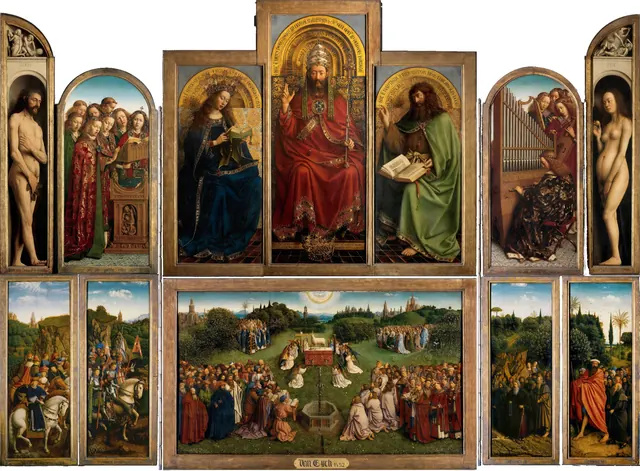
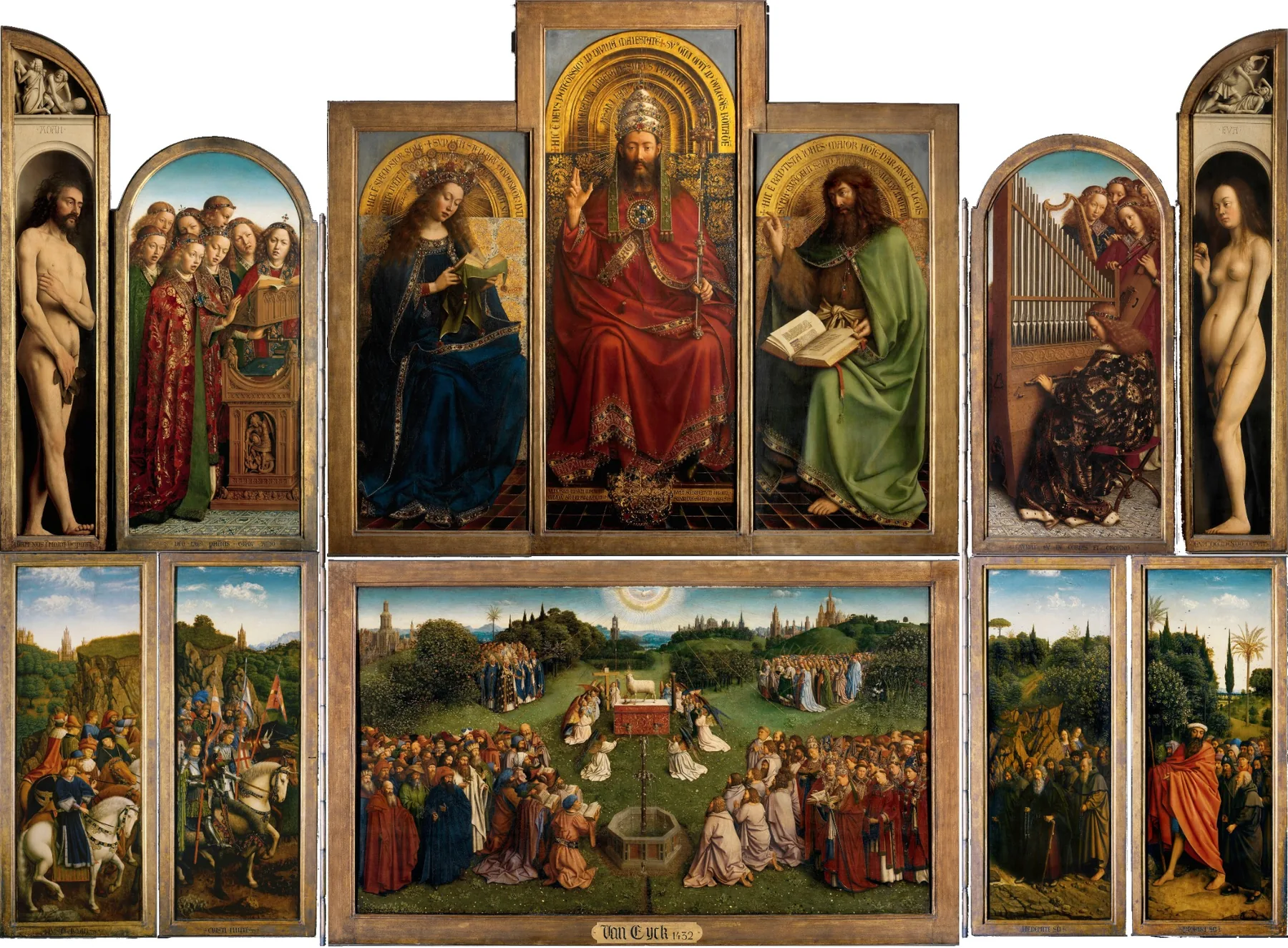
Open the wings and the first thing that strikes the eye is the near‑lifesize presence of Adam and Eve, rendered as nude figures that seem to step out of their sculpted niches and into the viewer’s space. Their bodies, bathed in soft, natural light, create a startling illusion of three‑dimensionality, as if the biblical ancestors are sharing the same room as us. This daring projection of flesh into real space underscores the van Eycks’ mastery of oil’s ability to model form and volume. By placing these primordial figures so boldly, the artists bridge the gap between creation myth and contemporary observer, inviting contemplation of humanity’s origins within the sacred setting; the use of oil allows subtle gradations that render skin translucence, enhancing the illusion of flesh.
When the polyptych’s wings swing wide, the lower register unfolds into a continuous heavenly landscape, a procession of figures on horseback and on foot moving toward a central altar. These pilgrims, clothed in richly detailed garments, converge to adore the mystic Lamb of God, whose white fleece glows against a radiant sky. The seamless panorama draws the eye across the panel, creating a sense of infinite space that invites the viewer to join the celestial crowd. The uninterrupted horizon suggests an unbounded divine realm, while the varied attire of the travelers hints at the universal reach of salvation; the luminous lamb becomes a focal point that unites the disparate participants in collective worship.
The lower register does not stop at the procession; it teems with a diverse assembly of warriors, judges, apostles, saints, and other dignitaries, all gathered in a paradisiacal setting to worship the Lamb. Each figure is rendered with individualized expression and attire, from the gleaming armor of knights to the humble robes of monks, emphasizing the universal appeal of the divine sacrifice. This crowded yet harmonious scene showcases the van Eycks’ ability to populate a complex composition without losing clarity. The inclusion of both secular and holy personages reflects the theological notion that Christ’s sacrifice transcends earthly hierarchies, offering redemption to all strata; the careful spatial arrangement ensures each character retains presence within the crowded tableau.
At the heart of the opened altarpiece stands the Lamb of God, its white fleece illuminated and its blood flowing into a chalice. This vivid image is not merely decorative; it directly symbolizes the Eucharistic sacrifice of Christ, a ritual that would be celebrated daily in the Vijd Chapel. The visual of blood pouring into a cup ties the painted scene to the liturgical act, reinforcing the theological message that the altar is both a visual and a sacramental focal point. The juxtaposition of the lamb’s innocence with the sacrificial blood creates a powerful visual paradox, reminding viewers of the paradox of divine love expressed through suffering; the chalice serves as a tangible link between the painted narrative and the real Mass.
Below the Lamb, a crystal‑clear stream bursts forth from the Fountain of Life, depicted as a radiant jet of water that cascades down toward the actual altar below. This flowing water, rendered with delicate brushwork, symbolizes the divine grace that nourishes the faithful. By channeling the painted water toward the real altar, the van Eycks blur the boundary between painted miracle and liturgical reality, inviting worshippers to experience the sacred narrative in their own space. The visual flow from the celestial fountain to the earthly altar suggests a conduit of salvation, where heavenly abundance is made accessible to the congregation; the meticulous rendering of water’s translucence showcases the medium’s capacity for subtle effects.
Looking upward, the upper register presents a Deësis: Christ as High Priest occupies the central throne, flanked by the Virgin Mary and John the Baptist, who act as intercessors before the Last Judgment. Their solemn faces and gestures convey a sense of mediation between the divine and humanity. This arrangement not only reinforces the theological hierarchy but also situates the viewer within a cosmic courtroom, where the saints plead on behalf of the faithful. The positioning of Christ in priestly vestments underscores his role as mediator, while the presence of Mary and John the Baptist amplifies the intercessory theme, inviting contemplation of divine mercy amid eschatological expectation.
When the altarpiece is closed, it reveals a unified composition across two registers. In the lower register, the Vijd donors kneel before stone‑sculpted figures of John the Baptist and John the Evangelist, their piety recorded for posterity. Above them, an Annunciation scene unfolds, linking the earthly act of devotion with the divine moment of incarnation. This closed view offers a contemplative narrative that balances donor commemoration with the mystery of the Incarnation. The closed configuration creates an intimate devotional space, where the patrons’ humility is juxtaposed with the celestial announcement, reinforcing the idea that personal piety is woven into the larger story of salvation.
Open the altarpiece, and the interior panels reveal a central corpus where God the Father presides with the Virgin Mary and John the Baptist, surrounded by angels playing instruments and singing. At each end of this central scene, the nude figures of Adam and Eve stand as reminders of humanity’s fall, framing the divine assembly. This intricate arrangement of sacred figures, music, and mythic ancestors demonstrates the van Eycks’ skill in weaving theological narrative across space. The harmonious blend of divine authority, celestial music, and the primordial couple creates a visual theology that traces the arc from fall to redemption, inviting viewers to contemplate the continuity of salvation history within a single visual field.
Art historians have called the Ghent Altarpiece the first major oil painting and regard it as marking the transition from the Middle Ages to the Renaissance. This assessment highlights the work’s pioneering use of oil, which allowed unprecedented depth of colour and subtle modelling, qualities that would come to define Renaissance art. Recognizing the altarpiece as a turning point underscores its influence on subsequent generations of painters, who adopted the medium to achieve greater realism.
The Ghent Altarpiece endures not only as a visual marvel but as a living testament to the power of art to bridge faith, innovation, and human experience across the centuries.
Thank you for joining us on this journey through one of history’s most extraordinary works of art.