The story
A Curious Title
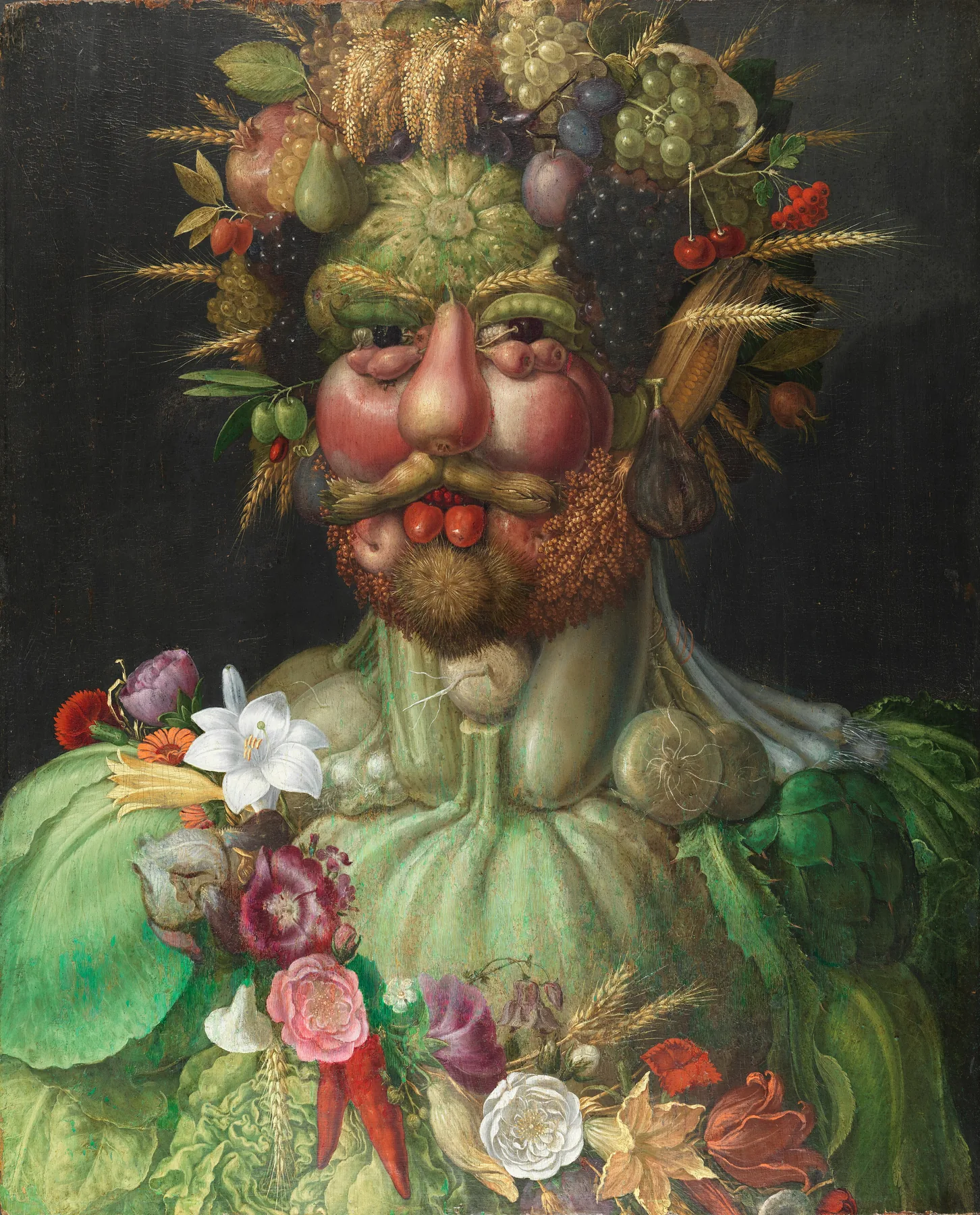
Before us unfolds a striking portrait whose very form is built from the bounty of the garden. Leaves, grapes, figs and blossoms intertwine to create the visage of a figure that is at once familiar and fantastical. The composition draws the eye to the subtle play of light on each fruit, the delicate shading that gives the whole a three‑dimensional presence. This visual puzzle invites us to look beyond the surface and discover the mythic identity that lies within the natural elements.
Arcimboldo’s Hand and the Late‑Sixteenth Century
Giuseppe Arcimboldo, the court painter celebrated for his imaginative composites, executed this work in oil on panel during the closing decades of the sixteenth century. The medium allows the pigments to glow with a gentle luminosity, while the smooth panel preserves the fine brushwork that defines each leaf and fruit. Knowing that Arcimboldo himself created the piece places it firmly within the vibrant artistic milieu of the Habsburg courts, where curiosity and experimentation were prized.
Vertumnus and the Imperial Portrait
At first glance the canvas presents the Roman god Vertumnus, the deity of plant life, his visage formed entirely from seasonal produce. Yet scholars have long recognized that the composition is also a portrait of Holy Roman Emperor Rudolf II, cleverly disguised as the god. The arrangement of grapes, figs, and vines follows the contours of the emperor’s face, while the crown of leaves hints at his sovereign status. This dual reading—mythology intertwined with imperial likeness—reveals how Arcimboldo merged allegory with flattery, offering Rudolf II a portrait that celebrates both his love of the natural world and his regal authority.
A Commission from the Emperor Himself
The painting was not a private exercise but a formal commission from Holy Roman Emperor Rudolph II, whose court in Prague was a hub of artistic experimentation. By ordering a portrait that disguised him as Vertumnus, the emperor aligned himself with the god of growth and transformation, a symbolic statement of his own aspirations for cultural renewal. This imperial patronage explains the work’s lavish detail and the confidence with which Arcimboldo could push the boundaries of portraiture, knowing he was fulfilling a direct request from the ruler himself.
Home in Sweden
Today the canvas resides in the collections of Skokloster Palace, a 17th‑century baroque estate in Sweden that houses one of Europe’s most remarkable art holdings. The palace’s galleries display the work alongside a trove of Dutch and Flemish masterpieces, allowing visitors to encounter Arcimboldo’s whimsical portrait within a historic setting far from its original imperial court. Its presence in Skokloster underscores the painting’s journey across borders and centuries, illustrating how a work created for a Holy Roman emperor now enriches a Swedish cultural treasure.
A Modern Conservation Experiment
The canvas itself dates to about 1590‑91, placing it firmly in the sixteenth century. Executed in oil on a smooth wooden panel, Arcimboldo’s deft brushwork gives each leaf, grape and blossom a luminous sheen that catches the light. The composition gathers the seasonal bounty into a single, unified visage, its rich greens and deep reds forming the contours of a regal face. This striking synthesis of nature and portraiture exemplifies the inventive spirit of the late Renaissance.
Identifying the Imperial Face
Scholars agree that the work is Arcimboldo’s portrait of Holy Roman Emperor Rudolf II, cleverly disguised as the god Vertumnus, rather than a self‑portrait by the artist. Conservation studies have confirmed the identification, yet no analysis to date has succeeded in matching the facial proportions of the composite figure to known likenesses of the emperor. The portrait thus remains a tantalising blend of imperial homage and imaginative allegory.
A Parallel Restoration
Beyond its own visual marvel, Arcimboldo’s Vertumnus has inspired countless artists to explore the boundaries between portraiture and allegory. Its inventive synthesis of natural forms and human likeness continues to spark imagination, reminding us that art can transform the ordinary into the extraordinary, and that a single canvas can carry layers of meaning across centuries.
Conclusion
Arcimboldo’s Vertumnus stands at the crossroads of myth, imperial ambition, and scientific curiosity. Created by a master of composite portraiture for an emperor who loved the natural world, it has traveled from a 16th‑century court to a Swedish palace, survived centuries of wear, and now benefits from cutting‑edge conservation science. Each layer of paint, each fruit‑formed feature, tells a story of artistic ingenuity and enduring fascination, inviting viewers to look beyond the surface and contemplate the many identities a single work can hold.
Take a moment to linger on Arcimboldo’s vegetable emperor, and let its quiet wonder linger in your mind.