The story
Opening the Scene
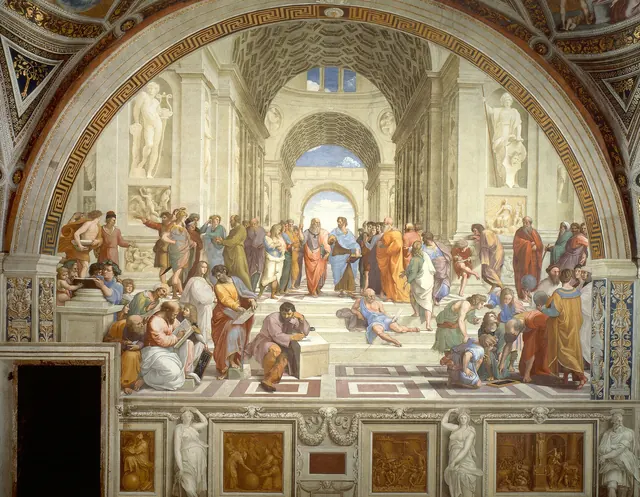
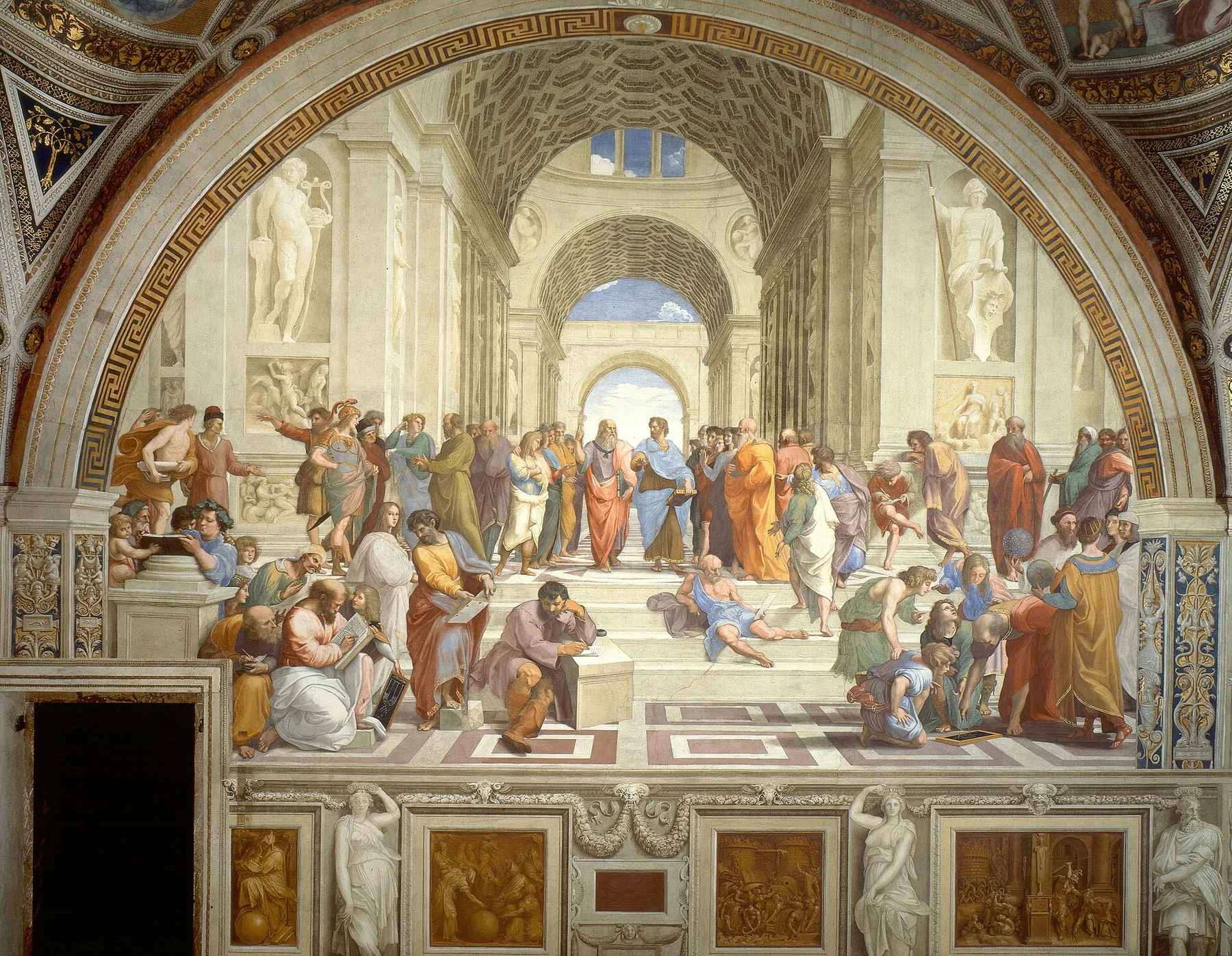
Step into the vaulted hall of the Stanza della Segnatura, and the eye is instantly pulled toward a single point where two great philosophers stand. Raphael’s fresco is celebrated for its flawless perspective projection, a technical feat that turns a flat wall into a convincing three‑dimensional space. Every receding line of floor tiles, every converging column, leads the viewer’s gaze to that vanishing point, creating a sense of depth that feels almost architectural. This visual precision is one of the work’s most striking qualities, inviting us to explore the gathering of minds that fills the painted arena.
Raphael’s Roman Arrival
In late 1508, Pope Julius II summoned the young Raphael to Rome, acting on the recommendation of the architect Donato Bramante. The papal patronage was part of a larger program to adorn the private apartments of the pope, known as the Stanze di Raffaello. The School of Athens was painted for the Stanza della Segnatura, the first of these rooms, and it would become the centerpiece of the papal study. This commission placed Raphael at the heart of the Vatican’s artistic renaissance, linking his talent directly to the ambitions of the pontiff and his architect.
A Classical Architecture Re‑imagined
The grand arches, towering columns, and vaulted ceiling that frame the philosophers are not imagined fantasies; they echo Donato Bramante’s design for the new St Peter’s basilica. Raphael borrowed the language of Bramante’s ambitious renewal of the early Christian basilica, embedding the ancient dialogue within a contemporary vision of Rome’s future cathedral. This architectural backdrop does double duty: it provides a believable stage for the gathering while also symbolically aligning the revival of classical thought with the papacy’s own project of renewing Christendom’s spiritual heart.
The Vanishing Point of Philosophy
At the heart of Raphael’s composition lies a single vanishing point, precisely aligned with the two central philosophers. This focal convergence is not accidental; it is the geometric anchor that organizes the entire scene. The perspective lines of the floor, the receding arches, and the distant arches all meet where Plato and Aristotle stand, reinforcing their intellectual primacy. By centering the composition on this point, Raphael turns the act of looking into an act of reasoning, inviting the viewer to follow the same logical path that the philosophers themselves pursued.
Plato and Aristotle – Ideals in Dialogue
In the centre, Plato gestures upward with his finger, a copy of his dialogue *Timaeus* clasped in his hand, while Aristotle holds a volume of his *Ethics* close to his chest. Their contrasting postures have long been read as visual symbols of their philosophical differences: Plato’s upward point suggests the realm of ideal forms, whereas Aristotle’s grounded stance reflects his focus on concrete particulars. Though the fresco does not label the gestures, scholars have popularly interpreted them in this way, turning the painted exchange into a silent debate between the two great thinkers.
Raphael’s Hidden Signature
On the extreme right, a modest figure in a black beret looks out toward the viewer. This is Raphael’s self‑portrait, a subtle insertion that places the artist among the great minds he admired. The black beret not only distinguishes the painter but also balances the composition, anchoring the bustling assembly on the opposite side of the central philosophers. By embedding himself in the scene, Raphael declares his participation in the intellectual conversation of his age.
The Enigmatic Heraclitus
Among the philosophers, a brooding figure with a distant gaze is traditionally identified as Heraclitus. Scholars have long linked this portrait to Michelangelo, the towering contemporary sculptor and painter, seeing in the figure a subtle homage to his rival’s genius. While Raphael never left written notes confirming the likeness, the identification has become widely accepted in art history, adding a layer of personal rivalry to the collective tableau of ancient thinkers.
The Overhead Inscription
Hovering above the assembly is a circular tondo‑label bearing the Latin phrase *Causarum Cognitio*. This decorative element, part of the surrounding program rather than the painted architecture itself, declares the subject of the fresco: philosophy. The inscription echoes Aristotle’s emphasis on understanding the causes of things, reinforcing the intellectual theme that unites the gathered scholars. Its placement directly over the converging perspective lines ties the pursuit of knowledge to the very geometry of the composition.
A Neoplatonic Vision
Beyond the individual figures, the fresco functions as a Neoplatonic visual program, harmonizing classical philosophy with the authority of the Roman Catholic Church. By gathering the great minds of antiquity within a space modeled on Bramante’s vision for St Peter’s, Raphael creates a symbolic bridge between ancient wisdom and contemporary faith. The work thus stands not only as a technical marvel of perspective but also as a carefully crafted statement about the power of knowledge to support the spiritual and cultural renewal championed by Pope Julius II.
In Raphael’s fresco, every line, gesture, and hidden portrait invites us to step into a timeless dialogue—one that continues to speak across the centuries.