The story
A Mysterious Masterpiece
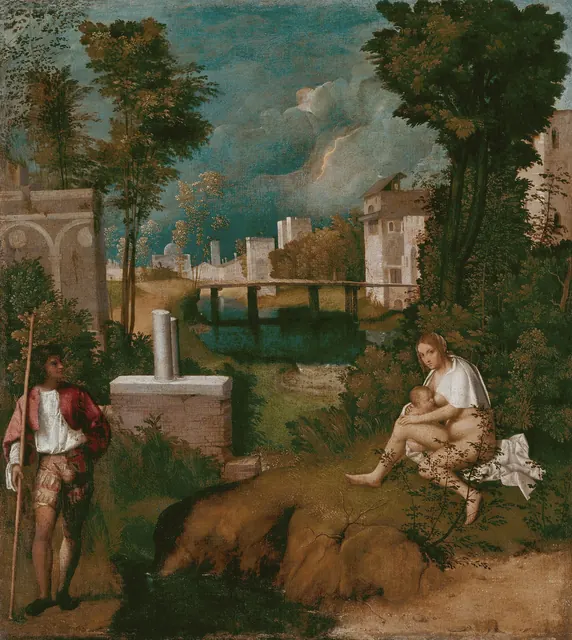
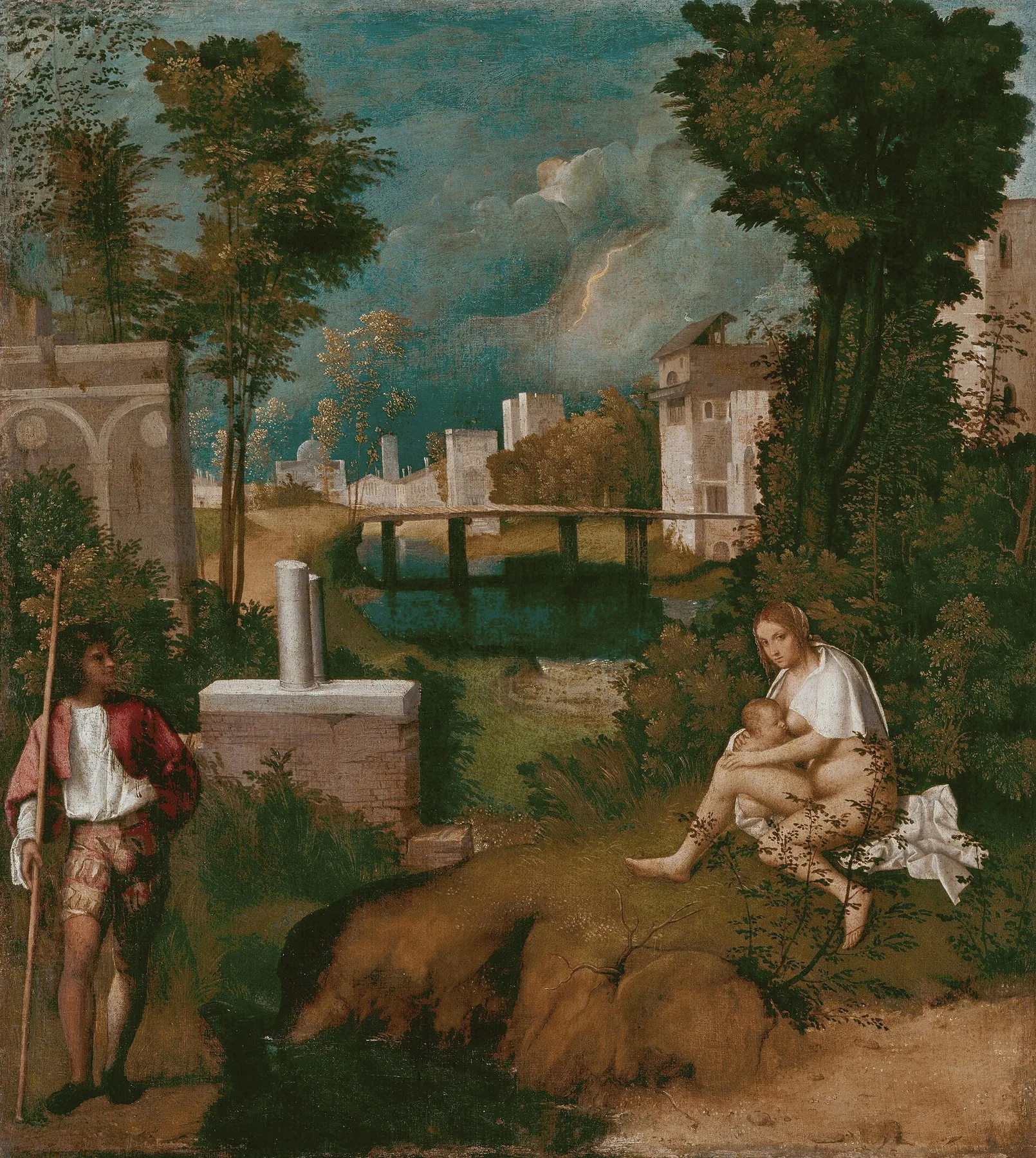
The canvas before us bears the title "The Tempest" and has long been attributed to the Venetian painter Giorgione. This attribution anchors the work within a very specific artistic circle, linking it to the early sixteenth‑century innovations that defined the High Renaissance in Venice. Knowing the name attached to the painting immediately frames our expectations: Giorgione is celebrated for his poetic ambiguity and subtle handling of light, so the very act of naming the artist invites viewers to search for those hallmarks in every brushstroke and compositional choice.
Even before we identify the hand that painted it, the scene itself commands attention: a storm appears poised to break over a quiet, open landscape, its dark clouds gathering weight above a lone figure and a nude woman by a small building. The tension between the calm foreground and the threatening sky creates a palpable sense of anticipation, as if the viewer is standing at the edge of a moment about to erupt. This dramatic juxtaposition of weather and human presence is the visual core of the work, inviting us to feel the breath of an imminent tempest.
Dating the Enigmatic Landscape
Scholars place the creation of The Tempest around the year 1507, a time when Venice was a bustling hub of artistic exchange and experimentation. This dating situates the painting at the cusp of Giorgione’s brief but influential career, just before the rise of his contemporary Titian. Understanding that the work emerged in the early 1500s helps us appreciate its pioneering approach to landscape, a genre that was still evolving from mere background to a central, expressive element in painting.
Early Ownership and Documentation
The earliest known owner of The Tempest was Gabriele Vendramin, a noted collector and patron who specialized in painting covers, or "timpani." Vendramin’s acquisition signals the work’s immediate appeal to connoisseurs who prized innovative compositions. His status as a patron also suggests that the painting may have been commissioned for a specific decorative purpose, aligning with the tastes of a collector who valued both artistic merit and the novelty of new visual formats.
In 1530, the Venetian nobleman and art enthusiast Marcantonio Michiel recorded a description of The Tempest, providing one of the first written testimonies of the painting’s existence. Michiel’s notes are valuable because they capture contemporary reactions and preserve the work’s early reputation within the cultural circles of Venice. His observation also offers a benchmark against which later interpretations can be compared, highlighting how the painting’s meaning has evolved over time.
The handwritten observations made by Michiel and other early viewers were eventually compiled and published in the volume Notizia d’opere di disegno in 1800. This publication brought centuries‑old commentary into the public sphere, allowing scholars and the broader art‑loving public to engage directly with primary descriptions of the painting. By making these notes accessible, the 1800 edition helped cement The Tempest’s place in art historical discourse and ensured that its early critical reception would not be lost to time.
A Milestone in Landscape Painting
Art historians regard The Tempest as a milestone in Renaissance landscape painting, marking a shift from background scenery to a fully realized, emotive environment. Its treatment of atmosphere, light, and weather anticipates later developments in the genre, where the landscape itself becomes a conduit for mood and narrative possibility. Recognizing the painting as a turning point helps us see how Giorgione’s subtle innovations opened new pathways for artists who would follow, expanding the expressive potential of the natural world on canvas.
Interpretive Horizons
Marcantonio Michiel, the same early chronicler, sensed a deep sense of disquiet and potential turmoil within the picture, interpreting it not as a straightforward narrative but as an allegory or impresa—a symbolic emblem meant to convey a moral or philosophical idea. This reading invites us to look beyond the literal scene and consider the work as a visual riddle, where the storm and the figures together encode a layered message that resists a single, definitive explanation.
Modern scholar Schmitter argues that The Tempest bears a strong resemblance to a portrait back, or "timpano," a decorative panel that once covered a portrait. He suggests that Giorgione’s invention was influenced by this "portrait adjacent imagery," meaning the painting may have been conceived as a companion piece to a hidden portrait, or as a visual front that engages the viewer before the main image is revealed. This theory reshapes our understanding of the work’s original function and its relationship to contemporary decorative practices.
Viewing The Tempest through the lens of contemporary imprese and the culture of painting backs frees us from the need to pin down a single iconographic solution. In the early sixteenth century, artists often created enigmatic images that served as moral or intellectual puzzles, meant to be contemplated rather than solved. By situating the painting within that tradition, we allow its ambiguity to remain intentional, appreciating the work as a sophisticated visual prompt that encourages ongoing inquiry rather than a closed narrative.
Finally, the painting’s composition, proportion, and scale reveal an inventive use of imagery that highlights its likeness to a relatively new type of artwork emerging in Venice. The careful balance of figures, architecture, and atmospheric sky demonstrates Giorgione’s mastery of spatial harmony, while the bold integration of a storm as a central visual element marks a departure from conventional portraiture or religious scenes. This inventive arrangement underscores the work’s role as a pioneering example of a genre that was still defining its own language.
The Tempest endures as a quiet yet powerful invitation to look beyond the visible and to let the mystery of its stormy horizon linger in our imagination.