The story
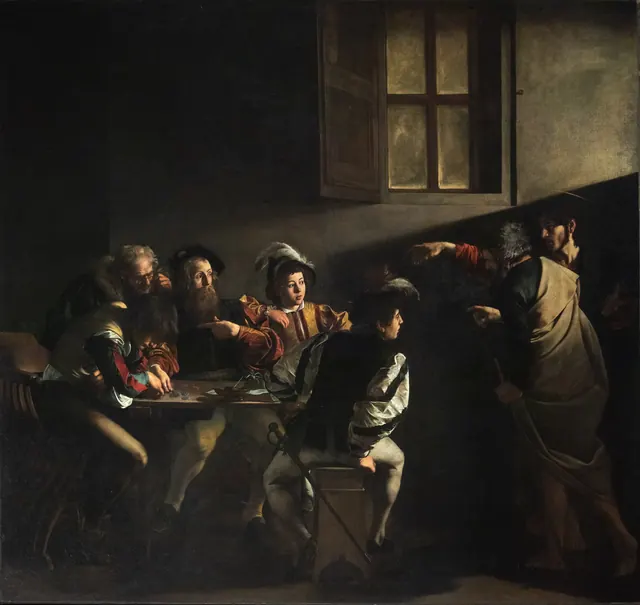
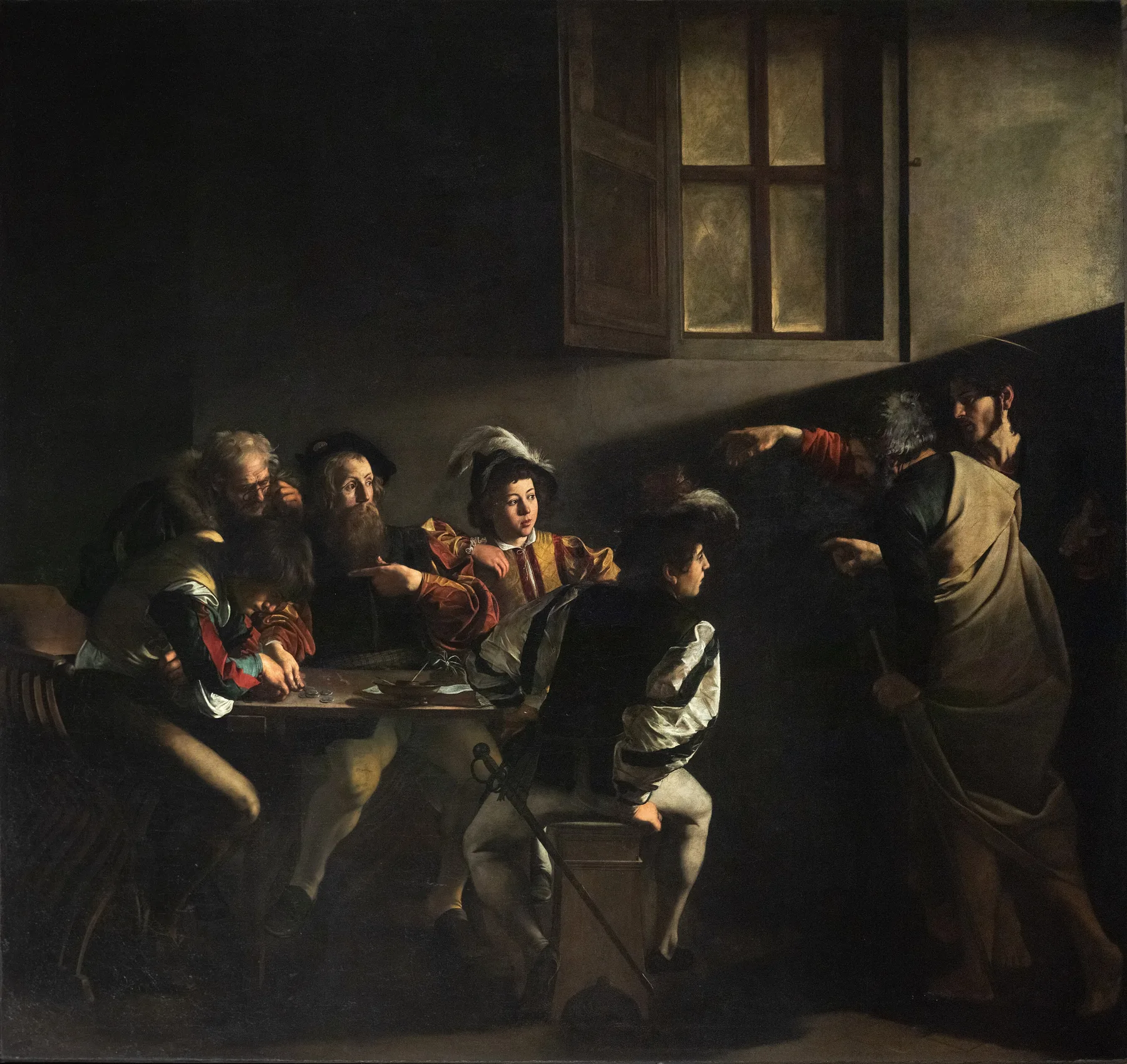
The canvas before us bears the unmistakable title “The Calling of Saint Matthew,” and it was painted by Michelangelo Merisi da Caravaggio, the artist known simply as Caravaggio. This naming does more than label the work; it anchors the image in a specific biblical episode and signals the hand of a painter whose dramatic use of light and realism would reshape Baroque art. Recognizing Caravaggio’s authorship invites us to look for the hallmarks of his style—tenebrism, naturalistic figures, and a theatrical staging—that will unfold as we move deeper into the scene.
The painting hangs in the Contarelli Chapel, a side chapel of the Church of San Luigi dei Francesi in Rome. Its placement within this sacred space indicates it was intended as a visual sermon for worshippers of the time, rather than for a private salon or secular gallery. Understanding the chapel’s architecture helps us see why the composition is oriented toward the altar, turning the act of divine invitation into a lived experience for those who entered the chapel.
Caravaggio’s canvas is one half of a paired commission for the Contarelli Chapel, the companion piece being the dramatic “Martyrdom of Saint Matthew.” By presenting the apostle’s calling alongside his ultimate sacrifice, the two works frame a theological narrative that moves from the moment of divine selection to the culmination of martyrdom. This intentional pairing underscores the patron’s desire to trace a saint’s entire spiritual journey, inviting viewers to contemplate both the beginning and the end of Matthew’s mission within a single sacred environment.
Caravaggio received his first ecclesiastical commission after Cardinal Francesco Maria del Monte purchased an earlier work, offered him living quarters, and actively promoted his talent. This patronage opened the door to the Contarelli Chapel project, marking a turning point in Caravaggio’s career from an independent painter to a sought‑after creator of sacred art. The cardinal’s support illustrates how networks of power and personal taste could shape an artist’s trajectory, explaining why Caravaggio was entrusted with such a prominent religious narrative in the heart of Rome.
Caravaggio painted the work specifically for a lateral wall, intending it to be viewed from an oblique angle. To accommodate this perspective, he incorporated strong diagonal lines that guide the viewer’s eye toward the altar of the chapel. These compositional choices not only heighten the drama of the moment but also integrate the painting into the architectural flow of the space, making the movement of worshippers part of the visual experience. The diagonals act as visual pathways, leading the faithful from the ordinary world of the tavern toward the sacred focal point of the altar.
A striking feature of the composition is the strong beam of light that cuts diagonally across the scene, illuminating the figures and slicing through the dim interior of the tavern. This shaft of light not only creates a dramatic contrast of shadow and illumination but also serves as a compositional guide, directing attention from the mundane activity of the tax‑collectors toward the sacred gesture of Christ. Its placement reinforces the narrative focus on the instant of divine intervention, turning an ordinary room into a stage for a miraculous encounter.
The gesture of Christ’s outstretched hand in the painting deliberately echoes the iconic hand‑gesture of Michelangelo’s “Creation of Adam” on the Sistine Chapel ceiling. By echoing that Renaissance masterpiece, Caravaggio links his own biblical moment to a broader tradition of divine touch. The parallel invites viewers to recall the act of creation while witnessing the calling of a new apostle, deepening the theological resonance of the scene through a visual dialogue that spans generations of Italian art.
Scholars interpret the luminous beam as miraculous, a symbol of divine intervention that marks the precise instant of Matthew’s calling. This reading suggests that the light is not merely a technical device but a narrative element that physically manifests the presence of the divine within an everyday setting. By framing the moment with a radiant shaft, Caravaggio transforms a simple tavern scene into a stage for the supernatural, inviting the viewer to sense the awe of a heavenly summons breaking into ordinary life.
A lingering question among experts concerns the figure of Saint Peter, standing at the far left of the composition. There is uncertainty whether he was added later or was intended from the start, as subtle stylistic differences have been noted. This ambiguity invites us to consider how the painting may have evolved, reminding us that even celebrated masterpieces can retain mysteries about their final form. Whether original or later, Peter’s presence reinforces the apostolic theme, linking the calling of Matthew to the broader community of Christ’s followers.
Through light, gesture, and the very walls that frame it, Caravaggio’s Calling of Saint Matthew continues to draw us into the moment of divine invitation, inviting each viewer to contemplate the power of a single, illuminated call.
Thank you for joining us on this journey into Caravaggio’s masterful blend of light, narrative, and space.