The story
Introducing the work
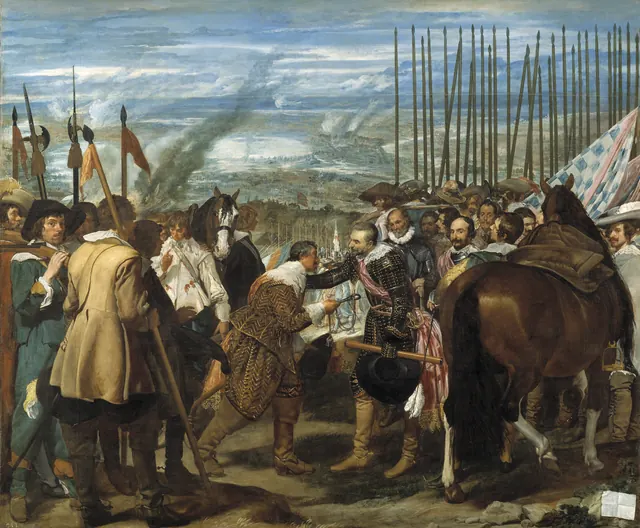
In the grand halls of Spain’s Golden Age hangs a canvas that has come to symbolize a nation’s glory. Titled “The Surrender of Breda,” this monumental scene was painted by Diego Rodríguez de Silva y Velázquez, the court’s most celebrated artist. The very name of the work hints at a moment of capitulation, yet the image before us is far richer than a simple record of surrender. As we step into the frame, we are invited to witness a carefully staged encounter that blends history, drama, and the painter’s masterful hand.
When the canvas was born
Velázquez completed this work around the middle of the 1630s, a period scholars narrow to between 1634 and 1635. Those years fell within the reign of Philip IV, a time when Spain was asserting its power across Europe and the Atlantic. By dating the canvas to this narrow window, we understand that the painting was conceived at the height of the monarch’s ambitions, serving both as a celebration of recent victories and as a visual reinforcement of the king’s authority during a pivotal decade of Spanish history.
Materials and scale
The painting is executed in oil on canvas, a medium that allowed Velázquez to achieve the subtle gradations of light and texture that define the scene. Its monumental size—over three meters wide and nearly four meters tall—immerses the viewer, making the figures appear life‑size and the drama palpable. Such a scale was typical for works intended to dominate a royal hall, ensuring that every detail, from the glint of metal to the folds of fabric, could be read from a distance while still rewarding close inspection.
A royal commission
The canvas was commissioned for the Hall of Realms in the Buen Retiro Palace, a grand gallery where Philip IV displayed his military triumphs. This hall was not merely a decorative space; it functioned as a throne room and a venue for music and theatrical performances, turning each wall into a stage for the empire’s narrative. By placing the surrender of Breda among other victorious scenes, the painting reinforced the king’s image as a victorious ruler and celebrated the Spanish army’s might in a setting designed for public spectacle.
Velázquez, the court’s premier painter
At the time of this commission, Velázquez held the position of the court’s most prestigious painter, a role that gave him unparalleled access to royal patronage and the resources of the palace. The king’s decision to entrust him with this pivotal work underscores the confidence placed in Velázquez’s ability to translate political triumph into visual language. His status ensured that the painting would be executed with the highest technical skill and artistic insight, qualities that continue to define its lasting impact.
The key exchange and a smoky horizon
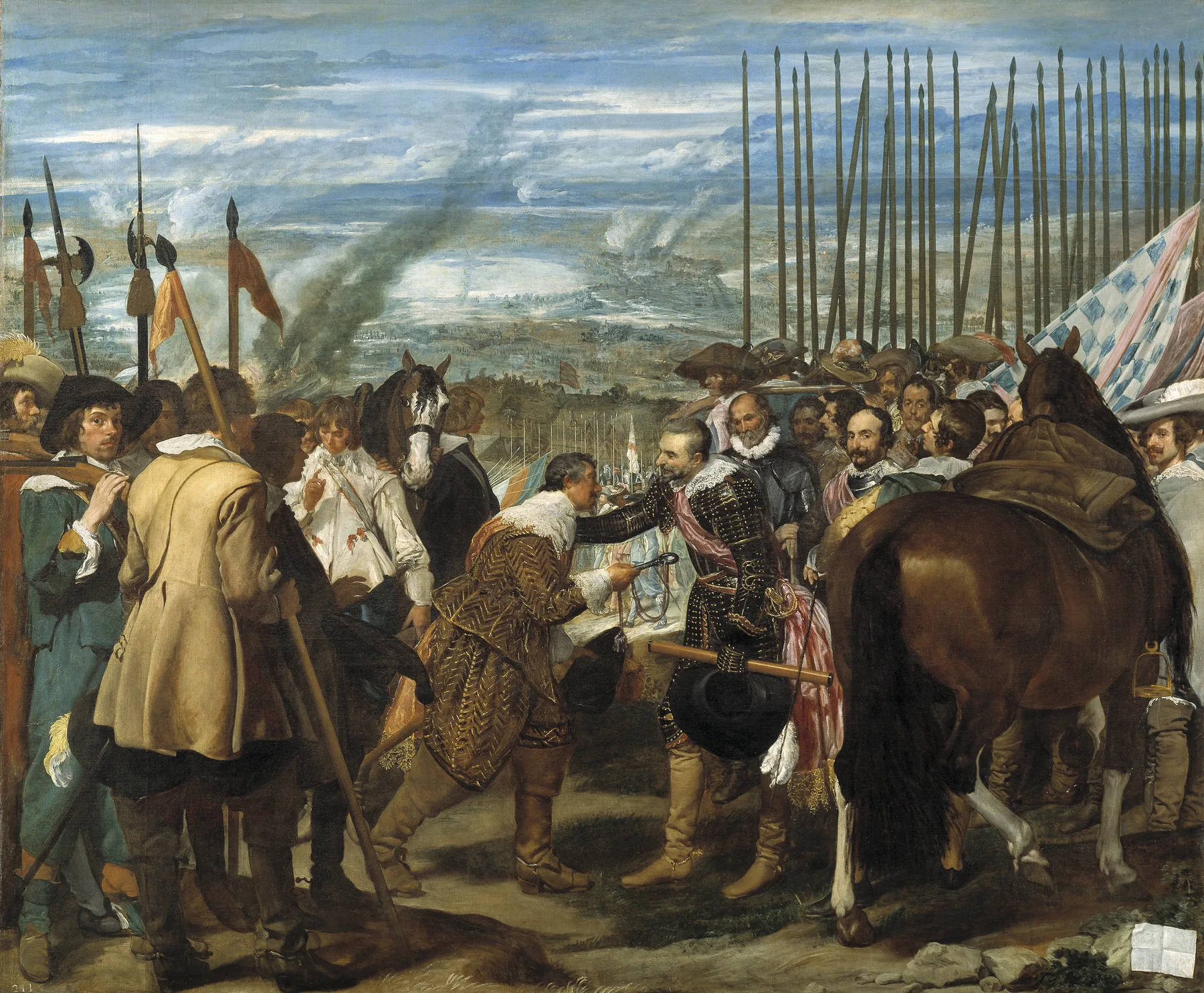
At the heart of the composition, a man in an ornate brown coat with gold zig‑zag pattern extends a large metal key to a figure in black plate armor, whose pink sash and white lace collar mark him as the Spanish commander. This exchange of keys, the painting’s most prominent motif, anchors the scene. Behind them, a smoky sky—dark plumes rising against lighter clouds—suggests the devastation of battle, casting a somber glow that frames the moment of surrender without obscuring the human interaction.
Contrasting armies
Velázquez deliberately sets the Dutch soldiers on the left as a disorganized, youthful group, few in number and rendered with looser brushwork. In stark contrast, the Spanish troops on the right appear as a large, well‑organized, seasoned force, their ranks tight and their armor gleaming. This visual opposition not only conveys the outcome of the battle but also reinforces the narrative of Spanish superiority, using composition and detail to tell a story of order triumphing over chaos.
The Lances and their nickname
In the distance, a vertical array of spears rises like a forest of iron, their shafts pointing skyward. This striking formation gave the painting its enduring nickname, “The Lances,” a moniker that highlights the dramatic presence of those weapons. The spears not only add depth to the battlefield but also serve as a visual reminder of the martial spirit that the work was meant to celebrate, anchoring the scene in a language of power and precision.
Palette and light
Velázquez employs a muted palette of earth tones—burnt umbers, soft ochres, and dusky grays—bathed in a gentle, diffused light. This combination lends the scene a naturalistic character, allowing the figures to emerge from the background with a quiet dignity. The restrained colors avoid theatrical flamboyance, instead reinforcing the sober mood of a negotiated surrender while still highlighting the richness of fabrics and the metallic sheen of armor.
Invented history and political rhetoric
Although the canvas portrays a real battle, it is not a literal documentary record. Velázquez deliberately invented the scene to honor the magnanimous character of the Spanish general Spinola and to present him as a gracious victor. In doing so, the painting becomes a rhetorical exaltation of Spanish national identity, a visual symbol of Philip IV’s power, and a tribute to Spinola, a personal friend of the artist. Thus the composition serves both artistic and political purposes, shaping memory as much as it reflects history.
Rubens’ echo in a Spanish canvas
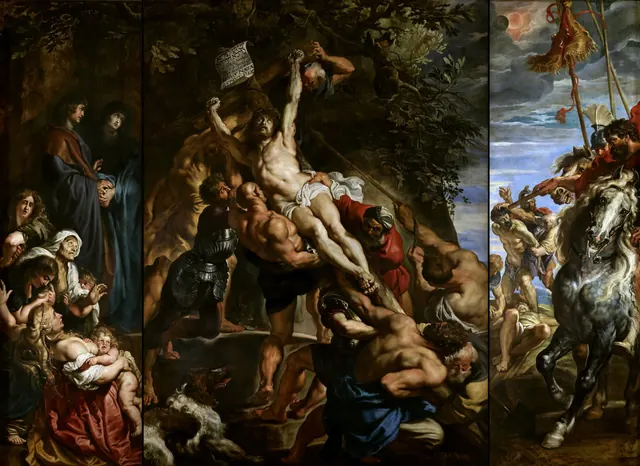
Scholars note that Velázquez’s handling of the dramatic sky and the dynamic arrangement of figures bears the imprint of Peter Paul Rubens, whose Baroque vigor had spread across Europe. While Velázquez adapts these influences to his own restrained palette, the sense of movement and the theatrical staging echo Rubens’ style, suggesting that the Spanish master was both aware of and responsive to contemporary artistic currents beyond his courtly sphere.
Legacy of a singular masterpiece
Today, “The Surrender of Breda” is regarded as a masterpiece of the Spanish Baroque and stands as Velázquez’s only surviving historical painting. Its blend of naturalistic detail, grand scale, and political nuance has secured its place in art history as a singular achievement, embodying the height of 17th‑century Spanish court painting while offering a timeless meditation on power, generosity, and the art of visual storytelling.
Take a moment to linger on the quiet exchange of keys, and let Velázquez’s vision of triumph linger in your thoughts.