The story
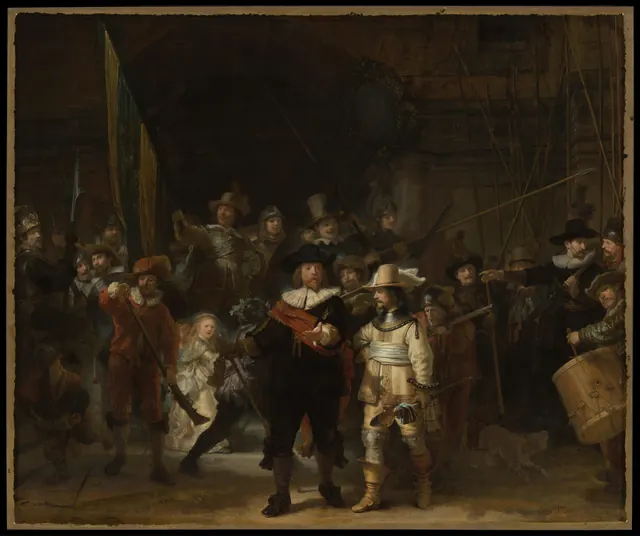
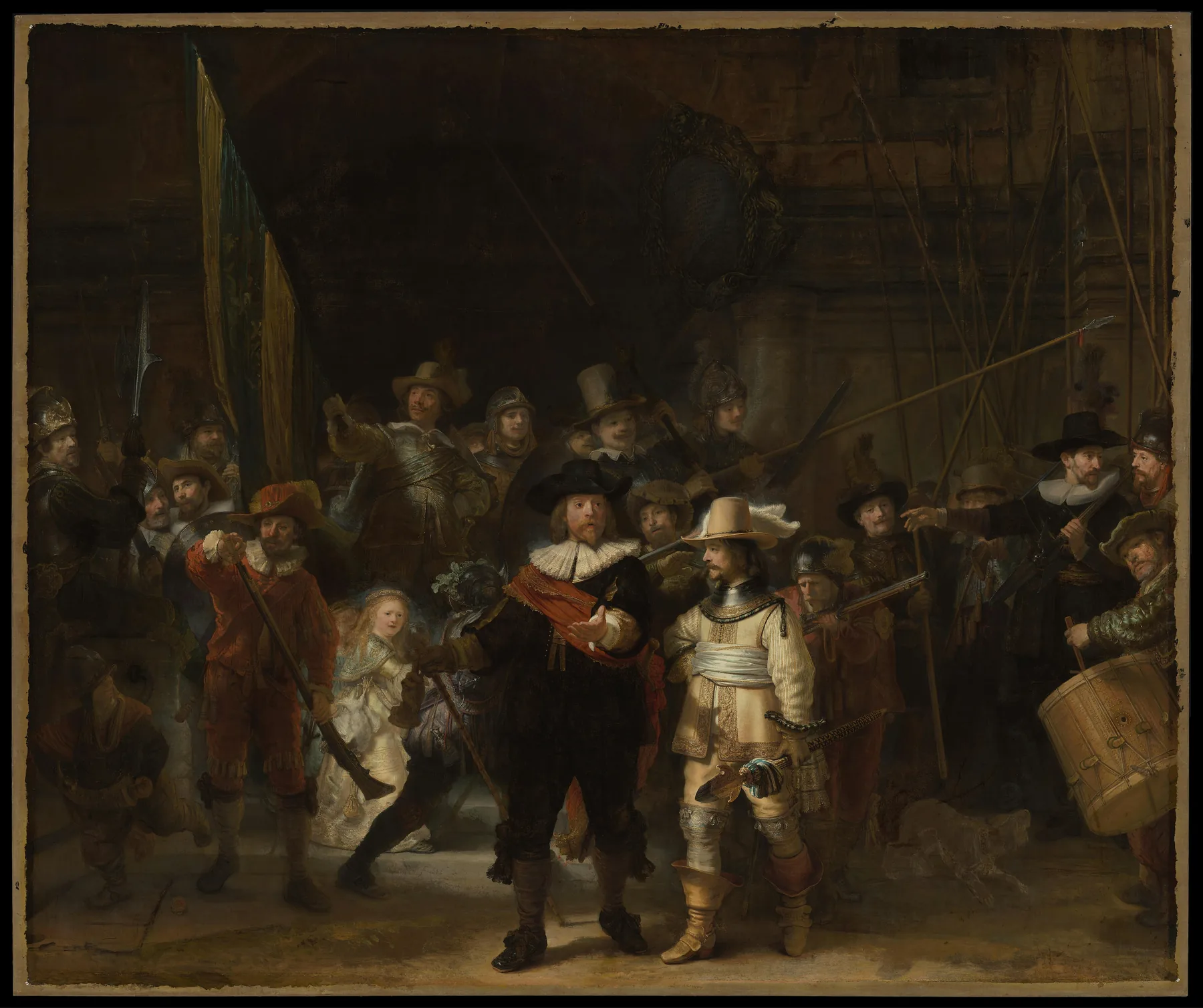
Before us hangs Rembrandt’s 1642 oil‑on‑canvas masterpiece, formally titled ‘Militia Company of District II Under the Command of Captain Frans Banninck Cocq’ and known worldwide as ‘The Night Watch’ (C1). The work was painted by Rembrandt van Rijn (C2) and completed in 1642 (C3). The canvas measures 379.5 cm high by 453.5 cm wide (C5), a monumental size that dominates the Rijksmuseum’s Gallery of Honour, where it is displayed on long‑term loan from the City of Amsterdam (C6). In the lower right corner the artist signed ‘Rembrandt f 1642’ (C17).
The composition bursts with movement. At its centre a captain thrusts his hand forward, a gesture that commands the viewer’s attention (C7). Beside him, a young girl—the militia’s mascot—holds a tiny bird, her figure illuminated with the same intensity (C7, C10). Rembrandt’s masterful use of light isolates these two elements, while a lieutenant in the foreground shines with an equally bright glow, creating a pair of intensely lit figures that dominate the scene (C11). This play of illumination not only guides the eye but also gives the crowded militia portrait a dynamic, almost theatrical rhythm.
The canvas we see today is not exactly the rectangle Rembrandt first laid out. In 1715 the work was cut down, and the peripheral sections were lost forever (C45). The original dimensions recorded were 379.5 cm by 453.5 cm (C5); the trimming reduced the width to accommodate the spatial constraints of its new setting. Although the exact present width is not recorded here, the loss of the outer edges is evident in the way the composition now feels slightly compressed, a reminder that the painting’s physical form has been altered by history.
During the turmoil of World War II the painting was hidden to keep it from Nazi hands. First it was stored in a coastal bunker, then moved to the cool caves of St. Pietersburg in Maastricht, where the stable environment offered protection against fire and humidity (C9, C46). These secret relocations ensured that the canvas survived the war intact, allowing it to return to the Rijksmuseum after peace was restored.
The Night Watch has also endured more recent violence. In 1975 a visitor attacked the canvas with a bread knife, carving deep gashes across the surface (C24, C47). Conservators at the Rijksmuseum painstakingly stitched the tears, backed the painting with a new linen support, and performed careful retouching to restore its visual integrity. The incident underscores the constant vigilance required to preserve such a treasured work.
Scientific analysis has uncovered surprising details in the paint itself. Researchers have identified the compound pararealgar within the layers (C12), and studies have detected lead(II) formate spread throughout the painting, from broad swaths down to microscopic particles (C13). These findings illuminate the complex chemistry of Rembrandt’s palette and provide conservators with a clearer picture of the materials that have aged alongside the canvas over the centuries.
The most striking recent discovery comes from Operation Night Watch, the museum’s large‑scale research project launched in 2019 (C52). Using X‑ray fluorescence and ptychographic nano‑tomography, scientists revealed an unknown lead‑rich layer in the painting (C14). This layer is a lead‑rich oil impregnation that Rembrandt applied before the first ground, spreading with large semi‑circular brushstrokes (C20, C30, C21, C33). The lead distribution map even shows the imprint of the original stretcher (C21, C34, C26). Analysis of a paint sample at the PETRA III synchrotron in Hamburg confirmed the lead’s presence (C35), and non‑invasive imaging in the Gallery of Honour corroborated the finding (C36). Because a lead‑rich oil provides better protection against moisture and mold than the typical glue layer used on seventeenth‑century canvases (C22), the hidden stratum likely helped the painting survive damp conditions. Scholars present the discovery as evidence of Rembrandt’s inventive spirit and willingness to experiment with new techniques (C23, C38), a view supported by the collaborative effort of universities in Amsterdam, Utrecht, Antwerp, and the DESY laboratory, funded by NWO (C37).
From its bold gestures of light to the concealed lead layer that has guarded it for centuries, The Night Watch remains a living laboratory of art and science. Ongoing research continues to peel back layers of history, inviting each new visitor to look deeper, question what lies beneath, and marvel at the ingenuity of a master who still speaks across the centuries.
Thank you for joining us on this journey through light, history, and hidden layers—keep looking closely.