The story
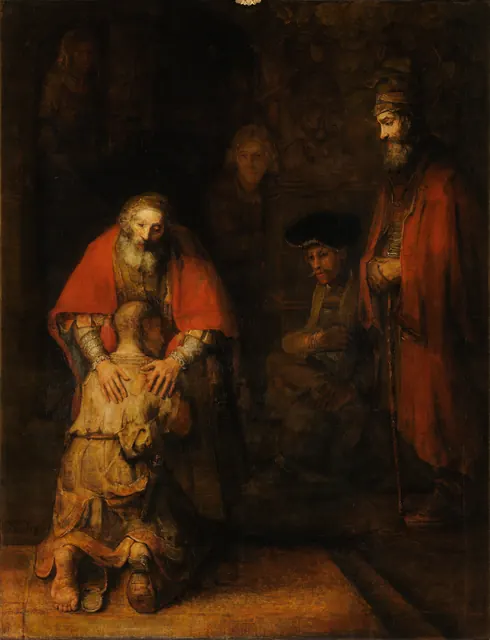
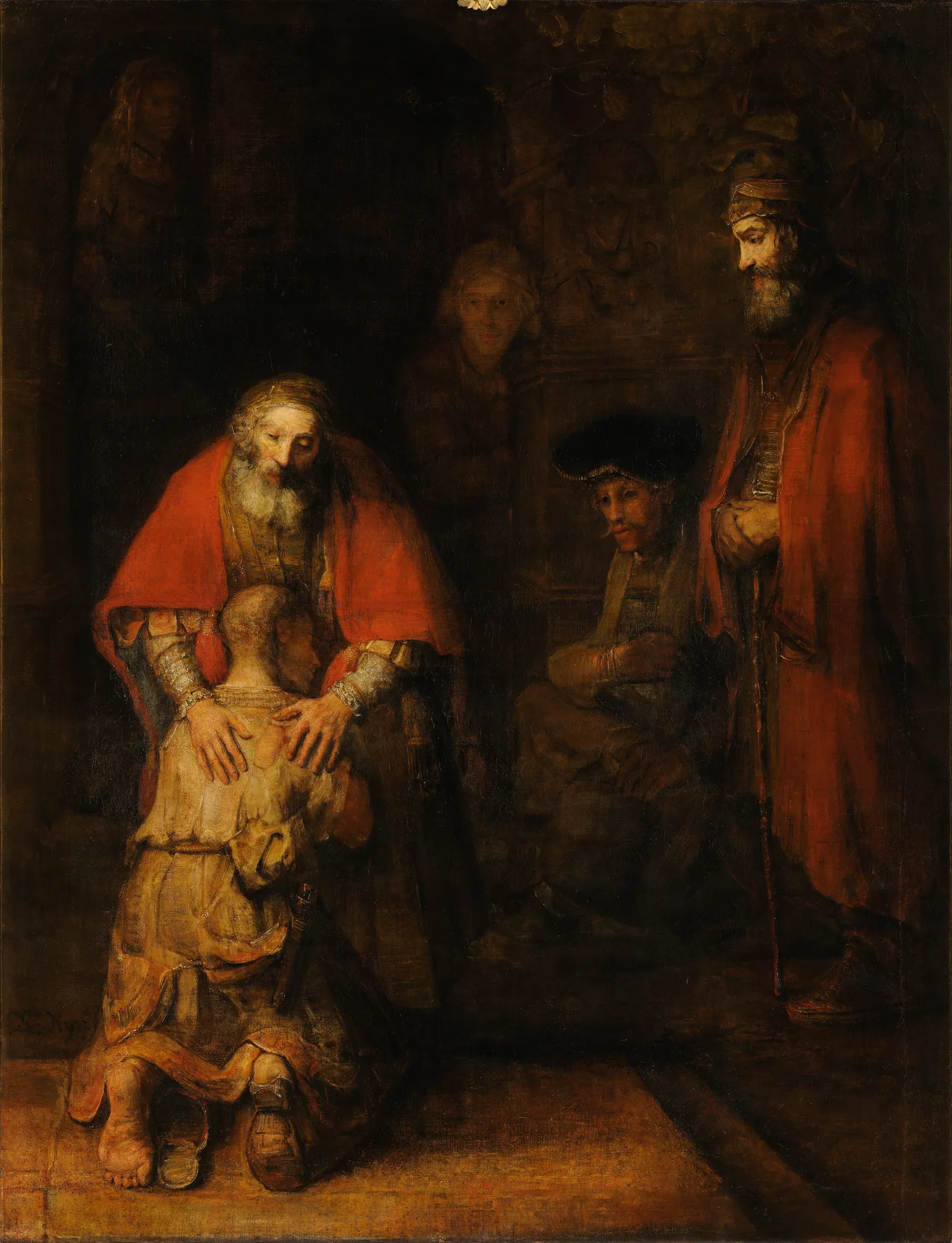
The painting bears the straightforward title “Return of the Prodigal Son,” directly naming the biblical parable that Rembrandt chose to depict. By using the familiar wording, the work immediately signals its narrative focus to viewers, inviting them to recall the story of a wayward son who, after squandering his inheritance, returns home seeking forgiveness. This title anchors the composition, allowing the viewer to read each gesture and expression as part of that moment of reconciliation. In the frame before us, the kneeling figure, the compassionate elder, and the surrounding witnesses all converge to dramatize that timeless act of return.
Rembrandt worked in oil on canvas, a medium that gave him unparalleled control over light, texture, and depth. The slow‑drying oil allows the artist to blend subtle tonal shifts, creating the warm glow that suffuses the scene. In this painting, the thick impasto on the old man's beard contrasts with the thin, almost translucent glaze on the kneeling son's torn garment, emphasizing both material richness and emotional vulnerability. The canvas itself, stretched to a substantial size, supports a grand composition that could accommodate a full‑length narrative without the need for a supporting frame. This choice of medium thus becomes a vehicle for the painter’s dramatic chiaroscuro and intimate detail.
The work entered the Hermitage Museum in 1766, becoming part of the vast collection amassed by Catherine the Great. That year, the Russian empress purchased the painting, adding a Dutch masterpiece to a gallery already renowned for its European holdings. The acquisition reflects Catherine’s ambition to position St. Petersburg as a cultural capital, and it placed Rembrandt’s late vision on view for a new audience far from Amsterdam. Knowing the painting arrived in the Hermitage at that moment helps us trace its journey from a private studio to a public institution, where it has been admired for more than two and a half centuries.
Today the painting remains in the Hermitage Museum in St. Petersburg, the same institution that first received it in the eighteenth century. Its presence in the museum’s permanent collection ensures that visitors can encounter the work in a setting that highlights its scale and narrative power. The Hermitage’s stewardship also guarantees careful conservation of the oil layers and canvas, preserving the luminous qualities that Rembrandt achieved. By situating the painting among other masterpieces, the museum offers a contextual dialogue that underscores the Dutch master’s influence on European art, while allowing the viewer to appreciate the work in a historic, yet living, environment.
Rembrandt completed this canvas only months before his death, making it one of his final statements as an artist. The proximity to the end of his life imbues the scene with a palpable sense of urgency and introspection, as if the master were reflecting on his own mortality and the promise of forgiveness. This late period is marked by a looser brushwork and a deeper, more resonant palette, qualities that are evident in the softened edges of the background and the glowing aura surrounding the elder’s face. Understanding that the painting was created at the twilight of Rembrandt’s career adds emotional weight to the themes of repentance and redemption that unfold before us.
Unusually for a large religious composition in Protestant Holland, Rembrandt produced this work without a commission. In a market where churches and wealthy patrons typically dictated subject matter, the artist’s decision to create a monumental biblical scene of his own accord signals a personal investment in the narrative. This autonomy allowed him to explore the parable’s moral complexities without external constraints, resulting in a composition that emphasizes human emotion over doctrinal display. The absence of a patron’s agenda also explains the painting’s intimate focus on the figures’ expressions and gestures, inviting viewers to engage directly with the story of forgiveness rather than a prescribed theological program.
The composition gathers witnesses whose placement reinforces the parable’s core message and hints at charitable behavior. To the right, a standing man in a red robe grips a wooden staff, his bearing both authoritative and supportive. Behind him, a seated figure in a dark hat folds his arms, watching the scene with a contemplative gaze. In the shadows, a faint female figure and a faint male figure linger, their partial illumination suggesting an unseen community bearing witness to the reunion. Together, these onlookers embody the societal call to generosity and compassion.
Rembrandt renders the old man’s face with a luminous quality that has been described as “shining like a star in the night sky,” a visual metaphor that elevates his paternal compassion to a near‑divine glow. The light catches the fine lines of his beard and the gentle creases around his eyes, creating a halo of warmth that contrasts with the darker surroundings. Above the kneeling wanderer, a red wrap drapes like a canopy, its rich hue framing the repentant figure and drawing the eye upward toward the elder’s benevolent expression. This interplay of light and color not only highlights the emotional climax of the scene but also reinforces the theme of forgiveness radiating from the father’s heart.
The painting conveys a theological message that God is merciful and ready to forgive repentant sinners, a meaning common to many depictions of the prodigal son. By portraying the elder’s open arms and the son’s humbled posture, Rembrandt visualizes the divine invitation to return to grace. The warm, golden tones that bathe the central group suggest a heavenly light, while the surrounding figures observe the act of reconciliation, reinforcing the notion that forgiveness is both personal and communal. This interpretation aligns the work with the broader Christian tradition that emphasizes grace, inviting viewers to contemplate the enduring promise of redemption.
Beyond its primary theological narrative, the painting also offers a secondary meaning—a clear admonition to be charitable. The four witnesses, each poised as if ready to act, serve as a visual reminder that the community bears responsibility for extending generosity. At the center of the composition, a relief of a horn‑player stands, representing a musician who would announce the reunion, reinforcing the call to celebrate kindness. By embedding this moral cue within the intimate family drama, Rembrandt invites viewers to reflect on personal duties toward others, suggesting that forgiveness and charity are deeply inseparable in our lives.
The painting’s acquisition by the Hermitage in 1766 as part of Catherine the Great’s collection underscores the Russian empress’s keen interest in Western art and her desire to enrich her court with masterpieces. By securing this late work of Rembrandt, Catherine not only added a valuable cultural asset but also demonstrated an appreciation for the moral depth and technical mastery embodied in the canvas. The painting’s presence in the imperial collection helped to cement its reputation across Europe, ensuring that its themes of mercy and charity would resonate with audiences far beyond its Dutch origins.
May the elder’s star‑like compassion linger in your thoughts as you revisit this timeless scene.