The story
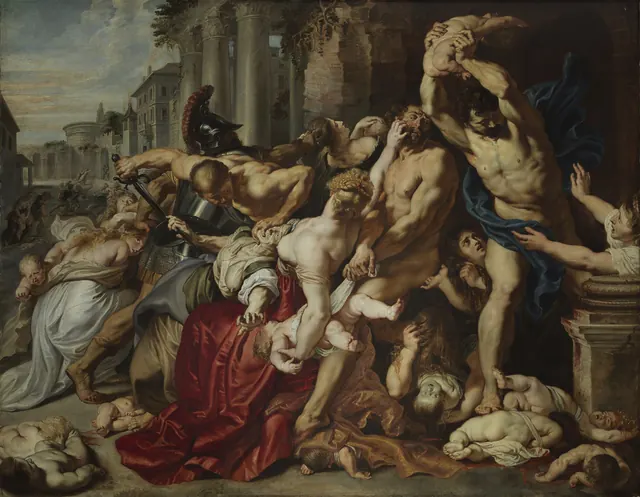
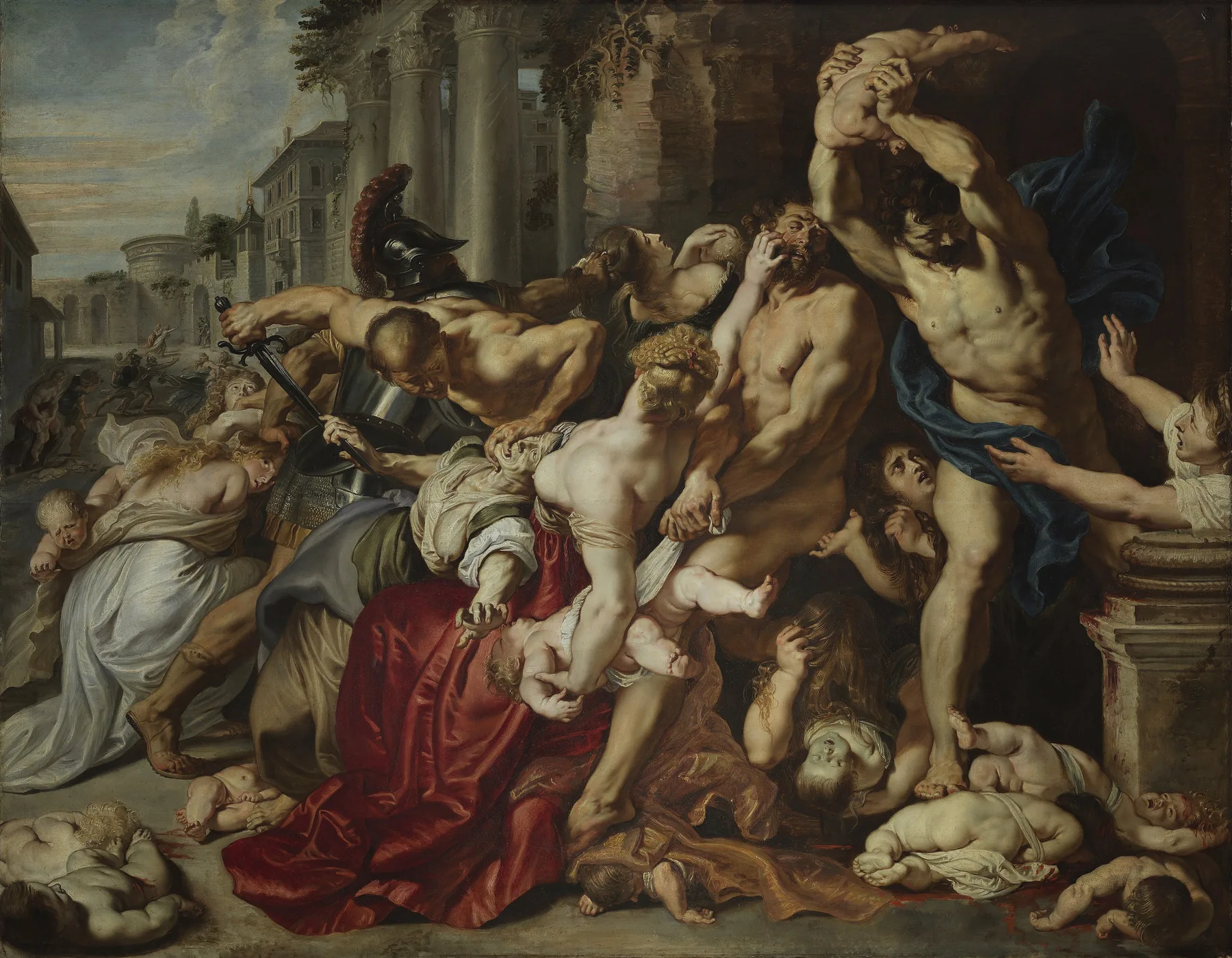
The canvas before us bears the solemn title The Massacre of the Innocents and bears the hand of Peter Paul Rubens. Scholars place its execution around 1610, situating it in the early years of Rubens’s mature career. Even without a precise date, that circa‑1610 context invites us to consider the work as a product of a turbulent era, poised on the brink of the Baroque’s dramatic surge. As the camera glides across the surface, the viewer is drawn into the unfolding crisis, a visual prelude to the harrowing story Rubens chose to render.
Rubens rendered this scene in oil on a solid panel, a choice that gives the surface a luminous depth and allows for the subtle modeling of flesh and fabric. The panel measures about 142 cm in height and 183 cm in width, a scale that brings the figures close to life‑size and immerses the viewer in the drama. Working on a single board, Rubens could build layers of pigment, letting light penetrate the paint and emerge with a rich, almost tactile glow that heightens the emotional intensity of the composition.
At the center of Rubens’s dramatic tableau, a muscular, bare‑chested man with dark curls and a blue draped cloth around his waist hoists a helpless infant high above his head; his both hands clasp the child’s torso, conveying a fierce yet tender grip. Beside him, a woman in a rich, shiny red dress kneels, clutching another baby against her chest, her white‑sleeved arm raised as she looks upward in raw distress. A second bare‑chested figure, short‑haired and grimacing, holds a third infant by the ankles, poised to hurl the child. On the ground, a blonde‑haired woman in a rumpled white dress lies, cradling a newborn while gazing to the right. An armored man with a dark helmet crowned by a red plume brandishes a long sword, his chainmail catching the light. Around them, additional figures—bare‑chested men raising their hands in horror and a woman seen from the back reaching out—populate the chaotic scene, each gesture amplifying the sense of panic.
Rubens’s return to Antwerp coincided with a twelve‑year truce between Spain and Holland, a lull that subtly shaped the subject of his artwork. While the painting depicts a biblical tragedy, the timing suggests Rubens was also reflecting on the recent religious wars that had scarred the Low Countries. The violent tableau can be read as an allegorical echo of contemporary conflict, a way for the artist to comment on collective suffering without naming the present directly. This layered meaning adds a political dimension to the raw emotional power of the scene.
The exhibition text describes Rubens’s work as “Bold, big and rich with detail.” Those words capture what we see: the sweeping scale of the composition, the muscular vigor of each figure, and the intricate rendering of fabrics, armor, and blood. The richness of detail is not decorative; it serves to heighten the narrative urgency, pulling the eye from one anguished face to the next. Rubens’s dramatic flair is evident in the stark contrasts of light and shadow, which carve the bodies from the dark background and give the scene a theatrical, almost cinematic quality.
According to the Early Rubens exhibition text, the painting offers powerful insight into the mindset of Antwerp’s citizens in 1610, expressing a collective trauma born of religious warfare. The visceral anguish of the mothers, the brutal force of the soldiers, and the stark presence of blood all mirror the anxieties of a city that had endured siege and sectarian strife. By portraying the biblical massacre, Rubens gives viewers a mirror for their own recent experiences of loss and fear, turning a distant story into a contemporary lament.
Today the panel is on loan to the Rubens House in Antwerp, the very building where Rubens painted it over four centuries ago. This temporary relocation marks a symbolic homecoming, returning the work to the environment that once echoed the artist’s brushstrokes. Curators see the loan as more than logistical; it reconnects the painting with its original studio, allowing visitors to contemplate the masterpiece within the very walls that inspired its creation. The move underscores the enduring bond between the artwork, its maker, and the city that nurtured him.
The panel you are seeing belongs to the Thomson Collection at the Art Gallery of Ontario, where it is celebrated as the highlight of the museum’s European art holdings. As a centerpiece of Ken Thomson’s generous gift, the work exemplifies Rubens’s masterful blend of drama and detail, inviting viewers to confront the raw emotion of the biblical tragedy. Its presence in the collection underscores the enduring relevance of Rubens’s vision within a broader narrative of European art.
Rubens’ Antwerp panel stands as a timeless testament to the power of art to capture both personal grief and collective history.
Thank you for joining us on this close‑up journey into Rubens’s masterful vision.