The story
Title, Artist and First Impression
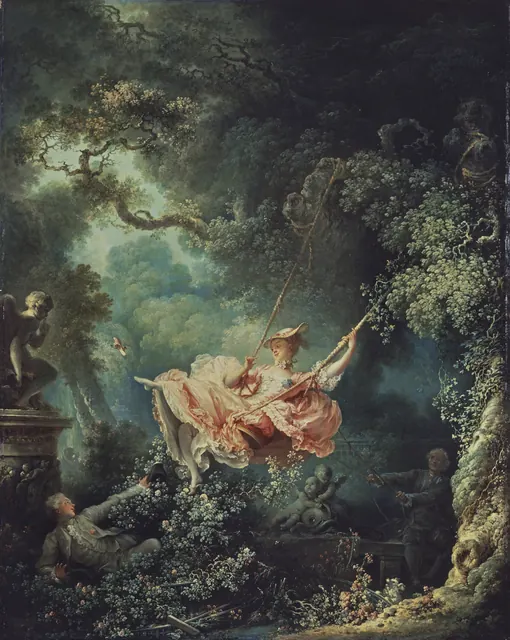
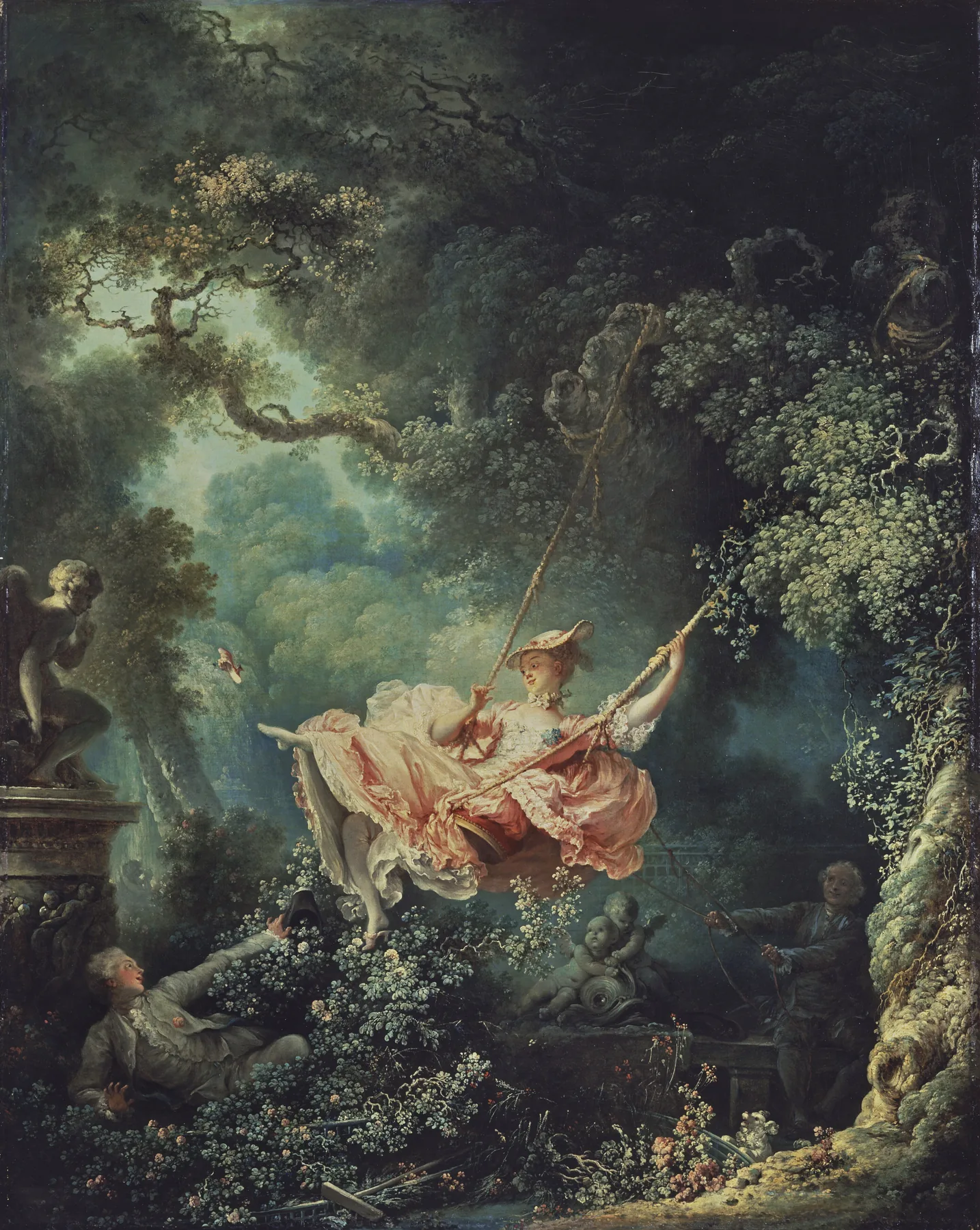
The canvas before us bears the title “The Swing,” known in French as “Les hasards heureux de l'escarpolette.” It was painted by the French Rococo virtuoso Jean‑Honoré Fragonard, whose deft hand and playful imagination made him one of the most celebrated artists of the eighteenth century. The very name of the work hints at chance and delight, inviting us to wonder how a simple garden pastime could become a vehicle for wit, romance, and a subtle commentary on the social games of the aristocracy. From the first glance, the title and the artist’s reputation set the stage for a scene that feels both intimate and theatrical.
When and Why Fragonard Painted It
The Wallace Collection records that Fragonard completed this picture around 1767 to 1768, placing it early in the height of his mature Rococo period. At that time a court gentleman—researchers often identify him as the Baron de Saint‑Julien—approached the artist with a daring brief. The patron originally imagined a bishop pushing the swing, but later settled on a more scandalous scenario involving a concealed lover, a detail that underscores the libertine spirit of the commission. Understanding this dating and patronage helps us see the painting as a product of a very specific social milieu, where wit and erotic suggestion were woven into the fabric of elite entertainment.
Material, Size, and Setting
Fragonard worked in oil on canvas, a medium that let him build luminous glazes and capture the fleeting sparkle of sunlight on silk. The Wallace Collection’s version measures a modest 81 × 64.2 centimetres, a size that encourages a close, almost voyeuristic encounter with the scene. Today the painting hangs in the gallery known as The Study, where its intimate dimensions allow viewers to step up close and feel the brushwork’s delicate texture. The museum’s careful placement underscores the work’s role as a cabinet picture—meant for personal enjoyment rather than grand public display.
A Playful Composition
The composition centers on a young woman suspended mid‑air on a swing, her dress billowing as sunlight catches the delicate fabric. In the foreground a small lapdog watches attentively, while two cherubic putti hover nearby. One of the putti, identified as Cupid, raises a finger to his lips—a timeless gesture of secrecy that hints at the concealed romance. The garden setting, rendered in soft pastel tones, frames the figures with a sense of airy elegance, while the play of light and shadow creates a luminous atmosphere that is unmistakably Rococo.
Symbolic Details
Beyond its surface charm, the painting is rich in symbolic nuance. The lapdog, described as a symbol of fidelity, raises the alarm by yapping loudly—a reminder that even secret trysts can be overheard. Britannica notes this association, reinforcing the dog’s role as a moral counterpoint. The swing itself was a conventional emblem of inconstancy, its back‑and‑forth motion suggesting the fickle nature of love. The putti serve as attendants of Venus, the goddess of love, further embedding the scene within a mythic framework that celebrates desire while hinting at its fleeting, capricious character.
Rococo Response to a Libertine Commission
Fragonard answered the libertine intentions of his patron by employing a Rococo idiom—light, decorative brushwork, pastel palette, and an airy composition that celebrates pleasure while cloaking it in elegance. Scholars interpret this as a deliberate response: the artist’s sumptuous technique masks a subtle moral edge, allowing the painting to function as both a flirtatious tableau and a sophisticated commentary on the games of the court. In this way, the work becomes a visual negotiation between the patron’s desire for scandal and the artist’s skillful, yet restrained, artistic language.
Recent Conservation
In the summer of 2021 the Wallace Collection’s The Swing underwent a gentle cleaning and restoration, a process that removed centuries of grime while preserving the original pigment layers. Funding for this meticulous work was provided by the Bank of America Art Conservation Project. The project’s excellence was recognized when it was shortlisted for Conservation Project of the Year at the 2021 Museum and Heritage Awards. This recent care not only revived the painting’s luminous colors but also ensured that future generations can continue to experience Fragonard’s delicate brilliance up close.
Legacy and Wider Influence
Britannica notes that The Swing is Fragonard’s most celebrated work and one of the best‑known images of eighteenth‑century art, a status reinforced by an 1782 engraving by Nicolas de Launay that gave the painting its familiar name. That print served as a template for countless caricatures and continues to inspire contemporary designers. A larger version of the composition entered the Samuel H. Kress Collection and now resides at the National Gallery of Art, catalogued as accession number 1961.9.17 and measuring 215.9 × 185.5 centimetres. Together, the two canvases illustrate how a single, playful scene can echo through centuries, shaping visual culture far beyond its original garden setting.
From its flirtatious brushstrokes to its careful preservation, The Swing endures as a luminous reminder that art can capture both the lightness of a moment and the deeper currents of desire.