The story
Historical Context
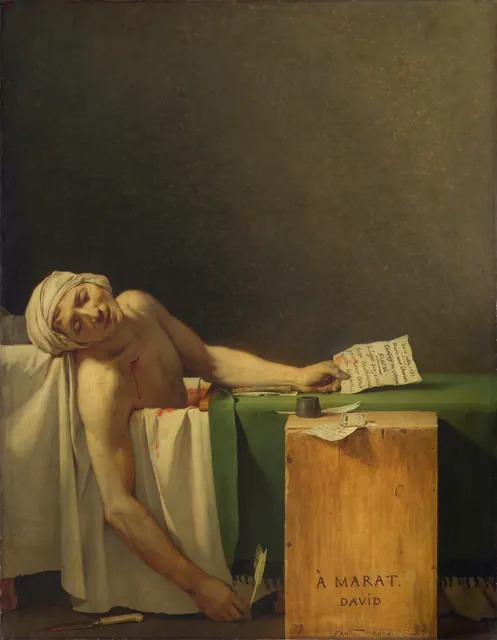
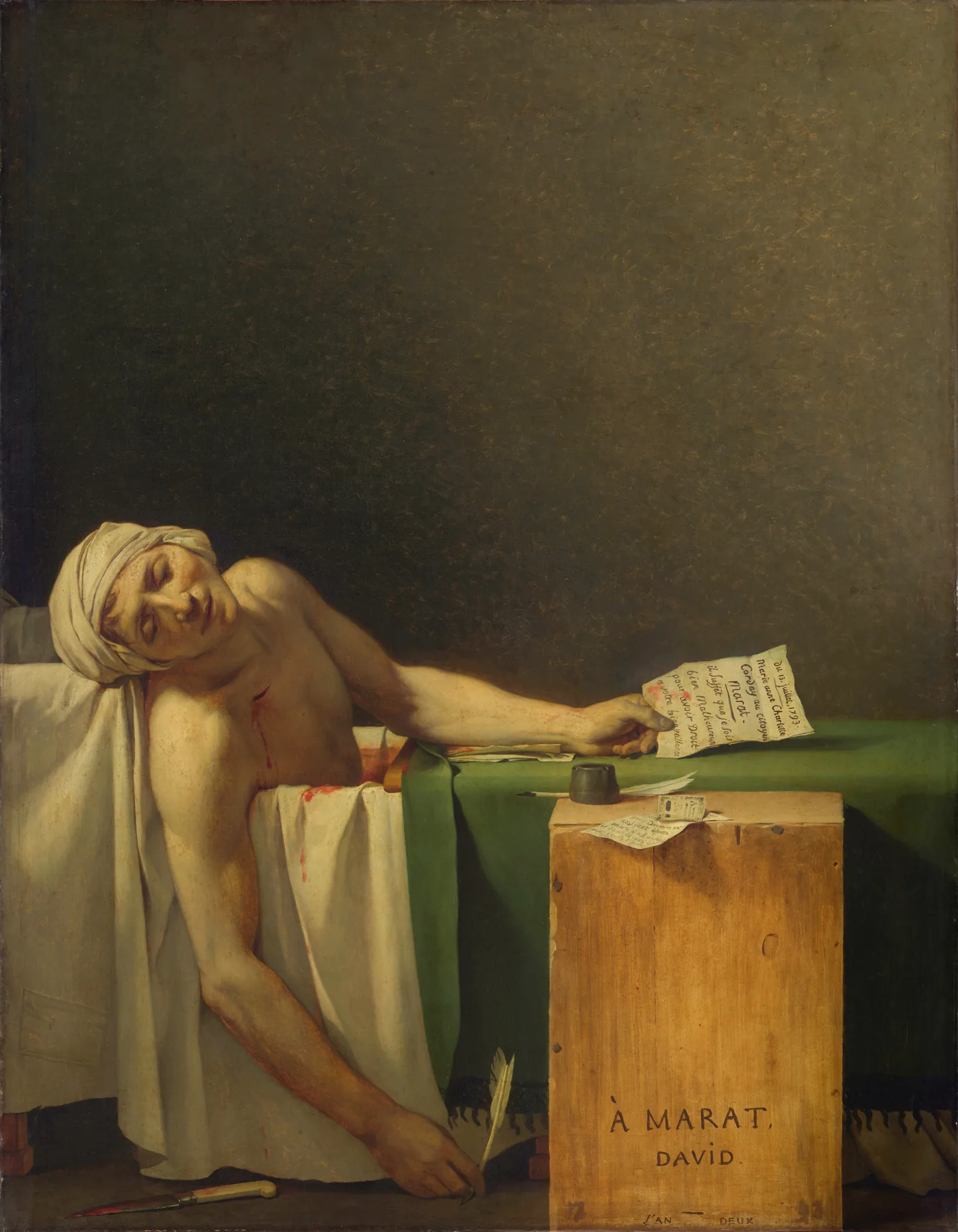
The Death of Marat is an oil painting completed in 1793 by Jacques‑Louis David. This fact anchors the work firmly within the tumultuous year when the French Revolution was reshaping the nation. As an oil medium, the canvas allowed David to achieve the depth and immediacy required for a portrait of a fallen revolutionary. The date of completion also places the painting among the most immediate visual responses to the political upheavals of the period, marking it as a contemporaneous document of revolutionary sacrifice. David’s direct engagement with events as they unfolded distinguishes the work from later historical reinterpretations.
The work was created in the early autumn of 1793, amid the wave of Revolutionary ardor that overthrew the French monarchy and founded the Republic. This temporal setting situates the canvas at a moment when the revolutionary fervor was translating political upheaval into visual culture. By painting during that specific season, David captured the immediacy of a nation in the throes of radical change, embedding the image within the very atmosphere that birthed it. The reference to the overthrow of the monarchy and the establishment of the Republic underscores the painting’s direct connection to the seismic transformations reshaping French society at that time.
David was commissioned to paint Marat to establish a canon of Revolutionary heroes. This commission indicates that the portrait was intended as part of an official effort to create a visual roster of figures embodying the new Republic’s ideals. By situating the work within a program of heroic commemoration, the painting served as a model of civic virtue, linking the artist’s skill directly to the revolutionary agenda. The explicit aim of establishing a canon underscores the political purpose behind the canvas, positioning Marat alongside other celebrated leaders and reinforcing the narrative of collective sacrifice that the revolutionary government sought to promote.
David completed only two major works during the Terror: the Death of Lepeletier de Saint‑Fargeau and The Death of Marat. This fact highlights the singular importance of the Marat canvas within the narrow window of artistic production under extreme political pressure. By limiting his output to these two monumental depictions of martyrdom, David focused his resources on portraying the most emblematic sacrifices of the revolutionary cause. The pairing of these works underscores a deliberate artistic strategy, where each painting functions as a visual testament to the radical upheaval and the personal costs endured by its leading figures.
Visual Details
In the composition, Marat collapses while still holding a quill and a list of suspects. This detail anchors the scene in a moment of unfinished work, showing the revolutionary leader engaged in investigative activity at the instant of his death. The presence of the writing implements emphasizes the intellectual and political labor that defined Marat’s public role. By depicting the fallen figure clutching these objects, the painting records the tangible tools of his activism, underscoring the abrupt interruption of his mission. The visual focus on the quill and the list invites viewers to contemplate the concrete responsibilities that were left incomplete.
David portrays Marat as an idealized figure, evoking Christian imagery, with a restrained composition that emphasizes simplicity, heroism, and stoic virtue. This approach presents the revolutionary martyr in a visual language traditionally associated with sacred subjects, inviting a comparison between political sacrifice and religious sanctity. The restraint in the arrangement avoids excessive dramatization, allowing the viewer to focus on the calm dignity of the central figure. By foregrounding simplicity and heroism, the painting underscores a moral clarity that aligns with the revolutionary narrative of virtuous self‑sacrifice. The stoic virtue conveyed through the composed posture reinforces the portrayal of Marat as a timeless exemplar of civic dedication.
The work relies on the framing constellation of accessory objects, interlocked within an austere rectilinear order. This compositional strategy arranges the quill, the list, and other surrounding elements into a tight geometric framework that guides the eye toward the central figure. The austerely rectilinear order creates a sense of visual discipline, ensuring that each accessory contributes to a balanced field without distracting from Marat’s presence. By interlocking these objects, the painting achieves a harmonious structure that reinforces the restrained mood established by the overall composition. The deliberate arrangement of these accessories underscores the artist’s intent to fuse form and content in a unified visual statement.
Interpretation and Reception
The painting has been called the “pietà of the Revolution,” a phrase that frames the image as a secular counterpart to a classic religious motif. By invoking the pietà, observers draw a parallel between the tender mourning traditionally reserved for the Virgin Mary and the revolutionary reverence afforded to Marat. This designation highlights the work’s capacity to evoke a sense of compassionate loss without relying on overtly religious iconography. The comparison underscores how the composition, through its restrained dignity and the portrayal of a fallen hero, can resonate with the emotional gravity associated with the historic pietà, thereby amplifying its impact as a visual memorial.
Thomas Crow argues that the painting functions as a “talisman of popular insurgency,” resurfacing in successive waves of political dissent. He suggests that Marat’s “spectral presence” has re‑emerged during key moments of democratic challenge. This interpretation positions the canvas as more than a historical portrait; it becomes a recurring emblem invoked when movements seek a visual anchor for collective resistance. By describing the work as a talisman, Crow emphasizes its perceived power to inspire and legitimize insurgent sentiment across different eras, while the notion of a spectral presence underscores the painting’s enduring resonance in moments of political upheaval.
The painting’s enduring power was revived during the countercultural tumult of the 1960s, and it has become a frequently reproduced image. Its resurgence in that decade indicates that the canvas resonated with a generation questioning authority, while its frequent reproduction demonstrates how the work has entered the visual lexicon. Recognized as one of the best known, most memorable, and widely reproduced paintings in the Western canon, the image continues to appear across diverse media, reinforcing its status as an iconic visual reference. This ongoing visibility testifies to the work’s capacity to remain relevant and recognizable far beyond its original revolutionary context.
Provenance and Aftermath
The painting is now in the collection of the Royal Museums of Fine Arts of Belgium. Its presence in a major European museum situates the once‑political French artifact within a broader institutional framework, where scholars and the public can encounter the image far from its original revolutionary setting. Being part of this collection ensures the work’s preservation and accessibility, allowing ongoing study and appreciation across generations. The museum setting also highlights the painting’s transition from a tool of revolutionary propaganda to an object of artistic heritage, reflecting its enduring significance within the global narrative of art history.
After the political climate shifted, David hid the painting and was later exiled to Brussels, where he died. This episode illustrates how the artwork’s survival depended on secrecy once the revolutionary fervor cooled. The concealment and subsequent exile underscore the precarious relationship between art and politics, showing that a work celebrated in one moment could become a liability in another. David’s forced departure and the painting’s hidden status reflect the turbulent aftermath of the Revolution, marking a poignant close to the canvas’s original revolutionary purpose.
The Death of Marat endures as a visual testament to its era, inviting each generation to confront the stark humanity at the heart of revolutionary history.