The story
Creation and Patronage
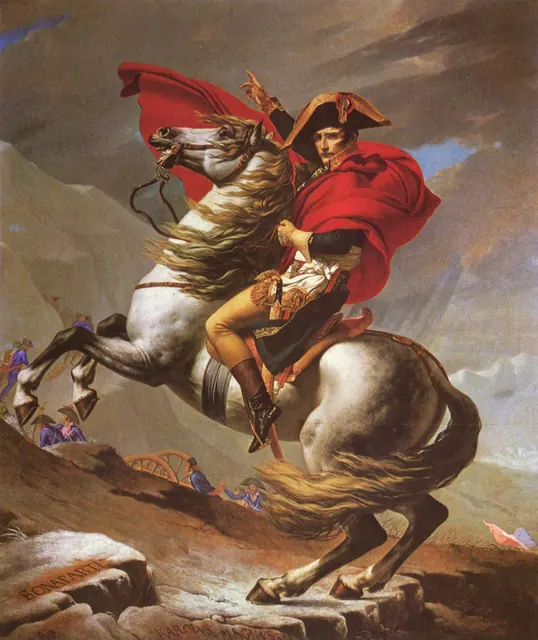
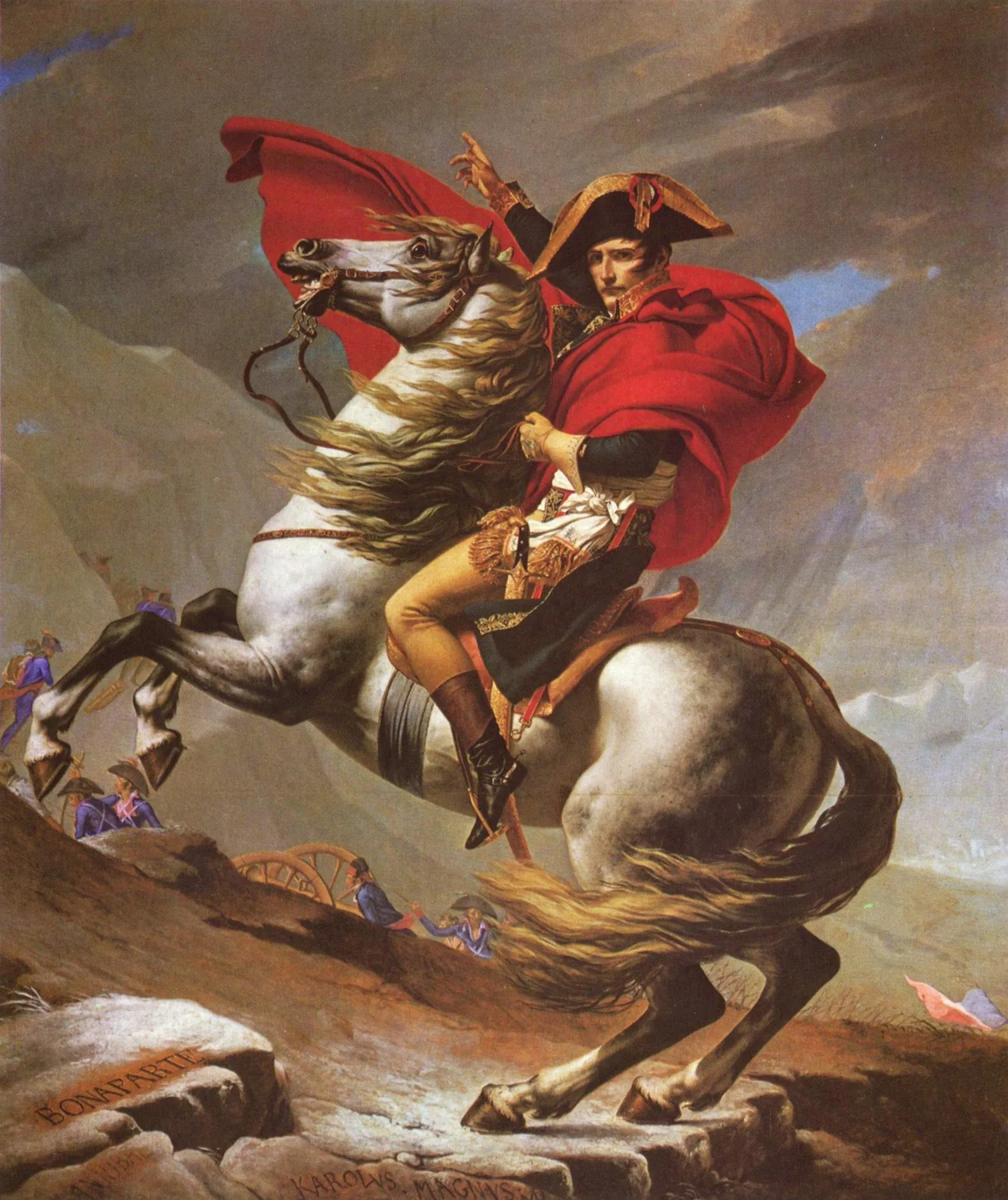
The canvas that would become one of the most recognizable images of the Napoleonic era was born at the turn of the nineteenth century. Between 1800 and 1801, Jacques‑Louis David set his brush to oil on a large canvas, producing a work he titled “Bonaparte Crossing the Alps at Grand‑Saint‑Bernard.” Today the painting hangs in the Musée national des Châteaux de Malmaison et Bois‑Préau at Reuil‑Malmaison, preserving both its original scale and the ambition of its creator.
The commission for this dramatic scene came from an unexpected patron: King Charles IV of Spain, who sought a visual testament to the rising French power. David, working within Napoleon’s circle, received direct guidance from the future emperor himself. Napoleon chose the moment to be immortalized and instructed the artist to portray him “calm, mounted on a fiery steed,” a directive that shaped the painting’s heroic tone from its inception.
In the finished work, Napoleon appears not as a distant ruler but as First Consul, poised at the forefront of his army as it surges toward Italy. The composition captures the decisive 1800 crossing of the Alps, a strategic move that opened the road to northern Italy for the French forces. By placing the young leader at the very heart of the mountain pass, David transforms a military maneuver into a moment of personal destiny, inviting viewers to see the consul as the engine of French ambition.
Visual Drama and Historical License
David’s brushwork turns the Alpine wind into a visible force. The horse’s mane whips forward in tangled strands, while Napoleon’s cloak billows as if caught in a howling gale. This dramatic rendering of fabric and hair does more than suggest weather; it amplifies the sense of motion, making the viewer feel the chill of high altitude and the relentless drive of the French advance. The swirling drapery and fierce mane become visual metaphors for the unstoppable energy that the painting seeks to convey.
The rearing horse dominates the lower half of the canvas, its muscular body thrust upward in a moment of controlled wildness. Its powerful stance balances the vertical thrust of the mountain cliffs, creating a dynamic tension that draws the eye toward Napoleon’s commanding figure. The animal’s forward motion, captured in a single, breath‑stopping instant, reinforces the narrative of a leader who commands both nature and his troops, turning the landscape itself into an extension of his will.
Carved into the craggy rock behind the rider are the names of two legendary conquerors: Hannibal and Charlemagne. Their inscriptions sit beside the space where Napoleon’s own name would be imagined, forming a silent trio of military genius. By embedding these historic figures directly into the terrain, David creates a visual lineage that links the French consul with the strategic brilliance of the Carthaginian commander and the imperial authority of the medieval emperor, suggesting that Napoleon’s triumphs belong to a timeless tradition of conquest.
Yet the painted drama departs from the factual record. Historical accounts note that Napoleon’s actual Alpine crossing was made on a modest mule, a practical choice for navigating the treacherous passes. David’s decision to replace the mule with a galloping horse was a conscious artistic liberty, intended to elevate the scene from a logistical journey to a mythic charge. This contrast between the humble reality and the heroic imagination underscores the painting’s purpose as a statement of power rather than a documentary snapshot.
Legacy, Copies, and Propaganda
The impact of David’s vision was immediate. Napoleon, impressed by the result, ordered a personal version of the work for his own collection. In response, David and his workshop produced four additional copies, spreading the iconic image across the empire. These reproductions ensured that the dramatic portrayal of the consul’s Alpine ascent reached a wide audience, reinforcing the narrative of a leader who could master both the elements and the fate of nations.
Beyond its visual splendor, the canvas quickly became an emblem of imperial majesty. Contemporary viewers recognized the painting as a proclamation of French authority, with Napoleon positioned as the embodiment of sovereign strength. The work’s grand scale, dramatic composition, and heroic subject coalesced to present an image of rulership that was both awe‑inspiring and politically potent, cementing its status as a symbol of the empire’s self‑image.
David’s portrayal does more than glorify a single man; it aligns Napoleon with the historic generals Hannibal and Charlemagne, weaving a narrative that links the French leader to a lineage of timeless conquest. This deliberate association functioned as propaganda, legitimizing Napoleon’s rule by presenting him as the heir to celebrated military brilliance. Scholars note that such portraits helped solidify the archetype of the successful general‑turned‑politician, a visual template that would endure in the public imagination long after the empire’s fall.
In the swirl of wind, the flash of a rearing horse, and the stone‑carved names of ancient conquerors, David’s canvas transforms a modest Alpine crossing into an enduring emblem of power, ambition, and the art of myth‑making.