The story
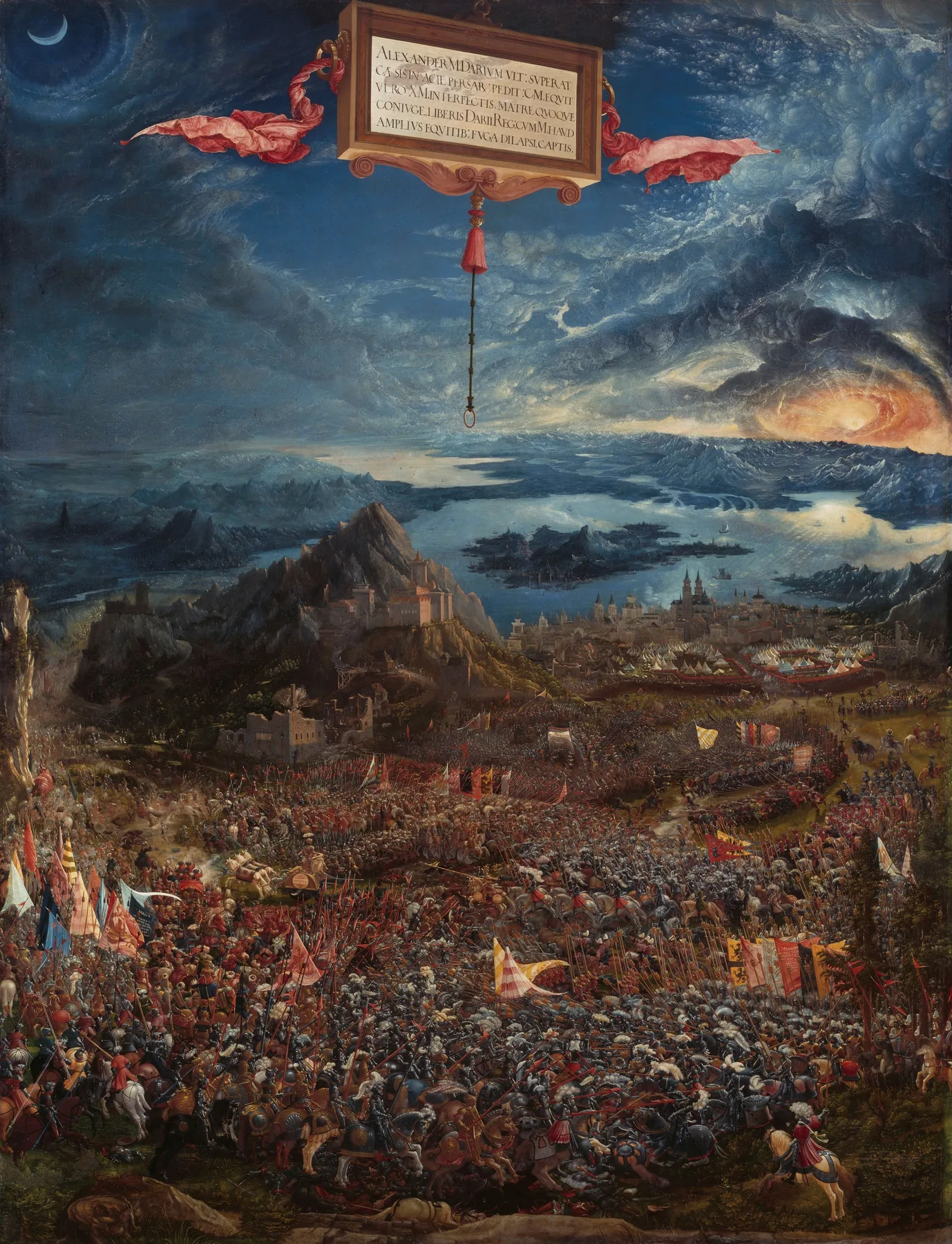
The Battle of Issus, painted by Albrecht Altdorfer in 1529, stands on a wooden panel rendered in oil, its surface spanning roughly 158 × 120 cm. It is held in Munich’s Alte Pinakothek, where its sheer scale dominates the wall. The broad expanse invites the eye to sweep across a sprawling battlefield, awash in earthy tones and luminous blues that hint at sky and sea. Altdorfer’s layered brushwork creates glimmers of light and deep shadows, giving the flat surface a palpable sense of depth.
A duke commissioned Altdorfer to depict the legendary encounter between Alexander the Great and the Persian king Darius III. The patron’s brief placed the artist at the heart of a grand historical narrative, tasking him to translate a moment from antiquity onto a sixteenth‑century panel. By accepting the commission, Altdorfer was given the freedom to arrange the clash according to his own artistic vision, while still honoring the patron’s desire to see this iconic battle brought to life. The resulting painting thus becomes a dialogue between patron and painter, anchored in a single, dramatic episode from the ancient world.
The early sixteenth century was a time of palpable tension on Europe’s eastern frontier. Ottoman forces were advancing, soon to lay siege to Vienna, and the Duke of Bavaria prepared to join the Christian defense. This geopolitical backdrop informs Altdorfer’s choice to revive a distant ancient battle, casting it as an allegory for contemporary resistance against the Turks. By linking Alexander’s triumph to the duke’s prospective role, the painting functions as a visual rallying cry, suggesting that the same decisive leadership that toppled Persia could be summoned to protect Europe. Understanding this context deepens the viewer’s appreciation of the work’s political urgency, even as the canvas remains rooted in a far‑removed historical moment.
One of the most striking compositional choices Altdorfer makes is the inclusion of celestial symbols: a pale moon ascends on the left, while a golden sun sets on the right. These opposing lights frame the battlefield, creating a sense of cosmic balance and suggesting that the clash transcends earthly concerns. The moon’s cool glow casts a subtle sheen over the Persian flank, whereas the sun’s warm rays illuminate Alexander’s side, subtly reinforcing the narrative of triumph. This duality of light not only enriches the visual drama but also hints at a timeless, almost mythic dimension to the historical event, as if the heavens themselves bear witness to the outcome of the struggle.
Altdorfer populates the scene with a dense army of individual soldiers, each rendered with distinct weapons—lances thrust forward, bows drawn, arrows arcing through the air. Notably, the armor they wear mirrors the contemporary military dress of Altdorfer’s own era rather than authentic Hellenistic gear. This anachronistic choice grounds the ancient clash in the visual language familiar to sixteenth‑century viewers, making the chaos of battle instantly recognizable. The varied helmets, breastplates, and gauntlets catch the light, while the spears and bows create a rhythmic pattern across the field. By focusing on the minutiae of each combatant, the artist conveys both the scale of the conflict and the human cost, inviting the audience to feel the immediacy of the melee.
In the heart of the composition, Darius’s chariot is captured in a moment of frantic retreat, wheels kicking up dust as it flees the onslaught. Behind it, Alexander rides a powerful horse, his lance aimed forward, embodying decisive leadership. The contrast between the fleeing Persian vehicle and the advancing Macedonian rider creates a dynamic axis that draws the eye across the canvas. This visual narrative not only identifies the two historical protagonists but also dramatizes the turning point of the battle, emphasizing Alexander’s dominance and Darius’s desperation in a single, sweeping gesture. The tension between motion and stillness, dust and dust‑raised air, adds a palpable sense of urgency to the scene.
To achieve a believable landscape, Altdorfer consulted contemporary maps, arranging rivers, mountains, and plains in a way that suggested geographic coherence. Yet, the resulting topography does not correspond to the actual terrain of the ancient Syrian battlefield. This deliberate inaccuracy reveals the artist’s priority: to craft a visually compelling stage rather than a precise cartographic record. By reshaping geography, Altdorfer could position key figures, celestial symbols, and armies in optimal visual relationships, reinforcing the painting’s narrative flow. The imagined hills and winding waterways guide the viewer’s eye, while the expansive sky opens the composition, underscoring the blend of observation and imagination that defines the work.
Beyond its aesthetic achievements, the painting was conceived as a flattering tribute to the duke and, more broadly, to the Western world. By portraying Alexander—a celebrated conqueror as the victorious hero, Altdorfer aligns the patron’s ambitions with those of the ancient Macedonian king. This interpretation suggests the work was meant to honor the duke and celebrate Western ideals, inviting viewers to consider how art can be used to elevate a patron’s status. The grand scale, the luminous lighting, and the heroic pose of Alexander all serve to underscore the flattering intent, turning the historic battle into a vehicle for contemporary praise rather than a mere record of past events.
Through Altdorfer’s masterful blend of history, imagination, and political nuance, The Battle of Alexander at Issus endures as a vivid window into the concerns of a sixteenth‑century Europe.
And so, standing before Altdorfer’s monumental canvas, we glimpse not only a clash of ancient empires, but also the hopes and anxieties of a world on the brink of its own historic battles.