The story
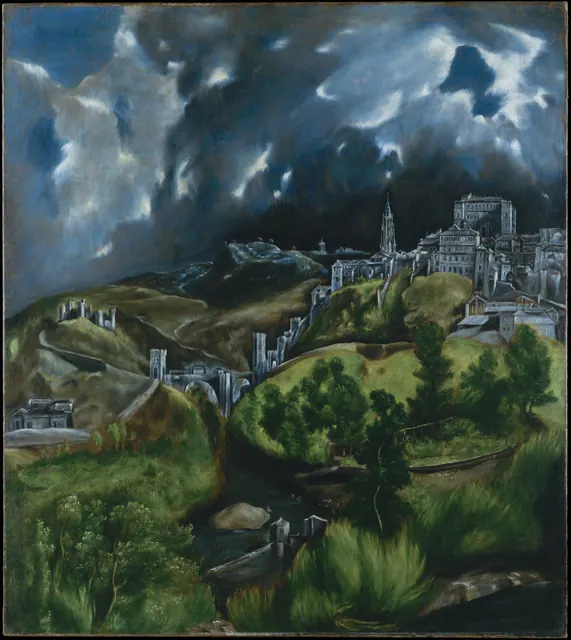
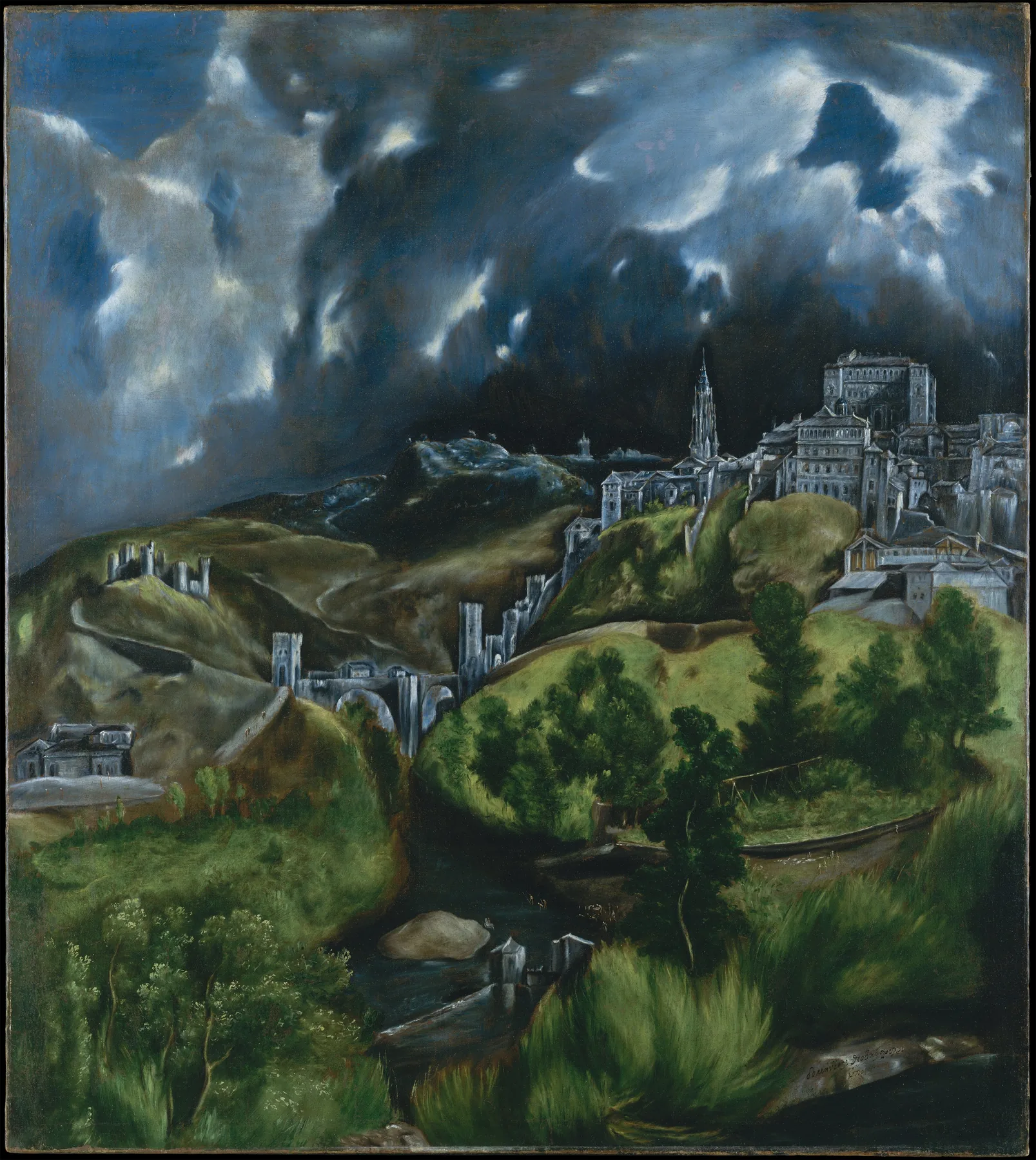
The canvas bears the title View of Toledo, a straightforward statement that places the Spanish city at the very heart of the picture. It was painted by the artist known as El Greco, whose birth name was Domenikos Theotokopoulos. By foregrounding the name of the place, the work invites us to look for the city’s character within the brushstrokes, while the signature of El Greco reminds us that this vision is filtered through his distinctive hand. These two facts anchor everything that follows – the title tells us what we are looking at, and the artist tells us how it is being seen.
Scholars agree that the picture was executed at the very end of the sixteenth century. Most place it around 1599 to 1600, while a smaller group prefers the slightly earlier window of 1598 to 1599. Those dates locate the canvas in the final phase of El Greco’s Spanish career, a period when his style had already reached the soaring, expressive language that defines his later masterpieces. Understanding the year helps us see the work as a culmination of decades of artistic experimentation, a moment when the painter felt confident enough to stretch the accepted limits of subject matter.
The picture is executed in oil on canvas, a medium that gave El Greco the ability to build luminous depth and a richly textured surface across sky and stone alike. Its size—about four feet tall and a little over three and a half feet wide—gives the work a physical presence that draws the viewer into its turbulent atmosphere. Oil on canvas was the dominant medium for Spanish painters of the era, offering flexibility and durability that explain why the painting has survived in such vivid condition. The generous scale also provides the artist room to orchestrate the complex interplay of architecture, landscape, and storm that defines the composition.
The canvas emerged in a Spain still feeling the reverberations of the Counter‑Reformation, a movement that followed the Council of Trent’s 1563 decree limiting the acceptability of pure landscape subjects. By choosing a cityscape that foregrounds religious architecture—a cathedral and the royal Alcázar—El Greco navigated the restrictive climate while still indulging his fascination with the natural world. In this way the painting becomes a subtle negotiation between doctrinal constraints and artistic ambition, showing how a devout society could still accommodate a work that pushes the boundaries of what was deemed appropriate for sacred art.
In the composition El Greco gives the cathedral and the royal palace greater prominence, allowing their towering forms to dominate the visual field and draw the eye upward toward the pointed Gothic spire. To the left, a solitary monastery appears to float on a cloud, its stone walls seemingly detached from the earth, reinforcing the otherworldly mood. Above, stormy skies swirl in dark blues, whites and greys, their turbulent brushstrokes darkening the buildings and turning the foliage an almost lurid green, a visual cue that the forces of nature—and perhaps divine wrath—are at work. Throughout, the forms twist and float, a hallmark of El Greco’s style that turns ordinary architecture into a dreamlike, almost spiritual tableau.
Art historians have often described the canvas as a “spiritual portrait” of Toledo, suggesting that the city itself is rendered as a living, devotional entity rather than a mere topographical record. In that reading, El Greco arguably produced what many consider the first Spanish landscape, breaking with the prevailing focus on religious narrative alone. Yet the artist does not aim for cartographic fidelity; he deliberately reshapes the locations of several landmarks, moving the monastery and re‑ordering the river’s course. This willingness to alter geography underscores his priority: to convey an inner, mystical vision of the city rather than a literal document of its streets.
The brooding palette—deep blues, muted greys and the occasional lurid green—creates a mood of solemn mysticism, as if a wrathful deity watches over the city from the storm‑laden heavens. The dark, moody colors amplify the sense that divine power dominates the urban scene, a reading reinforced by the swirling, almost supernatural forms that seem to float above the landscape. These visual strategies align with El Greco’s broader spiritual concerns, turning the canvas into a meditation on the relationship between humanity, nature and the divine. The painting thus invites viewers to feel the weight of an unseen, powerful presence rather than simply observe a cityscape.
Modern scholars have noted that El Greco’s tempestuous sky anticipates the swirling vigor later celebrated by Vincent van Gogh in his iconic Starry Night. Though separated by three centuries, both works share a kinetic brushwork that transforms night into a living, breathing entity. This comparison highlights how View of Toledo was ahead of its era, daring to infuse landscape with emotional turbulence that would not become common until the advent of Expressionism. Recognizing this lineage helps us appreciate the painting not only as a product of its time but also as a prophetic glimpse into future artistic possibilities.
The canvas entered the Metropolitan Museum of Art’s collection in 1929, thanks to the generous bequest of the H. O. Havemeyer Collection. The work, object number 29.100.6, arrived through that same Havemeyer bequest, placing El Greco’s dramatic vision of Toledo among the museum’s European masterpieces. This acquisition allowed a broad audience to encounter a work that had long been celebrated in scholarly circles, and its presence in the Met underscores the painting’s enduring relevance, offering visitors a rare opportunity to stand before a piece that bridges religious devotion, innovative landscape and expressive brushwork.
Taken together, the painting’s bold composition, its defiance of Counter‑Reformation conventions, and its visionary handling of light and atmosphere reveal a master at the height of his powers. El Greco transforms Toledo from a geographic location into a living, breathing symbol of divine mystery, using storm and architecture to convey a world where the sacred and the earthly intertwine. As viewers stand before the swirling clouds and floating forms, they are invited to sense the same awe that moved the artist centuries ago—a reminder that great art can both reflect its time and transcend it, speaking across the ages with a voice as unmistakable as the city’s towering spire.
When the storm finally clears, the silhouette of Toledo remains, a timeless echo of El Greco’s visionary hand.
Thank you for joining us on this journey through El Greco’s View of Toledo.