The story
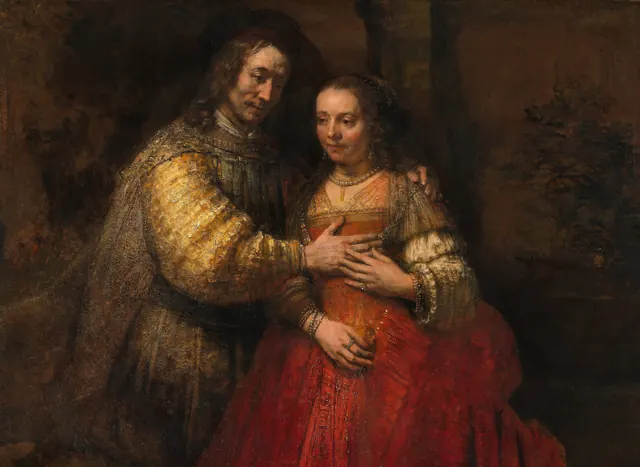
Rembrandt’s canvas known today as “The Jewish Bride” carries a name that was not attached in his own time. The Dutch title “Isaak en Rebekka, bekend als ‘Het Joodse bruidje’” translates to “Isaac and Rebecca, Known as ‘The Jewish Bride’”, a label that only emerged in the nineteenth century, long after the artist’s death. Yet the painting’s allure has always rested on Rembrandt van Rijn’s hand, the master of Dutch Baroque. By foregrounding this later nickname, we are invited to consider how later viewers, rather than the painter himself, have shaped the work’s enduring mystery.
The work is executed in oil on canvas, a medium Rembrandt refined throughout his career to capture the subtle play of light on flesh and fabric. Today it resides in the Rijksmuseum in Amsterdam, where it hangs among the museum’s most treasured Dutch Golden Age holdings. Knowing the material and its present home helps us appreciate the painting’s physical presence: a substantial, richly layered surface that has survived centuries of handling, and a location that makes it accessible to countless visitors who can stand before its intimate drama.
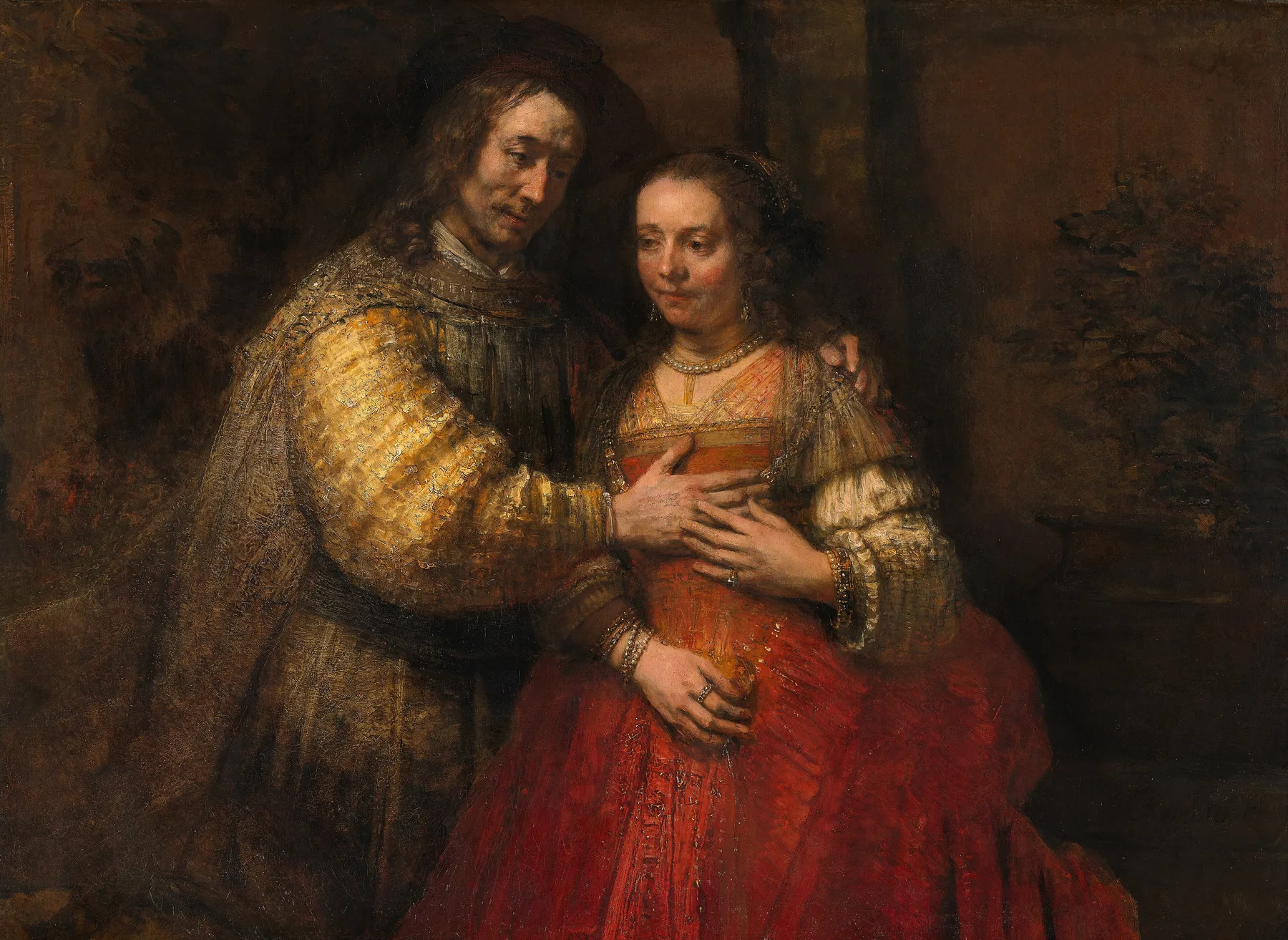
A first glance reveals Rembrandt’s masterful manipulation of paint itself. In some passages the surface is thick with impasto, the brushstroke visible as a sculptural ridge, while elsewhere the application is thin, allowing the canvas to glow through. Heavy slashes of pigment give the woman’s red dress its dramatic folds, and delicate highlights catch on the pearls and the gold of her bodice. The man’s right sleeve, rendered with tiny square strokes, shimmers like a field of tiny tiles, creating a luminous golden texture that contrasts with the darker tones of his coat. These tactile differences invite the eye to wander across the canvas, feeling the painting as much as seeing it.
The composition presents a woman in a luxurious red dress, her neck encircled by a single strand of pearls that catch the light, and a gold‑trimmed bodice that glints against the dark background. A man with a voluminous right sleeve rendered in shimmering golden squares reaches toward her, his right hand placed gently on her breast. Neither figure looks at the viewer or at each other; they exist in a private moment suspended in shadow, a tableau that emphasizes texture and gesture over narrative clarity.
Scholars have long debated who the sitters might be. The most widely accepted identification pairs the figures with the Biblical couple Isaac and Rebecca, a reading that aligns with the painting’s title in Dutch. Yet alternative attributions have surfaced over the centuries, suggesting the portrait could depict Rembrandt’s own son Titus and his wife, or even a father‑daughter pairing. These competing theories reflect the painting’s ambiguous narrative, where the lack of explicit symbols leaves room for multiple personal and biblical readings, each adding a layer to the work’s enigmatic appeal.
Beyond the question of identity, the canvas functions as a portrait historié—a tradition in which real individuals are presented in the guise of biblical or mythological figures to convey moral virtues. By casting the sitters as Isaac and Rebecca, the painting could be read as an embodiment of fidelity and piety, virtues prized in seventeenth‑century Dutch society. This interpretive layer helps us understand why Rembrandt might have chosen such a timeless, allegorical setting, allowing the personal intimacy of the couple to resonate with broader cultural ideals.
Art historian Nan T. Atwood argues that Rembrandt deliberately left the woman’s identity ambiguous, inviting viewers to associate her with several biblical heroines—Rebecca, Ruth, and Esther—each representing different facets of virtue and destiny. This intentional vagueness means the painting operates on multiple narrative levels, allowing each observer to project their own cultural or theological associations onto the figure. The ambiguity is reinforced by the lack of direct eye contact, a compositional choice that keeps the viewer at a respectful distance, further encouraging contemplation rather than narrative certainty.
The painting’s magnetic pull even reached Vincent van Gogh, who confessed that he would surrender ten years of his life to sit before it for two weeks, subsisting on a stale crust of bread. Van Gogh’s hyperbolic admiration underscores the work’s capacity to inspire profound devotion among artists, highlighting how Rembrandt’s handling of light, texture, and emotional restraint can captivate a viewer to the point of yearning for prolonged communion with the canvas.
Most scholars agree that the scene draws from an Old Testament theme, reinforcing the portrait historié reading. Jonathan Bikker adds a nuanced observation: by omitting the figure of Abimelech, the painting casts the viewer in the role of the spying king, subtly implicating us in the narrative tension. This deliberate exclusion creates a silent dialogue between the painted couple and the onlooker, turning the act of viewing into an act of participation in the biblical story.
Through its layered textures, ambiguous identities, and quiet drama, Rembrandt’s “Jewish Bride” continues to invite each generation to look closer, to question what is shown and what is left unseen. The painting stands as a testament to the artist’s ability to blend technical mastery with narrative openness, ensuring that the canvas remains a living conversation between past and present, light and shadow, viewer and painted couple.
Take a moment to linger on the couple’s silent exchange, and let the mystery linger with you.
And so the silent dialogue between brush and viewer continues, inviting each of us to linger a little longer.