The story
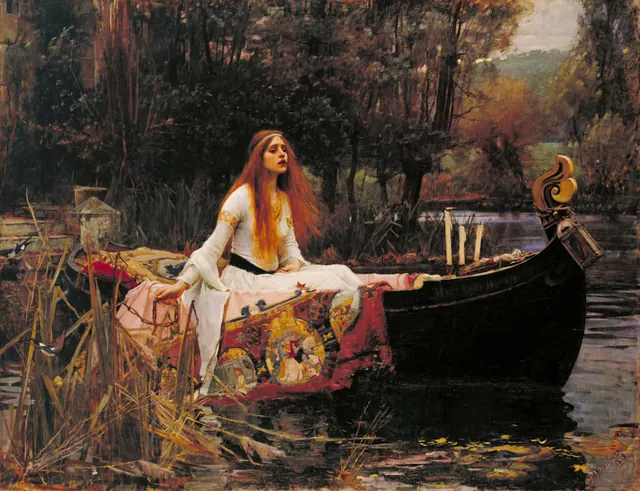
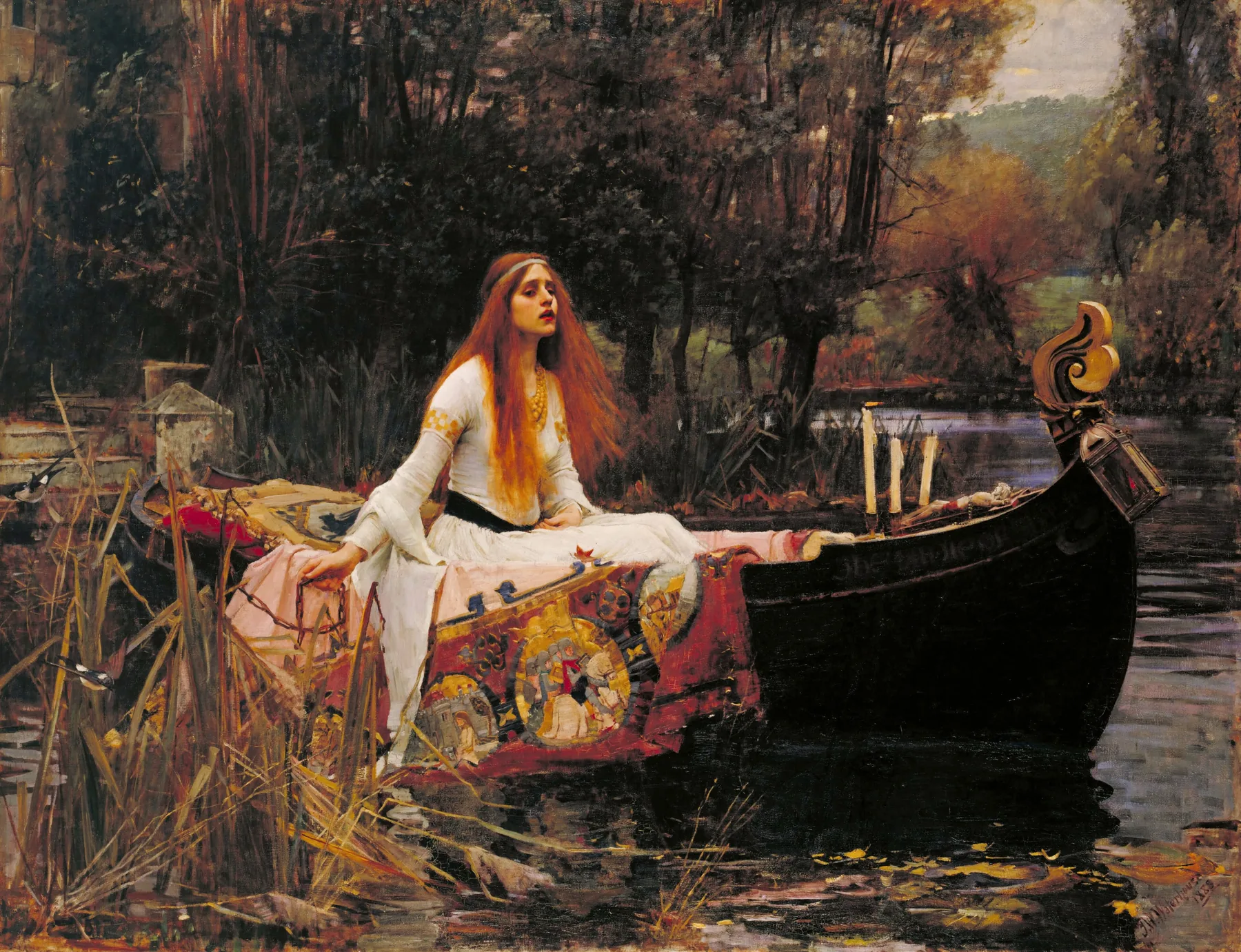
In 1888 John William Waterhouse turned Alfred, Lord Tennyson’s haunting poem into a canvas that would become one of three paintings he produced on the subject. The work bears the simple title “The Lady of Shalott,” and its creation date and authorship are firmly recorded. By choosing this moment from the poem, Waterhouse joined a Victorian tradition of visualizing tragic love, yet he isolates a single, intimate scene rather than a sweeping narrative, inviting us to linger on the quiet drama that unfolds on the water’s surface.
At the heart of the painting sits a young woman alone in a modest boat, her figure the sole focus of the scene. She wears a long white dress that falls in soft folds, cinched at the waist by a low‑slung black belt that grounds the light fabric. A light green band rests on her head, echoing the muted foliage beyond. Her long hair drifts gently in a faint breeze, while her lips are painted a vivid red and slightly part, revealing a breath of sorrow. The expression on her face is unmistakably sad, capturing the tension between duty and yearning that the poem so often describes.
In her right hand the lady loosely grasps the heavy chains that tether the boat to the shore. The metal links catch a faint glint of light, and the relaxed grip suggests a resignation rather than a struggle. By placing the chains within her easy reach, Waterhouse visualises the paradox of her situation: bound by a curse yet holding the means to release herself, a visual echo of the poem’s conflict between fate and choice.
The prow of the boat is fashioned like a tiny altar, complete with a crucifix and three candles. Two of the candles appear extinguished, a detail that some viewers read as a foreshadowing of the lady’s impending end. The remaining candle flickers softly, casting a delicate glow on the water. The crucifix, positioned beside the candles, adds a quiet religious resonance, hinting at themes of sacrifice without asserting a single definitive meaning.
A richly woven tapestry hangs across the side of the boat, its heavy fabric trailing into the water and pulling at the edges as if caught by a gentle current. The draped cloth introduces texture that contrasts with the smooth surface of the river, reinforcing the sense of burden that the lady carries both physically and metaphorically.
At the water’s edge, slender reeds sway beside a carpet of amber‑toned autumn leaves, grounding the scene in a specific season of transition. These foreground elements are rendered with crisp detail, inviting the eye to linger on the natural world that frames the lady’s solitary journey.
Waterhouse creates a striking visual contrast: the foreground, including the lady and the reeds, is rendered in sharp focus, while the background recedes into a shady, indistinct thicket of autumn trees painted with a brushy technique. This shift from clarity to softness draws the viewer’s attention to the central figure and emphasizes her emotional isolation against a dreamlike, less defined world.
The palette is rich and lush, saturated with deep greens, warm earth tones, and the luminous white of the lady’s dress. Golden natural light spills across the scene, illuminating her skin and the red of her lips while casting gentle shadows that model her form. This radiant lighting not only enhances the painting’s visual appeal but also heightens the sense of a fleeting, almost sacred moment captured in time.
Two low‑flying swallows dart across the sky above the water, their swift silhouettes adding a dynamic element to the otherwise still composition. While the birds are clearly present, some observers interpret their flight as an ominous sign, a subtle cue that something unsettling may be unfolding in the narrative.
A single red poppy is reflected in the mirror‑like surface of the water, its vivid hue standing out against the muted palette. Scholars have suggested that the poppy may symbolize eternal sleep and foreshadow the lady’s impending doom, though the painting itself leaves the meaning open to interpretation, allowing viewers to contemplate its possible resonance with the poem’s tragic conclusion.
Interpretations of the lady’s role vary. In the context of nineteenth‑century Britain, some see her as a figure of agency, choosing to defy her confinement in pursuit of personal desire. Others read her as embodying the Victorian archetype of the doomed woman who sacrifices everything for love. Both readings coexist, reflecting the painting’s capacity to evoke questions about freedom, sacrifice, and the cultural expectations placed upon women of the era.
Through meticulous detail and a palette that glows with quiet intensity, Waterhouse’s 1888 “Lady of Shalott” invites us to linger on a single, haunting instant—where poetry, visual art, and the mysteries of choice converge on the still surface of a river.