The story
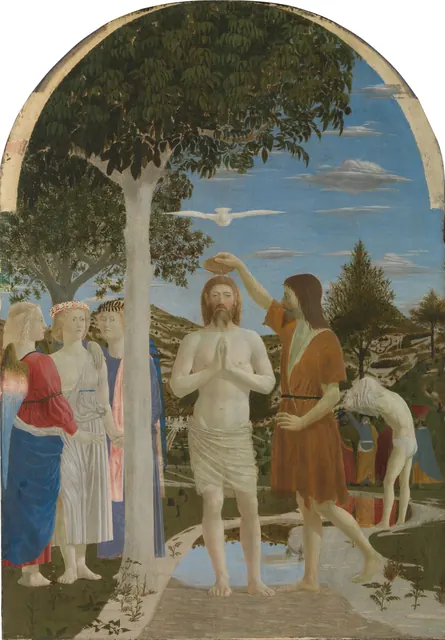
The work before us bears the simple, reverent title “The Baptism of Christ”. Though the name tells us only the subject, it also anchors the painting within a long tradition of devotional imagery. Scholars agree that the hand behind this serene scene belongs to the Italian Renaissance master Piero della Francesca, whose reputation for mathematical precision and calm composition has endured for centuries. Recognizing both the title and the artist allows us to place the panel within the broader currents of fifteenth‑century art, where faith and intellect often walked hand in hand.
Dating this panel has long invited debate. While some sources place the work in the 1450s, other scholars have suggested an earlier date, though the exact year remains uncertain.
The Baptism of Christ was not intended for a private wall but for a sacred space. Historical documents tell us it served as the central altarpiece in the chapel of Saint John the Baptist at the Camaldolese Abbey on the outskirts of San Sepolcro, a site that also fed the nearby church of San Giovanni Battista in Val d’Afra. Knowing the work’s original liturgical function explains its grand scale and its emphasis on a communal act of purification, inviting the faithful who gathered before it to contemplate the very moment Christ entered the waters of baptism.
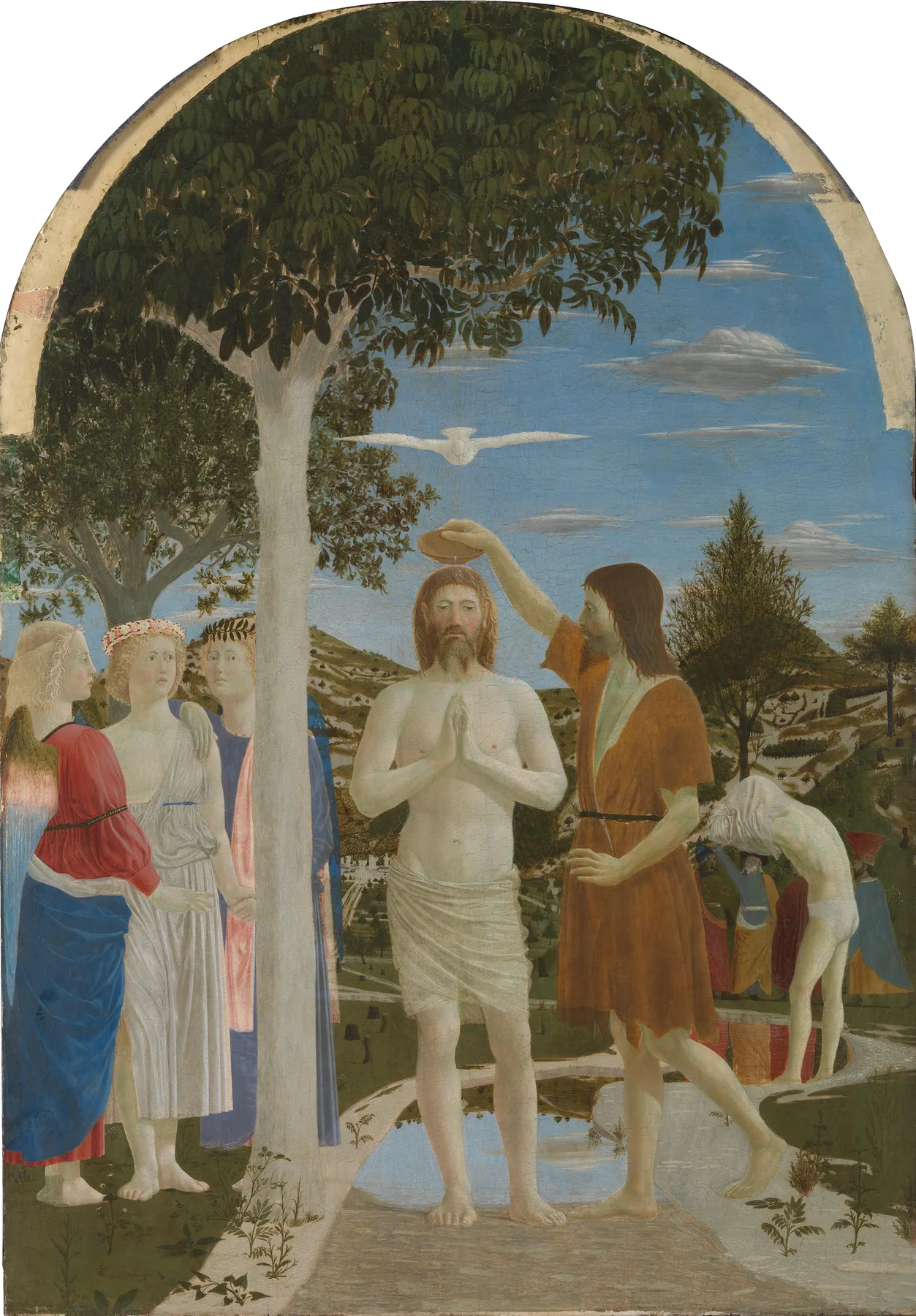
In the foreground, Christ stands waist‑deep in a shallow, winding stream, his pale skin glowing with the subtle luminosity that Piero achieved through layered tempera. He is barefoot on the exposed riverbed, while to his left John the Baptist, dressed in a brown robe, lifts a shallow bowl and lets water cascade over Christ’s head, the droplets tracing his hair and forehead. Three angels hover nearby, bearing silent witness to the sacrament. The scene unfolds against the warm Italian landscape that frames the ritual, grounding the holy moment in a tangible, earthly setting.
The lower register of the painting grounds the holy scene in a tangible world. The figures stand barefoot on an exposed riverbed, their feet touching the cool stones that glisten beneath the clear water. Beyond them, a warm Italian landscape spreads out under a pale blue sky, thin horizontal clouds drifting lazily across the horizon. A tall walnut tree rises on the left, its trunk cut off by the panel’s curved top, its foliage framing the composition and reinforcing the sense of depth that leads the eye toward distant, white‑washed buildings nestled among rolling hills.
Piero chose egg tempera applied to a poplar wood panel, a medium prized in the quattrocento for its luminous quality and fine detail. Tempera, made by mixing pigment with egg yolk, dries quickly, forcing the artist to work with small, precise strokes. The poplar support provides a smooth, stable surface that responds to the medium’s translucency, allowing layers of color to build up subtly. This technical choice contributes to the painting’s overall clarity, where each hue glows from within rather than sitting on the surface, a hallmark of Piero’s meticulous craftsmanship.
The surface of the Baptism reveals Piero’s masterful handling of tempera’s translucency. Beneath the delicate flesh tones of Christ lies an under‑layer of green, a strategic choice that gives his skin a faint, almost otherworldly glow. Layered brush strokes, visible upon close inspection, create a sense of depth as light passes through successive glazes. This method not only models the figure’s volume but also unifies the composition, as the same luminous principle extends to the surrounding landscape, where the sky and water share that soft, inner light.
Piero’s reputation as the first artist to write a treatise on perspective finds concrete expression in this altarpiece. The receding hills in the background converge toward a single vanishing point, a mathematical device that draws the viewer’s gaze into the depth of the scene. By aligning the horizon line with the central figures, Piero creates a harmonious spatial order that mirrors the theological order of the baptism itself. This precise use of linear perspective underscores his belief that geometry could serve both artistic beauty and spiritual truth.
Beyond its devotional narrative, the Baptism of Christ stands as a study in strict geometry. The composition is organized around a central vertical axis, producing bilateral symmetry that balances the figures on either side of Christ. Horizontal lines—such as the river’s edge, the horizon, and the ledges of the surrounding landscape—slice the picture into harmonious bands, while vertical elements like the walnut tree and the standing angels reinforce the sense of order. This rigorous structuring reflects Piero’s fascination with mathematical perfection, turning the act of baptism into a visual embodiment of balance and proportion.
Standing before this panel, we are invited to linger on the quiet intensity of a single sacramental moment, rendered with a clarity that still feels immediate after five centuries. The interplay of light, geometry, and devotion reminds us that art can be both a precise calculation and a profound meditation. As you return your gaze to the gentle flow of water and the serene faces, consider how Piero’s measured hand captures a timeless act of faith, inviting each viewer to experience the baptism anew.
May the stillness of Piero’s brush linger with you as you contemplate this timeless baptism.