The story
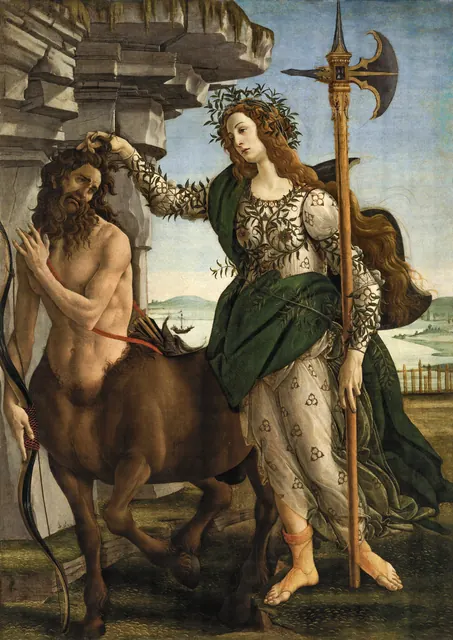
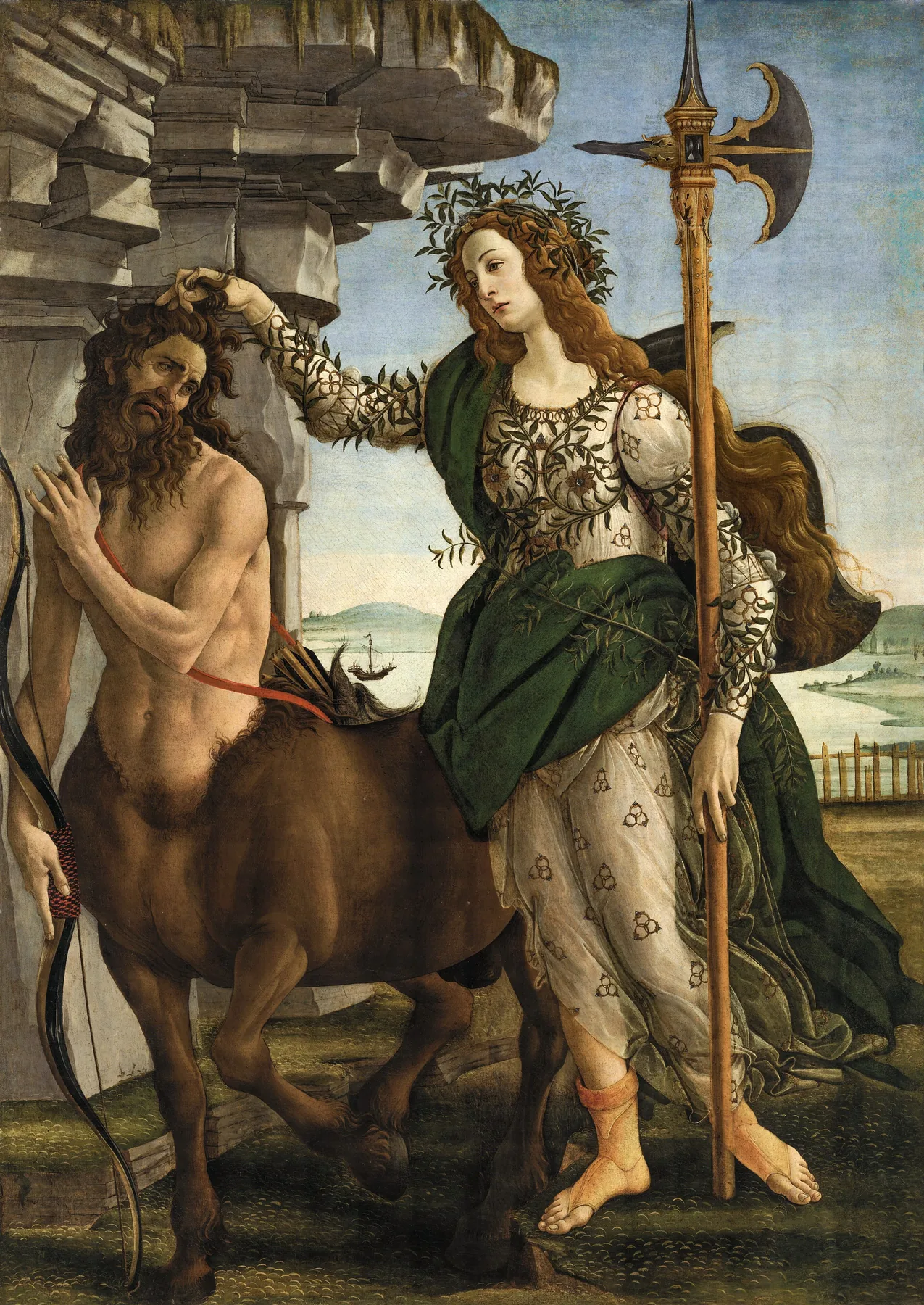
The canvas, titled Pallas and the Centaur, is thought to date from about 1480‑1485 and is not another rendition of the subject. At its centre a young woman with long reddish‑brown hair, crowned by a wreath of green leaves, grasps a halberd and pulls the hair of the centaur. She wears a white dress embroidered with the Medici triple‑ring motif beneath a deep green mantle, linking the work to Lorenzo di Pierfrancesco, cousin of Lorenzo the Magnificent. Scholars suggest the painting may have been commissioned for Lorenzo’s 1482 marriage, portraying either Pallas Athena or the warrior virgin Camilla. The surrounding plant shoots hint at olive or myrtle, while the centaur symbolizes untamed instincts restrained by virtue, echoing Botticelli’s Neoplatonic interests.
In the foreground the heroine’s hand clasps the shaft of a tall polearm whose dark metal blade is trimmed in gold and capped by a pointed spike. The wooden shaft, light brown and studded with decorative fittings, bears a striking dragon‑head motif where the blade meets the handle, giving the weapon a ceremonial elegance. Her green mantle flows behind her, while the white dress beneath is embroidered with delicate floral vines and the Medici triple‑ring symbols that echo her aristocratic ties. This combination of martial hardware and refined attire underscores the painting’s blend of heroic vigor and courtly grace.
The painting’s provenance ties it directly to the Medici circle. Records indicate it belonged to Lorenzo di Pierfrancesco, a cousin of the famed Lorenzo de’ Medici, known as Lorenzo the Magnificent. This connection not only situates the work within the inner sanctum of Florentine patronage but also explains the presence of the Medici triple‑ring emblem on the heroine’s dress. By aligning the artwork with a specific branch of the family, the painting becomes a visual testament to the political and cultural aspirations of Lorenzo di Pierfrancesco, reinforcing his status through allegorical imagery.
One plausible scenario for the work’s creation emerges from the timing of Lorenzo di Pierfrancesco’s marriage to Semiramide Appiani in 1482. Scholars suggest the painting may have been commissioned to celebrate that union, offering a symbolic narrative of virtue taming untamed passion—an apt message for newlyweds. The presence of a noble figure restraining a wild centaur could reflect the hoped‑for harmony between the bride and groom, while the inclusion of Medici symbols underscores the family’s role in orchestrating the alliance. Though not definitively proven, this interpretation weaves together personal, political, and artistic threads into a cohesive context.
Interpretations of the female protagonist diverge between two classical heroines. Some experts argue she embodies Pallas Athena, the goddess of wisdom and strategic warfare, whose presence would justify the martial polearm and the olive‑branch symbolism. Others see her as Camilla, the fierce virgin warrior of Roman legend, associated with myrtle and known for her martial prowess. Both figures share attributes of courage and virtue, making the ambiguity intentional. By allowing the viewer to oscillate between divine wisdom and heroic virginity, Botticelli enriches the painting’s allegorical depth, inviting contemplation of the qualities that restrain raw, animalistic desire.
The centaur, half man and half horse, stands as a potent emblem of humanity’s untamed instincts. Its muscular, bare‑chested torso and powerful horse body convey raw, passionate energy, while the act of being pulled by the determined heroine suggests the necessity of virtue to govern such impulses. Contemporary inventories and literary sources describe the creature as representing the feral side of human nature, a reminder that unchecked temperament can lead to chaos. In this visual allegory, the centaur’s subdued posture under the woman’s grip illustrates the triumph of reason and moral restraint over base desire.
Around the woman’s face, delicate plant shoots unfurl, offering a subtle botanical clue to her identity. If the figure is Pallas Athena, the shoots may be interpreted as an olive branch, a traditional symbol of peace and the goddess’s patronage. Conversely, should she represent Camilla, the foliage could be myrtle, a plant linked to her mythic narrative. These botanical hints, though modest, deepen the painting’s symbolic layers, allowing Botticelli to embed multiple readings within a single visual element. The choice of greenery thus serves as a visual shorthand for the virtues each heroine embodies.
Beyond its immediate mythological references, the painting reflects Botticelli’s engagement with Neoplatonic philosophy, a current that sought to reconcile pagan ideals with Christian thought. By portraying a classical heroine exercising moral control over a bestial figure, the work illustrates the Neoplatonic ideal of the soul’s ascent from earthly passions toward higher, intellectual virtues. The integration of Medici symbolism, mythic narrative, and allegorical restraint underscores the intellectual climate of Botticelli’s Florence, where scholars and patrons prized the synthesis of ancient wisdom and contemporary faith. In this light, the canvas becomes a visual essay on the pursuit of spiritual refinement.
Thus, Botticelli’s Pallas and the Centaur endures as a timeless meditation on virtue over passion.
Thank you for joining us on this journey through Botticelli’s layered allegory.