The story
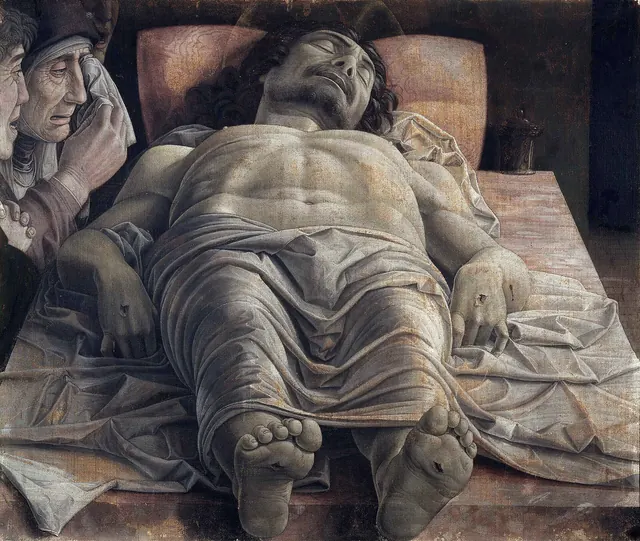
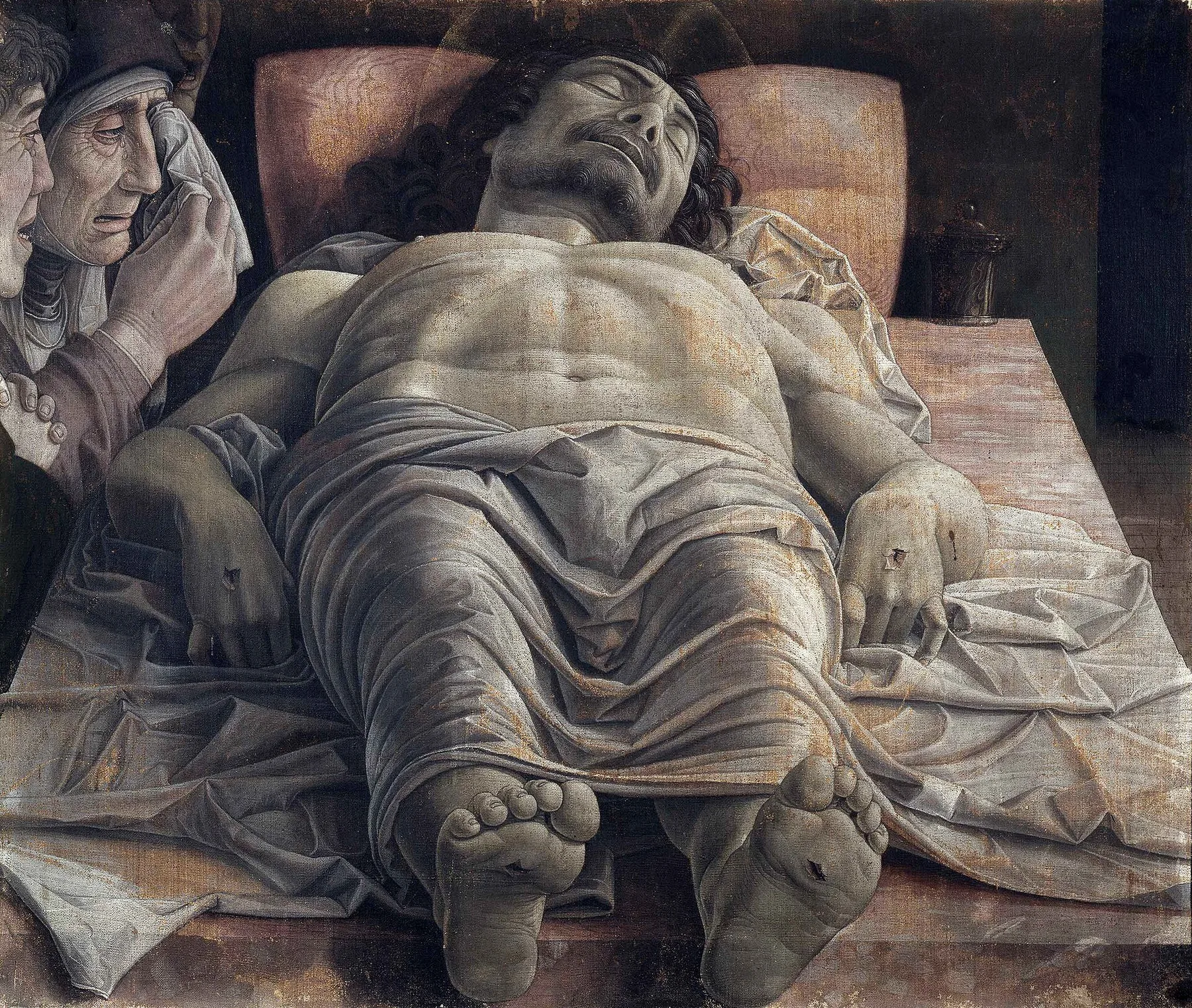
Andrea Mantegna’s small but powerful canvas bears two titles in the museum’s records. Officially it is catalogued as “Christ Dead in the Tomb with Three Mourners,” while scholars and visitors more often refer to it simply as “Lamentation over the Dead Christ.” Created by the Italian master Andrea Mantegna around the year 1483, the work belongs to the later phase of his career, when his skill in rendering anatomy and sculptural form had reached a mature height. Though modest in size, the painting commands attention through its stark intimacy, inviting us to contemplate a moment of profound sorrow captured by a hand that has endured centuries.
Executed in tempera on canvas, the painting’s surface retains the crisp edges and matte finish characteristic of the medium, allowing Mantegna to build delicate layers of colour that model flesh with a sculptural precision. The compositional choice places the viewer directly at Christ’s feet, a viewpoint that eliminates any surrounding architecture and compresses the visual field to the slab and the figures clustered around it. This close‑up perspective, rare for its time, forces an immediate encounter with the body, making the viewer a silent participant in the mourners’ vigil. The combination of tempera’s fine detail and the intimate viewpoint creates a visual experience that feels both immediate and timeless.
At the centre of the scene rests a light‑coloured slab, its flat top extending across the lower right of the canvas, its edge subtly visible as it disappears into shadow. Upon it lies a dark‑lidded cylindrical vessel, its rounded lid catching a faint glint, anchoring the composition with a quiet, almost ritualistic presence. Drapery in shades of grey and white cascades over Christ’s lower body, forming deep vertical folds that conceal his legs while revealing the delicate curvature of his thighs. The drapery’s texture, rendered in tempera’s fine strokes, catches the dim light, creating a gentle contrast against the nearly black background that swallows the scene beyond the slab. This restrained setting focuses all attention on the human forms and their gestures.
Seen from the very foot of the slab, Mantegna places us almost on the surface itself, eliminating any surrounding architecture. The viewpoint puts the viewer at Christ’s feet, with almost no space around the slab. The dead Christ dominates the picture, his pale body stretched along the canvas’s vertical axis, head near the top edge and soles near the bottom. His feet are presented with the soles toward us; both the left and the right foot bear a dark wound on their soles. Both hands lie on the grey‑white drapery that covers his lower body, the left fingers gently curled and the right spread, each palm marked by the same wound, emphasizing the physical reality of the crucifixion. The incisive lines draw the eye to these details, while a slight anatomical distortion makes the close‑up perspective believable. To Christ’s right, an older woman in profile weeps, clutching a crumpled white cloth to her face. Beside her stands a younger mourner, also in profile, his mouth slightly open; he does not rest his hand on the drapery.
The intimate scale of the canvas—just under a metre in height—suggests that Mantegna intended the work for private devotion rather than a public altar. Scholars propose a connection to the arrival of the relic of the Stone of Unction in Mantua, a sacred object believed to have miraculous properties. In such a context, the painting would have served as a focal point for personal meditation, allowing the viewer to contemplate the physical suffering of Christ in a setting stripped of grand architectural cues. The modest dimensions, combined with the intense close‑up composition, create a space where the faithful could engage directly with the sorrowful scene, turning a private moment of prayer into a visual embodiment of the relic’s spiritual significance.
The painting’s early history remained hidden until September 1506, when Mantegna’s son Ludovico uncovered the canvas in his father’s workshop. This discovery offers a rare glimpse into the life of a Renaissance studio, where even a master’s most personal works could lie stored, unseen for years after their creation. The fact that the work was still in the workshop at that time reinforces its authenticity as a direct product of Andrea’s hand, untouched by later hands or alterations. Ludovico’s finding also marks the earliest documented point in the painting’s provenance, anchoring its journey from a private devotional object to the masterpiece we now study.
While the factual record remains silent on the artist’s personal motives, one art historian has suggested that Mantegna may have painted this scene in response to the tragic loss of two of his own sons. This interpretation, though not universally accepted, invites us to consider how the intense focus on Christ’s wounds and the palpable grief of the mourners might echo a father’s private mourning. By framing the work as a possible personal memorial, the hypothesis adds a layer of emotional resonance to the already intimate devotional purpose, reminding us that Renaissance artists, like all humans, could channel personal sorrow into universal expressions of loss.
Mantegna’s daring close‑up of the dead body did not remain an isolated experiment. The painting proved highly influential on later generations, inspiring artists such as Tintoretto, Annibale Carracci, Orazio Borgianni, and the followers of Caravaggio, who echoed its dramatic intimacy and stark chiaroscuro in their own works. By compressing space and foregrounding the physicality of the Passion, Mantegna helped shape a visual language that would dominate Baroque painting and beyond. As we step back from this quiet tableau, the stillness of Christ’s form and the tender grief of his companions continue to speak across the centuries, inviting each viewer into a moment of shared contemplation that feels both personal and timeless.
Thank you for joining us in this quiet contemplation of Mantegna’s Lamentation.