The story
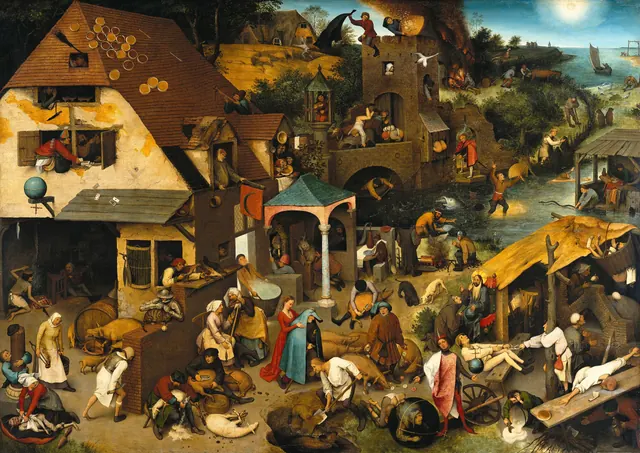
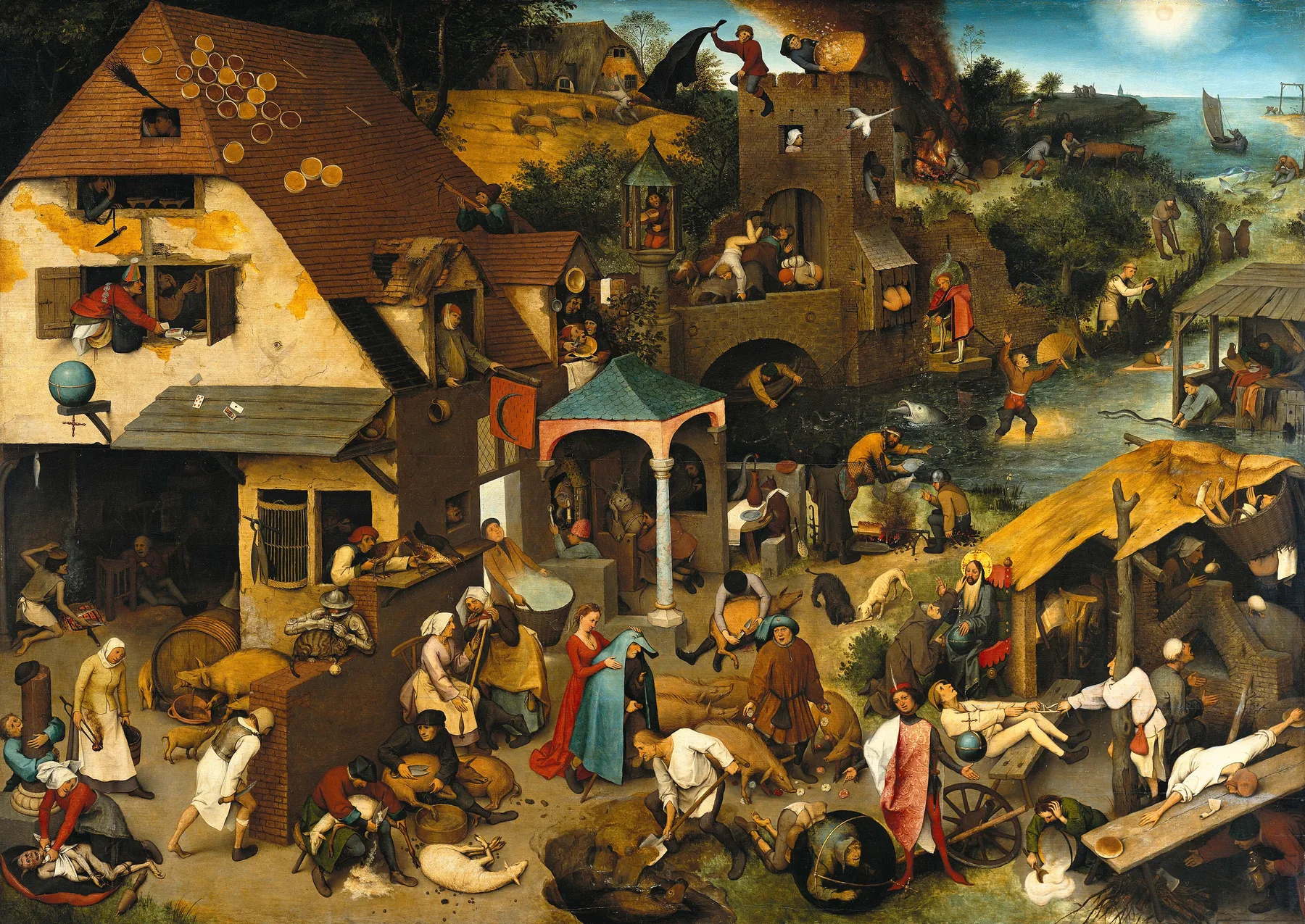
When the camera first settles on Bruegel’s Netherlandish Proverbs, the eye is immediately drawn into a bustling Flemish village that seems to breathe with activity. The canvas is packed with more than a hundred individual proverbs, each rendered as a tiny, literal scene within the same streets and market squares. This sheer number creates a visual encyclopedia of everyday wisdom, inviting viewers to wander from one vignette to the next, decoding each saying as they go. The painting therefore functions not merely as a landscape but as a living compendium of the culture’s shared language.
The power of the composition lies in how Bruegel orders this profusion. Though the village teems with figures, stalls, and animals, the layout follows a clear rhythm: winding lanes guide the eye, and architectural anchors such as roofs and arches provide reference points. This disciplined arrangement prevents chaos, allowing each proverb to stand out while still belonging to a cohesive whole. By embedding each saying within a shared spatial framework, Bruegel demonstrates a sophisticated design that balances detail with overall harmony, turning a crowded scene into an intelligible map of collective thought.
Every corner of the panel offers a new lesson. A man attempts to lift a heavy load while a donkey watches; a child chases a goose; a group gathers around a well. Each vignette directly illustrates a familiar saying, making the abstract concrete. Because the proverbs are placed side by side, the viewer senses a dialogue between them, as if the village itself is reciting a chorus of moral and humorous observations. This visual strategy reinforces the idea that language and daily life are inseparable, and that the community’s values are expressed through both words and deeds.
The painting’s impact is underscored by the fact that at least sixteen copies are known to exist. Such a number of reproductions signals that contemporaries found the work compelling enough to commission or create their own versions. Each copy, whether faithful or slightly altered, serves as a testament to the original’s resonance, spreading its intricate tableau of proverbs beyond its initial audience. The proliferation of these replicas highlights the painting’s popularity and suggests that its visual catalogue of proverbs struck a chord with a wide range of viewers. The very act of copying suggests that owners valued possessing a visual record of the proverb collection, further confirming its appeal.
These numerous copies played a vital role in extending the reach of Bruegel’s visual encyclopedia. As each replica entered new collections, it carried the dense network of sayings to fresh eyes, allowing people who had never seen the original to engage with its humor and moral lessons. In this way, the copies acted as ambassadors for the work, ensuring that its rich tapestry of proverbs could be appreciated across different regions and generations, amplifying its cultural footprint long after the first brushstrokes were laid. Such dissemination meant that the moral and humorous insights encoded in the scene could inform everyday conversation in distant towns.
Art historian Ceravolo suggests that Bruegel’s lively gestures are not merely decorative but are reinforced by a scholarly tradition of curating proverb collections. He argues that the humanist fascination with sayings, combined with the deliberate use of the Dutch vernacular, gave the gestures a deeper intellectual grounding. In this view, the animated figures become visual extensions of written proverbs, embodying the scholarly effort to preserve and celebrate native wisdom. The painting thus reflects a convergence of artistic skill and contemporary humanist interests, linking image and text in a purposeful dialogue. This reading highlights how visual art could serve scholarly purposes.
Building on Ceravolo’s reading, the emphasis on the Dutch language can be seen as a subtle assertion of regional identity. By choosing the vernacular over Latin, Bruegel aligns his work with a growing sense of local pride, allowing the proverbs to resonate more directly with everyday viewers. The gestural imagery, therefore, operates on two levels: it illustrates the sayings themselves while also participating in a broader cultural movement that sought to elevate native expression. This dual function enriches the painting’s meaning, positioning it as both a moral compendium and a statement of cultural self‑confidence.
In sum, Bruegel’s Netherlandish Proverbs stands as a masterful synthesis of visual density, popular appeal, and intellectual context. The composition’s over‑hundred proverbs create a vibrant village tableau; the multitude of copies testifies to its widespread admiration; and the gestural language, as interpreted by scholars, reflects a deep engagement with humanist scholarship and vernacular pride. Together, these layers invite us to wander the painted streets, decode each saying, and appreciate how a sixteenth‑century artist wove language, humor, and identity into a single, unforgettable canvas.
When we step back and consider the three strands together, a richer picture emerges. The sheer number of proverbs gives the work its encyclopedic character; the survival of many copies demonstrates that this character resonated far beyond its original setting; and the scholarly reading of its gestures reveals that Bruegel deliberately engaged with contemporary humanist currents. This convergence means the painting is not only a visual feast but also a document of 16th‑century intellectual life, embodying both popular folklore and learned ambition. In this way, the artwork continues to speak to modern audiences as a bridge between everyday wit and cultural self‑awareness.
Stay curious, and let Bruegel’s village of proverbs keep speaking across the ages.