The story
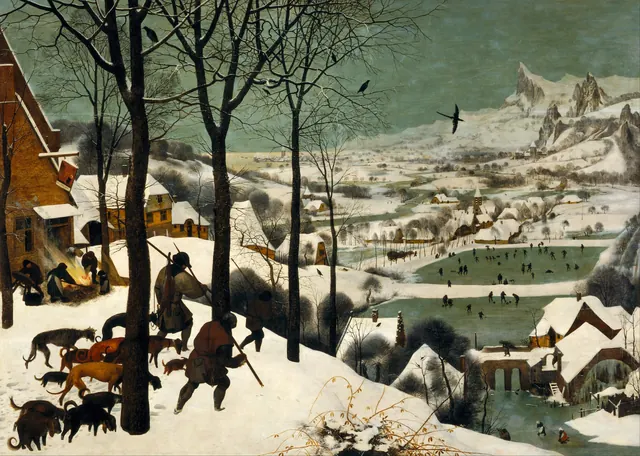
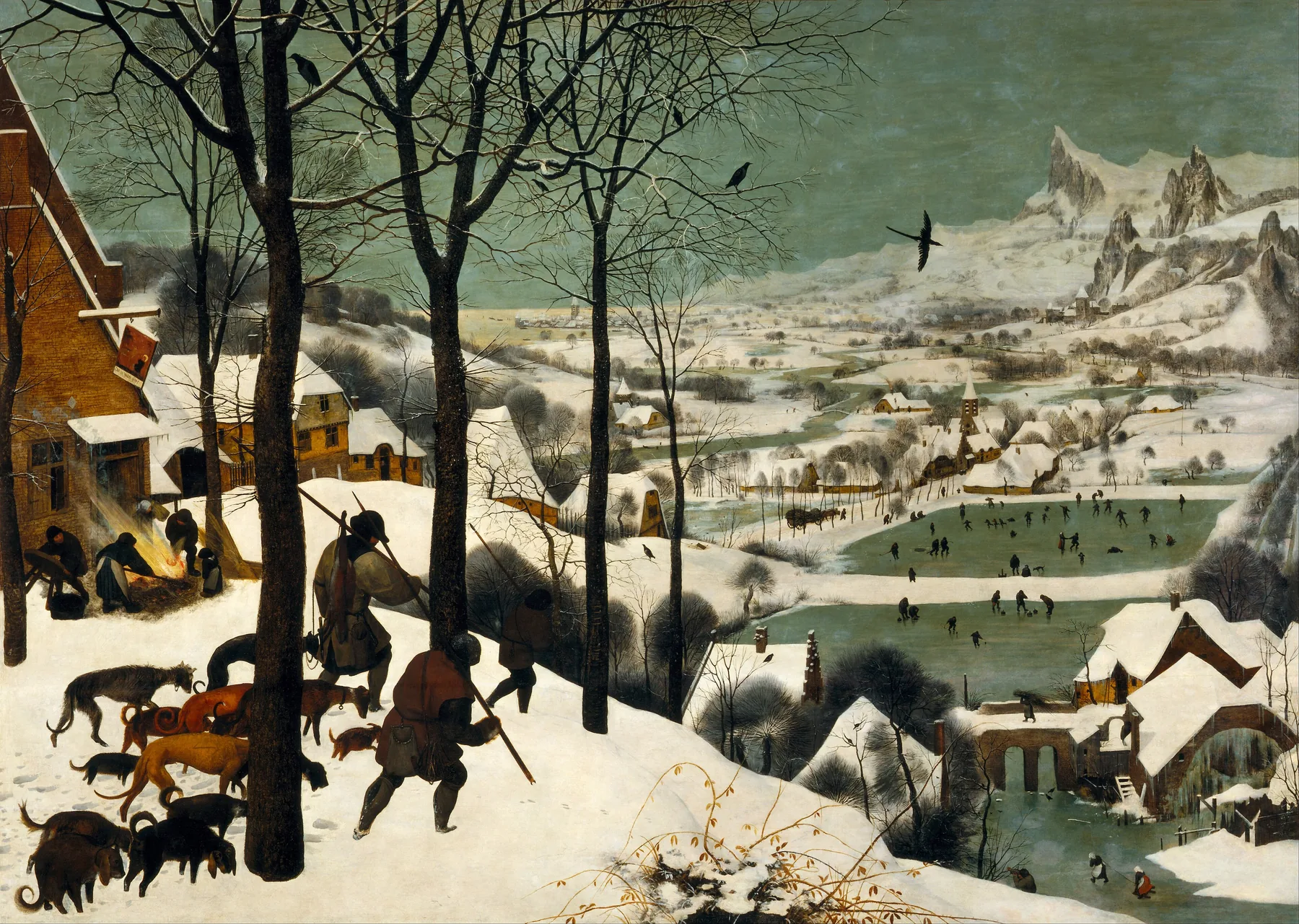
Pieter Bruegel the Elder painted Hunters in the Snow in 1565, using oil on a wooden panel. This medium allowed him to render the delicate translucence of snow and the sturdy grain of the board. The work was commissioned by Niclaes Jonghelinck, a wealthy Antwerp banker, as part of a larger series called the Labours of the Months. By situating the painting within that program, Bruegel linked everyday winter labor to the rhythm of the calendar, offering a visual anchor for the series. The choice of oil on panel reflects the Northern Renaissance’s technical advances, giving the scene a luminous, tactile quality that invites the viewer into the cold landscape.
The scene captures the heart of the winter calendar, representing the months of December and January. In those months, the Flemish countryside is locked under deep snow, and daily life turns to survival and communal activity. Bruegel’s decision to focus on this coldest period emphasizes the starkness of the landscape and the resilience of its inhabitants. By anchoring the painting to these two months, the artist provides a clear temporal context that frames every figure—hunters, villagers, and travelers—within a shared seasonal experience, reinforcing the painting’s role as a visual record of winter’s harshest days.
In the distance, a line of craggy peaks rises against a pale sky. These mountains are not imagined; they are drawn from sketches Bruegel made during his Alpine travels in 1552‑53. Their cool, bluish tones contrast with the foreground, which is unmistakably the flat, open terrain of his native Belgium. This juxtaposition creates a composite landscape that merges memory of distant highlands with the familiar low‑lying fields of home. The duality of rugged alpine silhouettes and gentle Belgian plains expands the visual field, inviting the eye to travel from the immediate snow‑covered ground to the far horizon, where the world seems both expansive and intimately known.
Bruegel assembled the painting as a composite scene, bringing together elements that may have been observed at different times or places into a single harmonious tableau. Hunters and their dogs, villagers, a frozen river, and distant mountains coexist, each drawn from observation or memory, yet arranged to tell a unified story of winter life. This compositional strategy allows a range of activities to be displayed within one spatial logic, turning the canvas into a bustling winter world that feels both documentary and orchestrated. By weaving disparate details into a single view, Bruegel creates a narrative richness that encourages viewers to explore every corner of the picture.
The composition is carefully guided by natural elements. A line of leaf‑laden trees on the left edge frames the scene, acting like a picture frame that draws the viewer’s gaze inward. From this anchor, the hunters and their eager dogs stride diagonally across the ice, their movement pulling the eye toward the right side of the canvas where a distant village glows faintly. This directional flow not only organizes the visual narrative but also makes the panel an ideal opening for a frieze of pictures, its structure anticipating continuation beyond its borders. The interplay of framing trees and the forward motion of the hunters creates a dynamic balance that sustains interest across the entire width of the work.
Every inch of the surface teems with activity, a testament to Bruegel’s meticulous observation. Small figures populate the frozen expanse, each engaged in a different winter pastime, from hunting to simple daily chores. Dogs accompany the hunters, while other inhabitants appear in the background, contributing to a lively tableau. This proliferation of details invites repeated viewing, as each glance reveals another subtle gesture or interaction hidden within the bustling scene. The richness of these minute observations underscores Bruegel’s ability to capture the complexity of everyday life within a single, cohesive landscape.
Beyond its immediate visual appeal, Hunters in the Snow illustrates Bruegel’s pivotal role in shaping the tradition of landscape painting in the Low Countries. By placing human activity within a fully realized natural setting, he treated the environment as more than a mere backdrop, allowing the landscape itself to become a central character in the narrative. This approach laid groundwork for later Flemish and Dutch artists, who would further develop the genre into a celebrated hallmark of their golden age. Bruegel’s integration of detailed observation with expansive scenery thus marks a significant step in the evolution of Northern European landscape art.
Through its meticulous detail and masterful composition, Bruegel’s Hunters in the Snow remains a vivid window into a 16th‑century winter, inviting us to step into the frozen world and feel its quiet, enduring presence.