The story
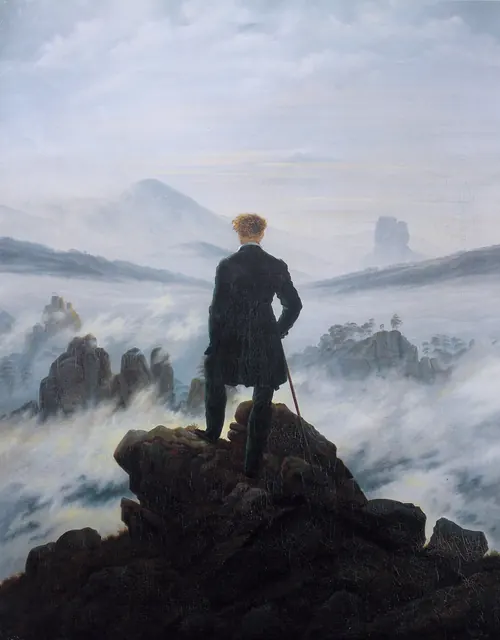
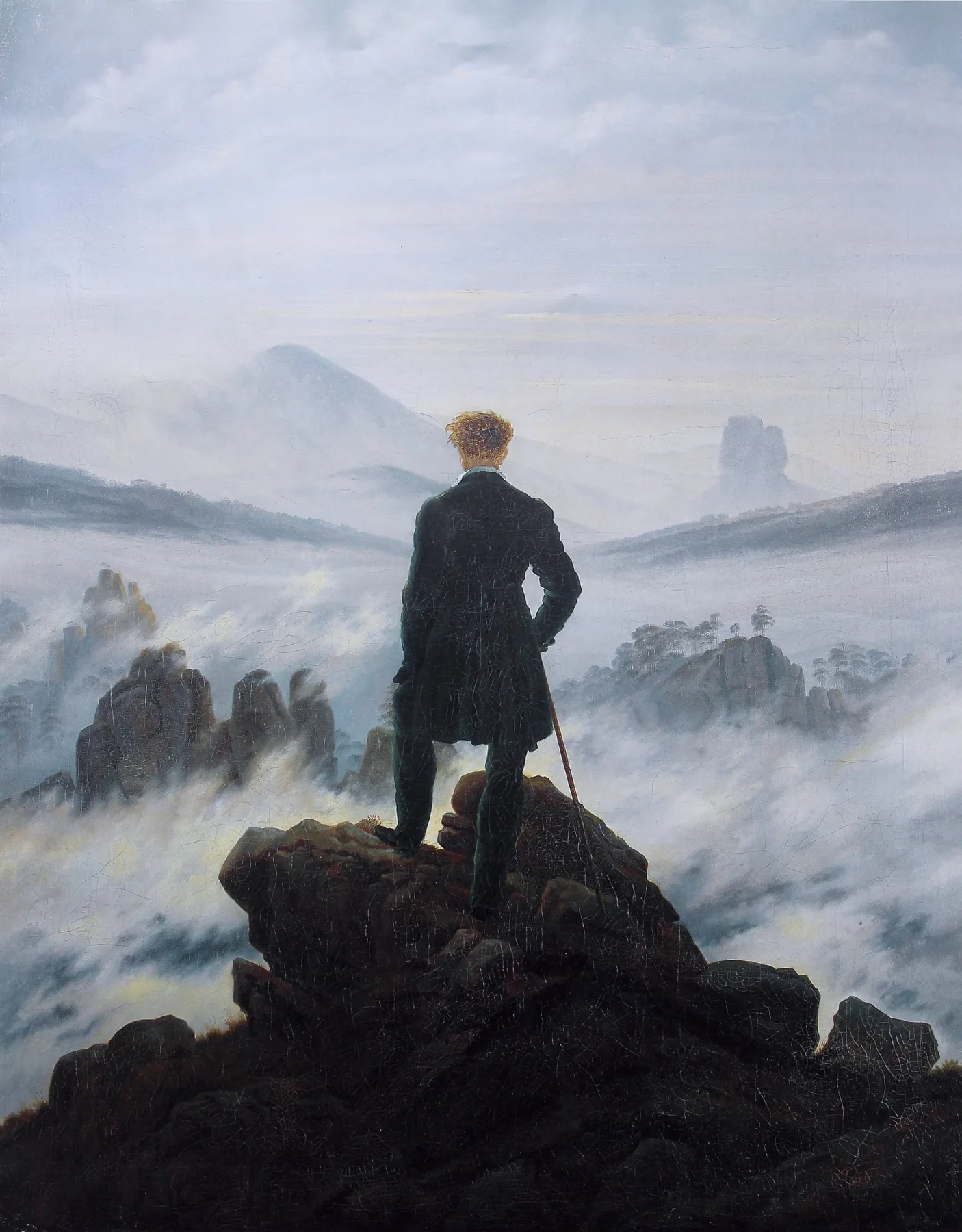
The canvas before us bears the title Wanderer Above the Sea of Fog, a work executed in oil by the German painter Caspar David Friedrich around 1817. Though the exact year is not fixed, scholars agree the painting emerged in the early nineteenth century, capturing the artist’s mature Romantic vision. The medium of oil allows Friedrich to render subtle gradations of light and shadow across the mist‑shrouded landscape, while the brushwork conveys both solidity and atmosphere. By situating this piece within Friedrich’s German heritage and the circa‑1817 timeframe, we begin to understand the cultural moment that shaped its conception.
The Wanderer has come to stand as one of the most representative and important works of the German Romantic movement, a status affirmed by generations of scholars. It is frequently described as the quintessential painting of the Romantic period and, indeed, as Friedrich’s most famous work. This reputation rests not merely on its popularity but on how the canvas encapsulates the Romantic preoccupation with the sublime, the individual’s encounter with nature, and the yearning for transcendence. By embodying these core ideals, the painting functions as a visual manifesto of its era, inviting viewers to contemplate the profound emotional currents that defined early nineteenth‑century German art.
At the heart of the composition lies a solitary figure, seen from behind—a classic Rückenfigur—standing upon a jagged rocky precipice. From this elevated perch he gazes out over a valley filled with rocks, trees and distant mountains, all rising above a thick, rolling mist that seems to swallow the horizon. Friedrich’s repeated use of the Rückenfigur device places the viewer directly behind the wanderer, sharing his line of sight and inviting a personal identification with his contemplation. This compositional strategy, a hallmark of Friedrich’s oeuvre, reinforces the sense that the figure is both observer and participant in the vast, indifferent landscape, a visual bridge between humanity and the natural world.
The palette Friedrich employs is dominated by deep, dark hues that lend the scene a mysterious, foreboding atmosphere. Muted blues and grays swirl within the rolling fog, while somber greens hint at distant foliage and stone. The figure’s coat absorbs earthier browns, anchoring him amid the ethereal haze. These restrained, shadowy tones do more than depict weather; they evoke the Romantic fascination with the unknown, allowing the mist to dominate the visual field and to convey a sense of awe‑inspiring power that lies beyond human control. In this way, color becomes a conduit for the painting’s emotional resonance.
Although the vista feels like a single sweeping panorama, Friedrich did not copy a specific location. Instead, he stitched together elements drawn from sketches he made during his travels across Germany and Switzerland. The craggy outcrop, the veil of mist, and the distant silhouettes each originate from separate studies, then recombined into a unified, imagined landscape. This method reflects Friedrich’s belief that the painter’s task is to convey inner sensation rather than a literal, faithful record of any one place. By assembling a composite scene, the artist creates a universal expression of the sublime, inviting viewers to experience a landscape that is both specific and imagined.
The lone wanderer’s identity has sparked scholarly debate for decades. Some researchers argue that the figure is a self‑portrait of Friedrich, a personal meditation on his own relationship with the sublime. Others point to a different reading: a scholar suggests the man represents a forestry official who fell fighting for Prussia against Napoleonic France. This divergent interpretation underscores the painting’s capacity to accommodate multiple narratives, each adding a layer of historical and personal resonance. Whether viewed as a self‑reflection or as a commemorative portrait, the figure’s anonymity invites us to project our own sense of contemplation onto the scene, reinforcing the work’s timeless appeal.
Friedrich himself articulated a guiding principle for his art: the artist’s task is not a faithful replication of nature, but rather a reflection of the artist’s soul and sensations, returning the spirit of nature to the picture. This credo explains why he chose to assemble a composite landscape and to employ the Rückenfigur, allowing personal feeling to shape the visual experience. By prioritizing interior truth over topographic accuracy, Friedrich transforms the external world into a mirror of inner experience, aligning his practice with the Romantic conviction that art must convey feeling as much as form.
The painting invites viewers to feel a profound sense of awe and unity with the natural world. As one looks upon the wanderer, it becomes clear that the figure both observes nature and is part of it, while the mist‑shrouded landscape cannot observe him in return. This paradox creates a silent dialogue between humanity and the environment, suggesting that the sublime is not a distant spectacle but an intimate, shared experience. By positioning us behind the figure, Friedrich encourages us to step into his contemplative stance, to breathe the cool fog, and to confront the vastness that both surrounds and reflects our own inner horizons.
In the hush of the fog, the wanderer remains—a timeless guide to the mysteries that lie beyond the visible horizon.