The story
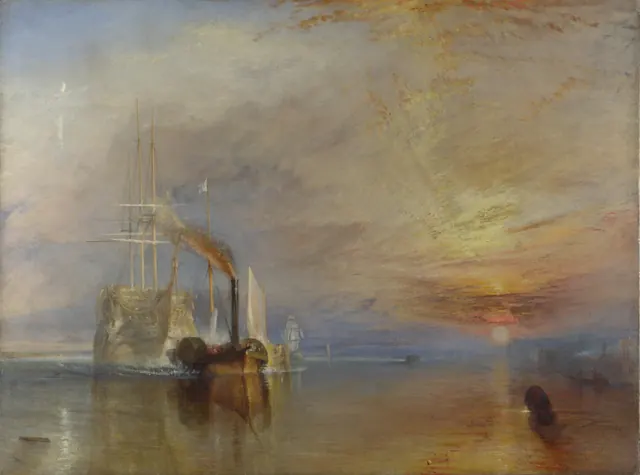
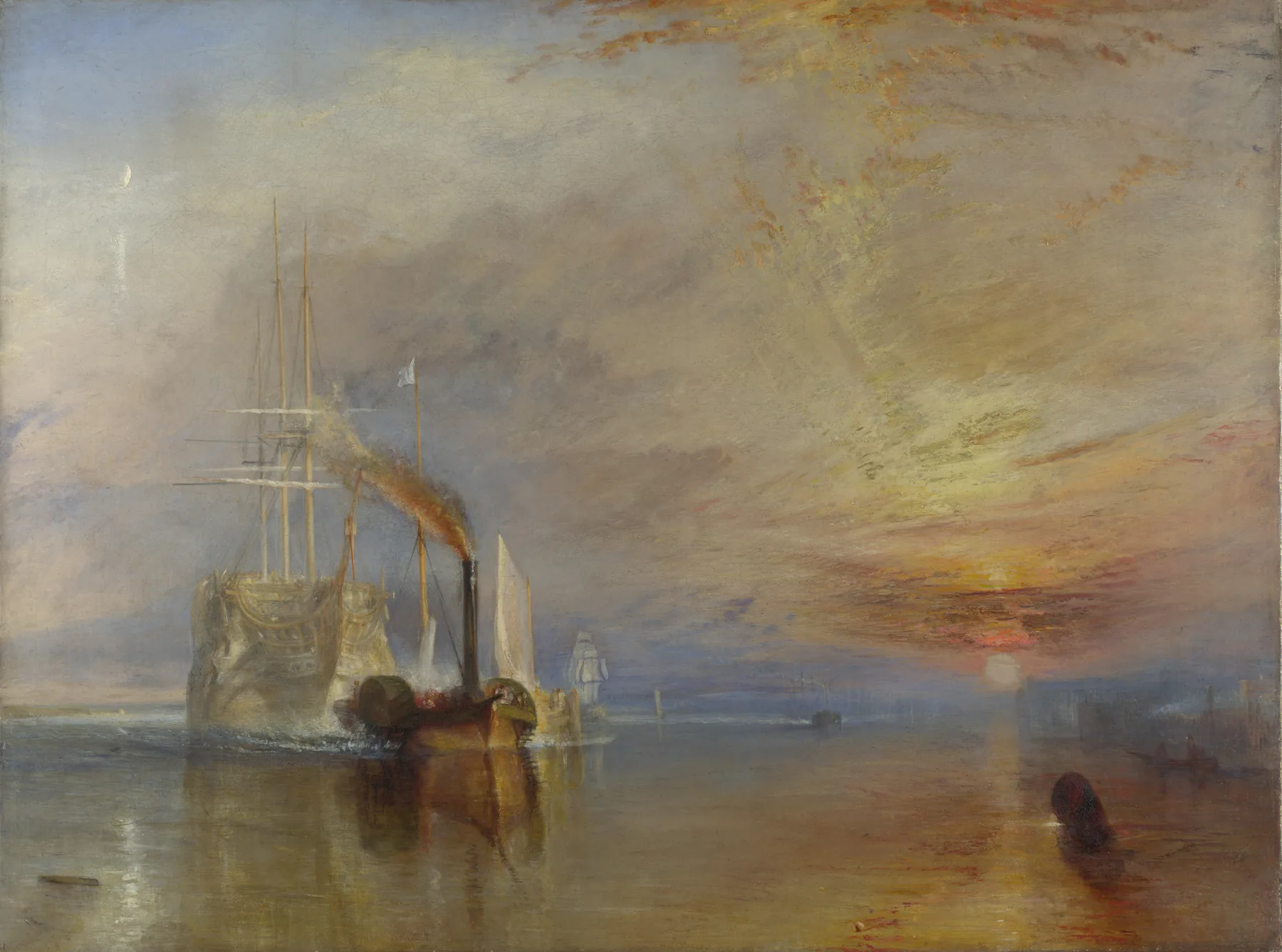
The canvas we encounter bears the full title “The Fighting Temeraire tugged to her last berth to be broken up, 1838”. This explicit naming not only identifies the ship but also records the precise moment of its final journey. The work is by Joseph Mallord William Turner, commonly known as J. M. W. Turner, whose reputation as a leading British painter is well established. By foregrounding the title on the painting itself, Turner ensures that viewers immediately recognize the historical episode being commemorated, anchoring the visual scene in a specific narrative of loss and transition.
Turner’s life spanned from 1775 to 1851, a period that saw Britain’s naval dominance reach its zenith. At the time he created this canvas, he was in his sixties, a stage of his career that preceded a more abstract final phase. Knowing the artist’s birth and death years, and his age when he painted, situates the work within the later period of his artistic development, providing a temporal framework that helps us understand the maturity of his technique and the reflective tone of the subject matter.
The painting was completed in 1839, a year after the event it records, and it was executed in oil on canvas. This medium, which Turner employed throughout his career, allowed him to manipulate colour and texture with great freedom. By noting the year of completion alongside the material, we see how the artist chose a traditional yet versatile medium to capture a contemporary historical moment, linking the immediacy of the subject with the enduring qualities of oil paint.
The canvas measures 90.7 centimetres in height and 121.6 centimetres in width. These dimensions give the work a moderate scale, large enough to accommodate a broad river landscape while still inviting close inspection of brushwork and detail. The size therefore balances an expansive visual field with an intimate viewing distance, enabling the viewer to appreciate both the overall composition and the nuanced handling of paint that Turner employed.
The work carries the inventory number NG524 and resides in the National Gallery’s Main Collection. It entered the museum through the Turner Bequest in 1856, a donation that transferred many of Turner’s works into public ownership. This provenance situates the painting within the national collection, confirming its status as a core piece of British art history and ensuring its preservation and accessibility for future generations.
The scene depicts the HMS Temeraire being towed from Sheerness to Rotherhithe on the River Thames for scrapping. Visually, the composition shows a small tugboat with paddlewheels and a black funnel pulling a large sailing ship; a pale crescent moon appears in the top left corner. These elements together frame a moment of transition, with the tug representing emerging steam power and the great warship embodying the fading age of sail. The placement of the moon adds a subtle atmospheric cue that underscores the evening setting of the event.
The Temeraire had fought at the Battle of Trafalgar in 1805, a decisive engagement that secured British naval supremacy. After more than forty years of service, the Admiralty sold the ship in 1838, and it was destined for dismantling. This historical trajectory—from heroic battle to commercial sale—provides the narrative backbone of the painting, linking the vessel’s celebrated past with its final, humble passage down the Thames. By embedding these facts, the canvas becomes a visual record of a celebrated warship’s concluding chapter.
The painting was exhibited at the Royal Academy in 1839, accompanied by lines adapted from Thomas Campbell’s poem “Ye Mariners of England”. Presenting the work alongside poetic verses linked the visual representation of the ship’s final journey with contemporary literary reflections on maritime heritage. The Royal Academy setting offered a public platform where the painting could be viewed by a broad audience, while the adapted poem reinforced the thematic connection between national memory and the fading of a once‑mighty vessel.
Turner likely did not witness the actual towing of the Temeraire; instead, he reconstructed the scene from contemporary reports. This reliance on written accounts rather than personal observation indicates that the composition is a synthesis of reported details, arranged to convey the essential elements of the event. By acknowledging the artist’s method, we understand that the painting balances factual reportage with artistic interpretation, ensuring fidelity to known information while still creating a compelling visual narrative.
The painting’s thickly applied paint creates a three‑dimensional surface that stands proud from the canvas. This impasto technique gives the work a tactile quality, with the raised layers physically projecting outward. By emphasizing the three‑dimensionality of the paint, Turner adds a sense of material presence to the vessels and sky, reinforcing the solidity of the forms within the composition without invoking any additional visual effects beyond what the paint itself achieves.
Turner restored the ship’s masts and rigging in the painting, even though they would likely have been removed before the actual tow, to give the vessel dignity in its final journey. This artistic decision ensures that the Temeraire remains recognizable as a tall‑masted warship, preserving its iconic silhouette for the viewer. By re‑adding these elements, the artist emphasizes the ship’s identity and honors its historic stature, even as the narrative moves toward its dismantling.
Major exhibitions of the work were held at the National Maritime Museum in 2013, at Tate Britain in 2020, and at the Laing Art Gallery in 2024. These recent showings have brought the painting to new audiences, reaffirming its relevance within both maritime and art historical contexts. By tracing its exhibition history, we see how the canvas continues to engage viewers and scholars, maintaining its position as a focal point for discussions of British naval heritage and Turner’s artistic legacy.
Through these verified details, we glimpse how Turner’s canvas records a moment of change, preserving the memory of a celebrated ship as it sails toward its final berth.