The story
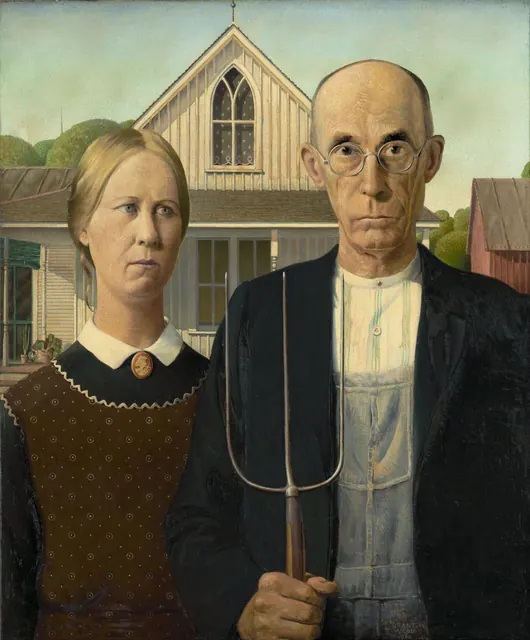
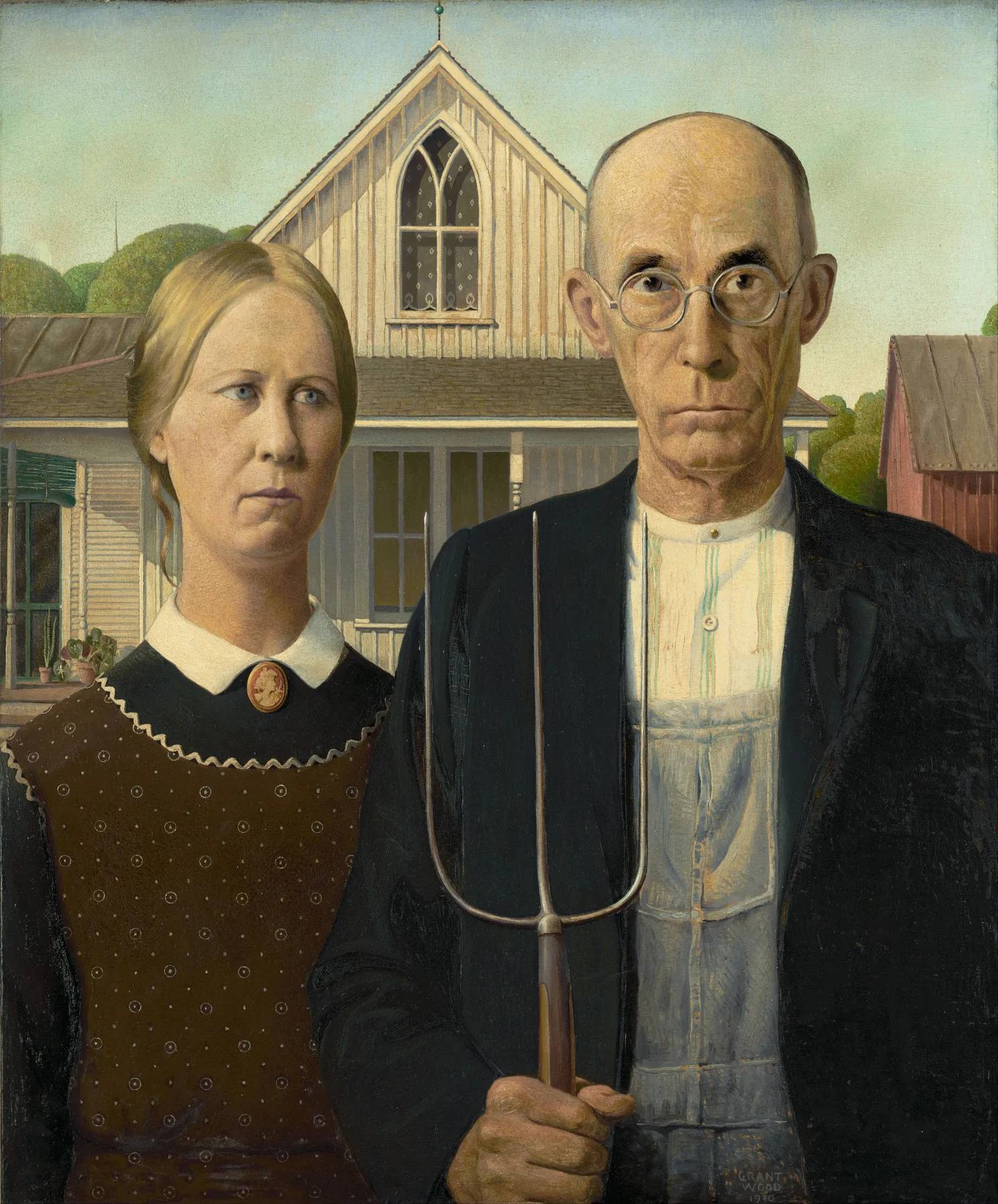
The canvas before us bears the unmistakable title “American Gothic,” a name that has become synonymous with the stoic couple framed by a sharply pointed roof. Grant Wood, the artist whose name is inseparably linked to the image, painted it with a regionalist sensibility that grounds the scene in everyday Midwestern life. By stating the title and the artist together, we set the stage for a painting that feels both personal and emblematic of a broader American story, inviting viewers to wonder what lies behind that austere façade.
Completed in the pivotal year of 1930, the work was rendered in oil on a beaver‑board support, a material choice that gave Wood a smooth, stable surface for his meticulous brushwork. The panel measures 78 centimeters tall by 65.3 centimeters wide, a modest scale that draws the viewer close enough to read the fine lines of the figures’ faces and the crisp geometry of the house behind them. These technical details—date, medium, and dimensions—anchor the painting in a specific moment of American art history while also shaping the intimate visual experience.
Today the painting hangs in Gallery 263 of the Art Institute of Chicago, displayed under the credit line “Friends of American Art Collection.” Its presence in a public museum invites countless visitors to stand before the iconic duo, while the credit line reminds us of the collective support that keeps such works accessible. By situating the work within a specific gallery space, we see how the institutional setting frames the public’s ongoing encounter with Wood’s vision.
Grant Wood intended the painting to convey a positive image of rural American values, offering reassurance at the beginning of the Great Depression. He saw the work as a visual affirmation of steadiness and perseverance, qualities that resonated with a nation facing economic uncertainty. This stated aim frames the solemn expressions and sturdy posture of the figures as embodiments of an earnest, hopeful ethos rather than a critique, positioning the painting as a quiet beacon of confidence in a turbulent era.
When first exhibited at the Art Institute of Chicago in 1930, the painting won a $300 prize and propelled Wood to instant fame. Contemporary reports recorded the work as a sensation, noting how visitors speculated about the identities and story behind the stoic pair. The prize and rapid rise in Wood’s reputation underscore how the image struck a chord with audiences, establishing it as a cultural touchstone from its very debut and cementing its place in the public imagination.
The house that frames the couple is a real white farmhouse built in 1881 in Eldon, Iowa, a design Wood encountered during a visit to the town. This architectural motif, with its steeply pitched roof and narrow Gothic window, supplied the visual cue that gives the painting its name. By grounding the scene in a specific Midwestern structure, Wood anchors universal themes in a tangible landscape, allowing the viewer to sense both the particularity of place and the broader symbolism of the American frontier.
Wood used his sister Nan as the model for the woman and his dentist, Dr. B.H. McKeeby, as the model for the man; they posed separately, and Wood combined their likenesses into a single composition. He described the figures as “types of people I have known all my life,” aiming to portray them truthfully rather than idealized. This choice of familiar, everyday people infuses the work with personal authenticity, allowing viewers to recognize the ordinary quality of the subjects while still feeling the weight of their symbolic presence.
The composition shows a farmer and his daughter posed stiffly, echoing the flat, posed quality of early photographic tintypes. The man holds a pitchfork—a tool that began as a rake in Wood’s preparatory sketches—transforming a humble implement into a striking visual anchor. This deliberate stiffness and the substitution of the rake for the pitchfork reinforce a sense of preserved moment, as if captured on a vintage photograph, while the meticulous detail underscores Wood’s commitment to a tightly controlled, highly detailed aesthetic.
Some contemporary viewers interpreted the work as a satirical comment on Midwesterners out of step with a modernizing world, while the Encyclopaedia Britannica suggests it may be read as a paean to rural Protestant earnestness. Wood consistently rejected the suggestion that the painting was a satire of Midwest values, insisting his intent was earnest. When exhibited in 1930, the painting became an instant sensation, prompting viewers to speculate about the figures and their story. This tension between audience interpretation and artist intention illustrates how a single image can generate multiple, sometimes conflicting, readings.
American Gothic has become one of the most recognized paintings in the world, drawing crowds as one of the most visited works on exhibit at the Art Institute of Chicago. Its iconic status has inspired countless parodies in magazine covers, political cartoons, and Halloween costumes, cementing its place in popular culture. According to Sotheby’s Institute of Art, it is the fourth most Googled artwork in the world, a testament to its enduring digital presence and global recognition. These layers of fame show how a regionalist portrait transcended its origins to become a universal cultural symbol.
In the quiet stare of Wood’s figures, we find a mirror of America’s past and a window onto its ever‑lasting curiosity.